
In the high-stakes world of quality control, the difference between a pass and a fail often comes down to a few microns. For quality engineers and inspection labs, precision measurement errors are the silent enemy of productivity and compliance. When a Coordinate Measuring Machine (CMM) or a laser scanner produces inconsistent data, the immediate reaction is often to blame the probe or the software. However, the root cause of metrology accuracy issues frequently lies much deeper—literally. The foundation upon which these measurements take place is critical, and ignoring it can lead to costly scrap, rework, and calibration failures.
The Hidden Sources of Error
Precision errors generally stem from three environmental and material factors: thermal instability, vibration, and structural deformation.
One of the most pervasive issues is thermal expansion. In a shop floor environment where temperatures fluctuate, metal bases (such as steel or aluminum) expand and contract. Even a minor temperature shift of 1°C can cause a metal base to warp enough to throw off sensitive measurements. This thermal drift introduces systematic errors that are difficult to compensate for via software.
Another major culprit is vibration. High-precision optical scanning or touch-probe inspection requires absolute stillness. However, ambient vibrations from nearby forklifts, HVAC systems, or even foot traffic can transmit through the floor and into the measurement setup. These micro-vibrations create “noise” in the data, reducing repeatability and causing false readings. Furthermore, the material of the base itself matters; porous or low-density materials can absorb moisture or oil, leading to swelling or corrosion that alters the geometry of the reference plane over time.
The Granite Solution
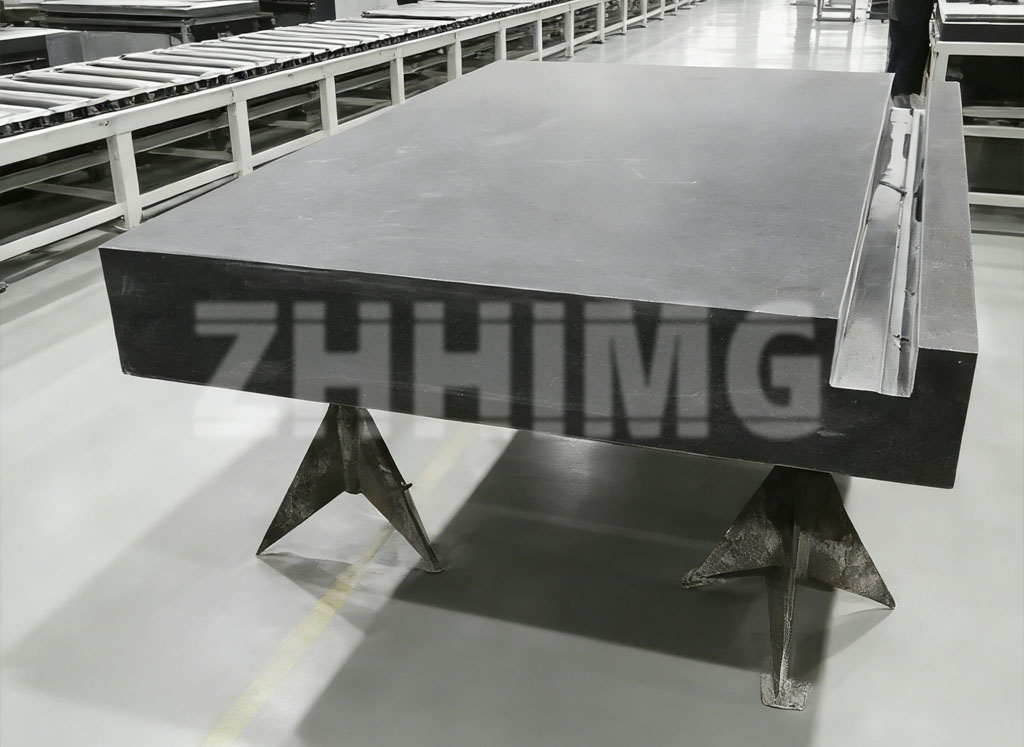
This is where the granite base advantages become undeniable. High-quality natural granite, specifically dense black granite or “Jinan Green” stone, possesses unique physical properties that directly counteract these common errors.
First and foremost, granite has an incredibly low coefficient of thermal expansion. Unlike steel, it remains dimensionally stable despite ambient temperature changes. This means that a granite base provides a constant, unchanging datum plane, ensuring that the “zero” point of your measurement remains accurate throughout the day. This thermal stability is essential for maintaining ISO compliance and reducing the frequency of recalibration.
Secondly, granite is a superior vibration damper. Its crystalline structure has high internal friction, which absorbs and dissipates vibrational energy before it can reach the sensitive measuring instrument. By isolating the measurement process from floor noise, granite bases significantly improve the signal-to-noise ratio, resulting in cleaner data and higher repeatability.
Finally, granite is non-magnetic, non-corrosive, and non-conductive. It will not rust in humid environments, nor will it warp under its own weight or the load of heavy parts. It provides a hard, wear-resistant surface that maintains its flatness for decades.
Investing in Stability
For inspection labs and quality departments, the solution to precision measurement errors is not just a better sensor, but a better foundation. By switching to a high-precision granite base, manufacturers can eliminate thermal drift, dampen environmental vibration, and ensure long-term geometric stability. It is a strategic investment that pays dividends in reduced scrap rates and increased confidence in quality data.
Post time: Apr-03-2026