
In the meticulous world of precision engineering, where tolerances are measured in microns and repeatability is non-negotiable, one foundational element often goes unnoticed—until it fails. That element is the reference surface upon which all measurements begin. Whether you call it an engineers plate, a granite master surface, or simply your shop’s primary datum, its role is irreplaceable. Yet too many facilities assume that once installed, this surface remains trustworthy indefinitely. The reality? Without proper care and periodic granite table calibration, even the highest-grade reference can drift—quietly undermining every measurement taken upon it.
This issue becomes especially critical when paired with today’s advanced mechanical measuring equipment—height gauges, dial indicators, optical comparators, and coordinate measuring machines (CMMs). These tools are only as accurate as the surface they reference. A micron-level warp in an uncalibrated engineers plate can cascade into false passes, unexpected scrap, or worse—field failures in mission-critical components. So how do leading manufacturers ensure their metrology foundation stays true? And what should you know before selecting or maintaining your own reference standard?
Let’s start with terminology. In North America, the term engineers plate is commonly used to describe a precision-ground surface plate—historically made of cast iron, but for over half a century, overwhelmingly crafted from black granite in professional settings. In Europe and ISO-aligned markets, it’s more often called a “surface plate” or “reference plate,” but the function remains the same: to provide a geometrically stable, flat plane against which all linear and angular measurements are verified. While cast iron plates still exist in legacy setups, modern high-precision environments have largely shifted to granite due to its superior thermal stability, corrosion resistance, and long-term dimensional integrity.
Granite’s advantages aren’t just theoretical. With a coefficient of thermal expansion roughly one-third that of steel, a quality granite engineers plate experiences minimal distortion during normal workshop temperature fluctuations. It doesn’t rust, doesn’t require oiling, and its dense crystalline structure dampens vibrations—critical when using sensitive mechanical measuring equipment like lever-type dial test indicators or electronic height masters. Moreover, unlike cast iron, which can develop internal stresses from machining or impacts, granite is isotropic and monolithic, meaning it behaves uniformly in all directions under load.
But here’s the catch: even granite isn’t immortal. Over time, repeated use—especially with hardened tools, gage blocks, or abrasive fixtures—can wear localized areas. Heavy components placed off-center may induce subtle sagging if support points aren’t optimized. Environmental contaminants like coolant residue or metal chips can embed into micro-pores, affecting flatness. And while granite doesn’t “warp” like metal, it can accumulate microscopic deviations that fall outside your required tolerance band. This is where granite table calibration becomes not optional, but essential.
Calibration isn’t just a rubber-stamp certificate. True granite table calibration involves systematic mapping of the entire surface using interferometry, electronic levels, or autocollimation techniques, following standards like ASME B89.3.7 or ISO 8512-2. The result is a detailed contour map showing peak-to-valley deviation across the plate, along with a statement of compliance to a specific grade (e.g., Grade 00, 0, or 1). Reputable labs don’t just say “it’s flat”—they show you exactly where and by how much it deviates. This data is crucial for high-stakes industries like aerospace, medical device manufacturing, or semiconductor tooling, where traceability to NIST or equivalent national standards is mandatory.
At ZHHIMG, we’ve worked with clients who assumed their 10-year-old granite plate was “still good” because it looked clean and smooth. Only after inconsistent CMM correlations prompted a full recalibration did they discover a 12-micron dip near one corner—enough to throw off height gauge readings by 0.0005 inches. The fix wasn’t replacement; it was re-lapping and recertification. But without proactive granite table calibration, that error would have persisted, silently corrupting quality data.
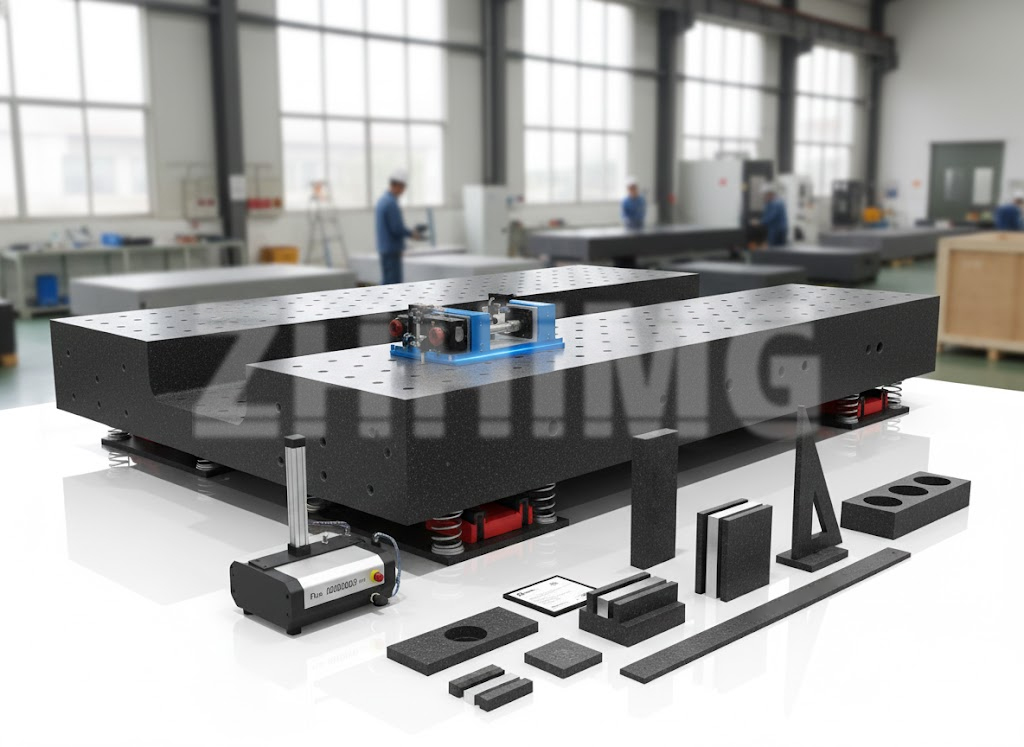
This brings us to the broader ecosystem of mechanical measuring equipment. Tools like sine bars, precision parallels, V-blocks, and dial test stands all rely on the engineers plate as their zero-reference. If that reference shifts, the entire measurement chain is compromised. Think of it like building a house on shifting soil—the walls might look straight, but the foundation is flawed. That’s why ISO/IEC 17025-accredited labs mandate regular calibration intervals for all primary standards, including surface plates. Best practice suggests annual calibration for Grade 0 plates in active use, and biennial for less demanding environments—but your risk profile should dictate your schedule.
When selecting a new engineers plate, look beyond price. Verify the granite’s origin (fine-grained, black, stress-relieved), confirm the flatness grade with actual certification—not marketing claims—and ensure the supplier provides clear guidance on support, handling, and maintenance. A 48″ x 96″ plate, for instance, requires three-point or multi-point support at precise locations to prevent deflection. Dropping a wrench on it might not crack it, but it can chip an edge or create a local high spot that affects gage block wringing.
And remember: calibration isn’t just about compliance—it’s about confidence. When an auditor asks, “How do you verify your inspection surface is within tolerance?” your answer should include a recent, traceable granite table calibration report with deviation maps. Without it, your entire quality management system lacks a critical anchor.
At ZHHIMG, we believe precision starts from the ground up—literally. That’s why we source only from workshops that combine traditional lapping craftsmanship with modern metrology validation. Every engineers plate we supply undergoes dual-stage verification: first by the manufacturer using ASME-compliant methods, then by our in-house team before shipment. We provide full documentation, setup support, and recalibration coordination to ensure your investment delivers decades of reliable service.
Because in the end, metrology isn’t about tools—it’s about truth. And truth needs a stable place to stand. Whether you’re aligning a turbine housing, verifying a mold core, or calibrating a fleet of height gauges, your mechanical measuring equipment deserves a foundation it can trust. Don’t let an uncalibrated surface be the hidden variable in your quality equation.
So ask yourself: when was the last time your engineers plate was professionally calibrated? If you can’t answer that confidently, it might be time to bring your foundation back into alignment. At ZHHIMG, we’re here to help—not just sell granite, but safeguard the integrity of every measurement you make.
Post time: Dec-09-2025