
As ultra-precision manufacturing continues to evolve, 2026 marks a decisive inflection point in material strategy. Across industries such as semiconductors, aerospace, photonics, and advanced metrology, a clear transition is underway: the gradual but persistent shift from traditional metal structures to high-performance non-metal structural components. This trend is not driven by novelty, but by the growing mismatch between the physical limitations of metals and the increasingly stringent demands of next-generation precision systems.
For decades, steel and cast iron have served as the backbone of machine structures due to their strength, machinability, and familiarity. However, as tolerances tighten into the micron and sub-micron range, the inherent drawbacks of metals—thermal expansion, vibration transmission, and residual stress—have become critical constraints. In contrast, materials such as granite, advanced ceramics, and carbon fiber composites are gaining traction for their superior stability and tailored performance characteristics.
One of the primary drivers behind this shift is thermal behavior. In ultra-precision environments, even minimal temperature fluctuations can induce dimensional changes that exceed allowable tolerances. Metals, with relatively high coefficients of thermal expansion, require complex compensation systems to maintain accuracy. Non-metal materials offer a fundamentally different approach. Precision granite, for example, provides near-zero expansion characteristics under controlled conditions, enabling passive thermal stability. Similarly, engineered ceramics exhibit extremely low thermal drift, making them ideal for applications where environmental control alone is insufficient.
Vibration management is another decisive factor. As machine dynamics become faster and more complex, the ability to dampen unwanted vibrations directly impacts both accuracy and throughput. Metals tend to transmit and amplify vibrations, necessitating additional damping mechanisms. In contrast, granite and certain composite materials naturally dissipate vibrational energy due to their internal structures. Carbon fiber, while lightweight and exceptionally stiff, can also be engineered to balance rigidity with damping, particularly in hybrid designs. This combination is increasingly valuable in high-speed systems where both precision and dynamic response are critical.
The comparison of granite vs carbon fiber highlights an important nuance in this trend. Granite excels in static stability, mass, and damping, making it the preferred choice for bases, reference surfaces, and metrology platforms. Carbon fiber, on the other hand, offers unparalleled strength-to-weight ratios, enabling lightweight structures that reduce inertia and improve dynamic performance. Rather than competing, these materials are often complementary, forming hybrid systems that leverage the strengths of each. This systems-level material integration represents a key direction for future machine design.
Another contributing factor is long-term structural integrity. Metals are susceptible to residual stress from casting, welding, and machining processes, which can lead to gradual deformation over time. Non-metal materials, particularly granite and ceramics, are inherently stable and resistant to such effects. They do not corrode, and their dimensional stability can be maintained over decades with minimal maintenance. For high-value equipment with long service lifecycles, this reliability is a significant advantage.
From a design perspective, the adoption of non-metal structural components is also enabling new architectural possibilities. Advanced manufacturing techniques, including precision grinding, ultrasonic machining, and composite layup processes, allow for complex geometries and integrated functionalities that were previously difficult or inefficient to achieve with metals. This opens the door to more optimized structures, where material properties are aligned precisely with functional requirements.
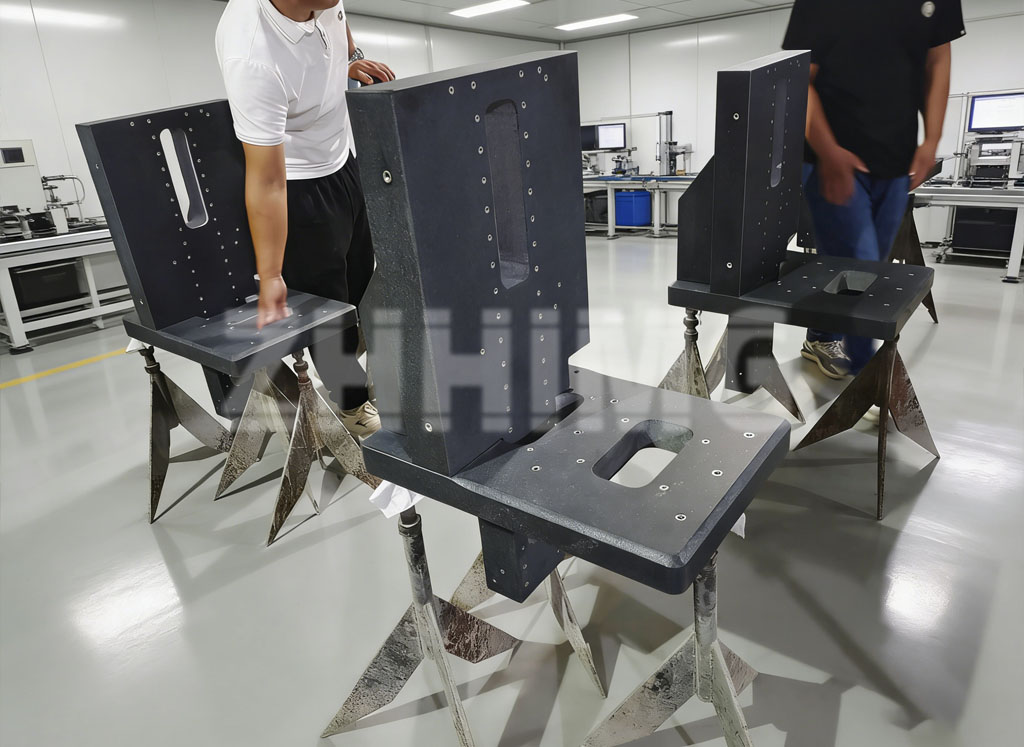
For R&D directors and CTOs, this trend carries strategic implications. Material selection is no longer a downstream decision but a core element of system innovation. Companies that continue to rely solely on traditional metal structures may find themselves constrained in both performance and competitiveness. In contrast, those who embrace non-metal solutions can unlock new levels of precision, efficiency, and design flexibility.
At the same time, successful implementation requires more than material substitution. It demands deep expertise in material science, precision manufacturing, and system integration. Each non-metal material brings its own set of engineering considerations, from anisotropy in composites to machining techniques for brittle materials. Partnering with experienced manufacturers who understand these complexities is essential to realizing the full benefits.
This is where forward-thinking suppliers play a critical role. Companies that invest in advanced capabilities across granite, ceramics, and carbon fiber are uniquely positioned to support this transition. By offering integrated solutions—from material selection and design optimization to precision fabrication and inspection—they become not just vendors, but strategic partners in innovation.
Looking ahead, the trajectory is clear. As ultra-precision manufacturing pushes the boundaries of what is technically possible, the materials that support these systems must evolve accordingly. The shift from metal to non-metal structures is not a temporary trend, but a foundational change in how precision equipment is conceived and built.
In 2026 and beyond, the question is no longer whether non-metal materials will play a role, but how extensively they will redefine the standards of performance. For organizations aiming to lead rather than follow, now is the time to align with this transformation and leverage the advantages it offers.
Post time: Apr-02-2026