
It’s 5:40 a.m. in Jinan, and Master Chen is already at the bench.
Before the first machine hums to life across the workshop, he lays both palms flat on a slab of granite and closes his eyes. No laser. No gauge. Just his hands, sliding slowly across a surface that looks like a mirror and feels — to almost anyone else — like nothing at all.
To Chen, it says everything.
“A machine will give you a number,” he says quietly. “It won’t tell you whether it feels right.”
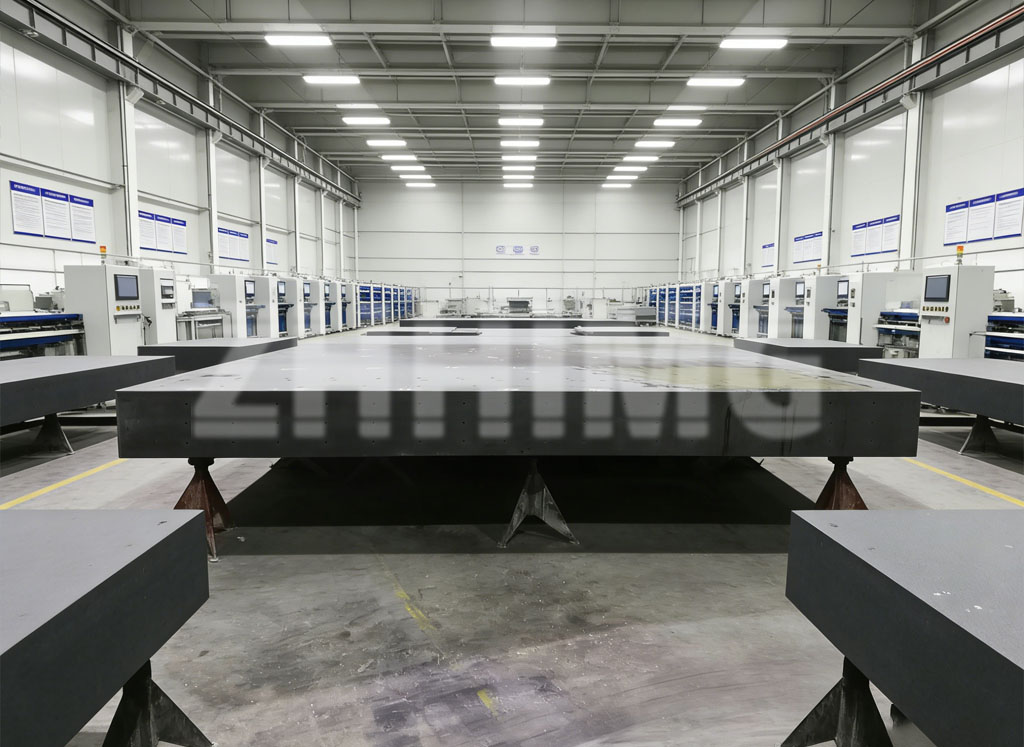
From apprentice to master
Chen entered the trade at eighteen, when a cousin brought him into a granite workshop in Shandong. His first job wasn’t precision — it was cleaning. For months he swept stone dust and watched the older craftsmen run their fingertips across surface plates, murmuring about “high points” he couldn’t yet feel.
“I thought they were pretending,” he laughs. “Then one morning I felt it. A tiny hill. Maybe a micron. And I understood.”
Thirty years later, that understanding has become instinct. Chen is now one of the senior lappers at Zhonghui Intelligent Manufacturing (ZHHIMG), where he has spent most of his working life teaching his hands to keep up with his eyes.
Lapping to a nanometer, one pass at a time
Hand lapping is the slowest and most stubborn step in the making of precision granite. A machine may grind a plate flat to a few microns. It is the lapper’s job to take it the rest of the way — to shave off those last fractions of a micrometer by hand, rotating an abrasive plate and feeling exactly where the surface “bites” and where it floats.
A good lapper works in microns. A master works in fractions of one. Chen’s arms move in long, patient figure-eights; a plate that took three hours yesterday might take five today, because “today the stone wants to talk more.”
Only when the surface is almost there does he reach for an autocollimator and a granite straight edge to verify. But the decision to stop — the moment a plate is finally, truly flat — is his alone.
“The walking electronic level”
His colleagues have a nickname for him: the walking electronic level.
Where a junior technician trusts a readout, Chen trusts his body. He can stand on a machine base, shift his weight, and sense a tilt that an instrument would barely register. He can hear the difference between a good lap and a great one in the sound the abrasive makes. He can walk into a cold workshop, touch a plate, and know it has drifted out of thermal equilibrium.
“It’s not magic,” he insists. “It’s thirty years of paying attention.”
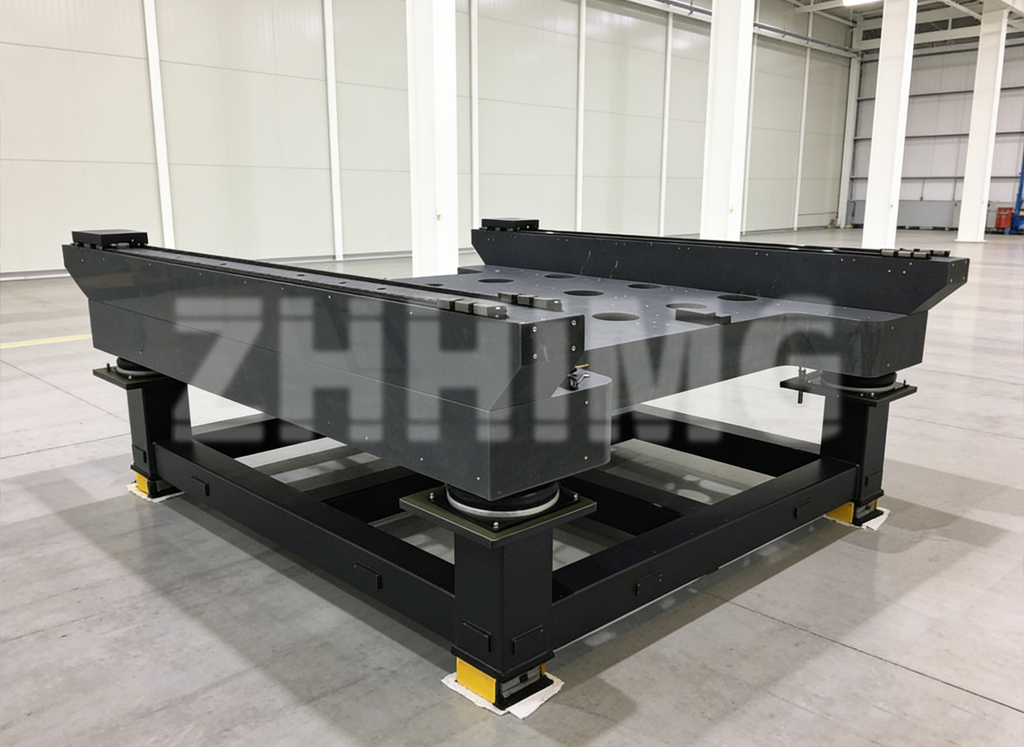
Why the human hand still matters
In an age of automated grinding, it would be easy to write the hand off as nostalgia. Chen argues the opposite. Machines are fast, repeatable, and tireless — but they grind to a program. They don’t notice when the stone’s grain shifts, when a fixture settles, or when the room cools by two degrees overnight. The hand notices. The hand compensates. The hand is the last quality gate before a plate is signed.
At ZHHIMG, every piece of precision granite components — from granite machine bases to gantries and surface plates — passes a human hand like Chen’s long before it earns a certificate.
Precision you can lean on
That blend of machine capability and human judgement is why Zhonghui’s granite parts are trusted in aerospace, semiconductor equipment, CMM and CNC machines, and precision laser systems — fields where a few microns decide whether a product works at all.
Zhonghui has been building precision since 1999, with 160 acres of production and storage space and the capacity to process single workpieces of up to 50 tons. Every base, assembly, and finished platform ships only after passing through assembly, calibration & inspection — and, quietly, through a pair of hands that have done this for thirty years.
Chen isn’t worried about being replaced by a machine. He’s worried about being replaced by nobody.
“The stones will always be here,” he says, running his palm across a surface you and I would call perfect. “I just hope someone keeps learning how to listen.”
Post time: Sep-16-2026