
In the relentless pursuit of nanometer-scale accuracy, semiconductor equipment manufacturers and optical inspection engineers face a fundamental challenge: precision without compromise. As lithography nodes shrink below 5nm and inspection tolerances approach atomic dimensions, the structural foundation of inspection equipment is no longer a passive component—it is the silent arbiter of yield, throughput, and long-term reliability.
For decades, the industry has relied on various materials for semiconductor machine base applications. Yet in recent years, a clear consensus has emerged among leading OEMs and research institutions: high-density black granite has become the gold standard for inspection bases. This article explores the five compelling reasons why precision granite components—specifically those achieving densities of 3100 kg/m³—are redefining what’s possible in semiconductor metrology.
At ZHHIMG, we’ve witnessed this evolution firsthand. Our engineers work daily with manufacturers pushing the boundaries of nanotechnology, and the evidence is consistent: when failure margins are measured in nanometers, the difference between “stable enough” and “truly stable” determines competitive advantage.
Reason 1: Superior Thermal Stability in Temperature-Critical Environments
Semiconductor inspection systems—whether for wafer defect detection, critical dimension measurement, or overlay metrology—operate in environments where thermal variation is the enemy of precision. Even microscopic thermal expansion can translate into measurement errors that destroy yield.
Black granite’s exceptional thermal stability derives from its low coefficient of thermal expansion (CTE). While steel exhibits a CTE of approximately 12×10⁻⁶/°C, high-quality black granite typically ranges between 0.6–1.2×10⁻⁶/°C—roughly 10 times lower than metallic alternatives.
This isn’t just theoretical. In a 24/7 fab environment where ambient temperatures can fluctuate by ±3°C despite sophisticated climate control, a steel-based semiconductor machine base may experience dimensional drift that compromises measurement accuracy. A black granite stability advantage means that critical alignment—between optical sensors, wafer stages, and measurement references—remains consistent throughout duty cycles without requiring continuous thermal compensation.
The physics behind this advantage is straightforward: granite’s crystalline structure, composed primarily of quartz, feldspar, and mica in a tightly interlocked matrix, resists thermal movement at the atomic level. When combined with black granite stability characteristics from properly aged and stress-relieved stone (a rigorous process at ZHHIMG), the material exhibits virtually zero “creep” or permanent deformation over decades of operation.
For optical inspection engineers, this translates to reduced calibration frequency, lower measurement uncertainty, and confidence that today’s alignment will still be accurate months or years from now.
Reason 2: Unmatched Vibration Damping for Nanometer-Scale Resolution
In the world of semiconductor inspection, vibration is noise—literally. Whether the source is external (building HVAC systems, foot traffic, nearby production machinery) or internal (linear motor actuation, air-bearing motion, robotics), high-frequency vibrations introduce artifacts that corrupt measurement data and degrade positioning accuracy.
Here, granite’s material composition provides a decisive advantage: its internal damping capacity is 3–5 times higher than cast iron and significantly exceeds that of other common structural materials. This inherent vibration absorption capability transforms what would be measurement-compromising noise into dissipated thermal energy.
Consider a typical scenario: a granite inspection base supporting an automated optical inspection (AOI) system operating at high throughput. As the inspection stage accelerates and decelerates rapidly to maintain wafer-per-hour targets, dynamic forces are transmitted to the foundation. A metallic base would transmit these vibrations, causing the optical system to “ring” and increasing settling time between measurements. The high-density black granite stability advantage absorbs these micro-vibrations, enabling:
- Faster settling times, directly impacting throughput
- Higher repeatability, with positioning errors staying below 5nm even during aggressive motion profiles
- Reduced need for complex active vibration isolation systems, lowering total cost of ownership
Real-world validation is compelling. Semiconductor fabs that have transitioned from steel to precision granite components report measurable improvements in inspection yield, particularly for critical applications like EUV lithography overlay metrology where vibration-induced artifacts can directly mask or create false defects.
For semiconductor equipment manufacturers, the implication is clear: specifying granite for inspection bases isn’t just about material selection—it’s a strategic decision that enables equipment to meet aggressive throughput targets without sacrificing accuracy.
Reason 3: Exceptional Density (3100 kg/m³) for Passive Inertia
Not all granite is created equal. In the precision engineering world, density matters—and the 3100 kg/m³ specification for high-grade black granite represents a significant advantage over lower-density stones and particularly over ordinary marble (which typically ranges from 2600–2800 kg/m³).
Why does density matter? In the context of a semiconductor machine base, higher density accomplishes three critical objectives:
-
Increased Mass for Passive Stability: At 3100 kg/m³, a granite base of given dimensions provides approximately 19% more mass than a 2600 kg/m³ alternative. This additional mass creates greater inertia, making the structure more resistant to disturbance from external forces. In engineering terms, it’s a “free” passive stabilization mechanism that doesn’t require energy or control systems.
-
Reduced Porosity and Increased Stiffness: High density correlates with lower internal porosity and greater material uniformity. This means fewer microscopic voids that could compromise structural integrity, and higher elastic modulus (stiffness) that resists deformation under load. For a precision granite assembly supporting multi-ton inspection equipment, this stiffness ensures that the reference plane remains flat and true.
-
Superior Surface Finish Capability: The dense, uniform crystal structure of high-grade black granite enables hand-lapping to extraordinary tolerances. At ZHHIMG, our master lappers achieve flatness specifications measured in microns across meter-scale surfaces—performance that is only possible with dense, homogeneous material.
The distinction becomes particularly relevant when comparing black granite vs. marble for precision applications. While marble may appear visually similar to non-experts, its lower density, softer mineral composition (primarily calcite rather than quartz), and higher susceptibility to chemical attack make it unsuitable for demanding semiconductor applications. The 3100 kg/m³ black granite specification isn’t arbitrary—it’s a threshold below which long-term precision retention becomes unreliable.
For procurement specialists, understanding this density specification is critical. When suppliers offer “granite” for inspection bases, the question must be: Is this truly precision-grade material, or decorative stone masquerading as engineered granite?
Reason 4: Long-Term Precision Retention: Addressing the “Calibration Drift” Concern
Perhaps the most persistent concern among semiconductor manufacturers is long-term accuracy retention. When equipment investments run into millions of dollars and fab lifespans span decades, the question is inevitable: Will this inspection system maintain its accuracy five, ten, fifteen years from now?
This is where black granite stability truly shines—and where it fundamentally outperforms metallic alternatives.
The physics of long-term material behavior reveals why:
Granite’s Crystalline Advantage: Granite’s metamorphic structure, when properly aged through natural weathering and artificial stress-relief processes, exhibits virtually zero internal stress relaxation. Once a granite precision granite assembly has been lapped to specification and calibrated, it maintains that geometry essentially indefinitely. The material doesn’t “work-harden,” fatigue, or undergo phase changes.
Metal’s Metallurgical Challenge: In contrast, cast iron and steel structures undergo subtle microstructural changes over time—even under ideal conditions. Stress relaxation, minor thermal cycling effects, and slow metallurgical aging can cause dimensional drift. While these effects are often measured in microns per decade, at the nanometer scale, they’re significant.
Corrosion Considerations: Metallic bases require ongoing corrosion protection—oils, coatings, or controlled environments—to prevent rust and surface degradation. When corrosion compromises even a few microns of surface finish, the entire reference geometry is affected. Granite is chemically inert and non-corrosive, requiring nothing more than routine cleaning to maintain its surface integrity.
Real-world validation comes from metrology labs worldwide. Coordinate measuring machines (CMMs) built on granite bases in the 1980s still operate today with accuracy specifications that meet or exceed original requirements—provided they’ve been properly calibrated. The long-term precision of granite isn’t conjecture; it’s documented history spanning decades.
For semiconductor fabs, this means lower total cost of ownership. Reduced recalibration frequency, fewer component replacements, and confidence that the initial investment delivers returns throughout the equipment’s operational lifespan.
Reason 5: Cleanroom Compatibility and Contamination Control
In semiconductor manufacturing, cleanroom protocols are non-negotiable. ISO Class 3 and tighter environments demand materials that generate minimal particulate contamination, resist chemical exposure from process gases and cleaning agents, and don’t compromise environmental control systems.
Black granite excels on every dimension of cleanroom compatibility:
Non-Particulate Surface: Unlike metallic surfaces that can generate wear debris through mechanical contact (particularly where linear guides or air bearings interface with the base), granite’s extreme hardness (Mohs 6–7) and non-metallic composition mean that contact generates minimal particles. This is critical for inspection systems operating near wafers at critical process steps.
Chemical Resistance: Semiconductor fabs use a range of aggressive chemicals—from ammonia-based cleaning agents to photoresist solvents. Granite is chemically inert to these substances, whereas metallic surfaces may corrode, pit, or require protective coatings that can degrade and generate contamination.
Static Dissipation: Granite is naturally non-conductive, which means it doesn’t accumulate static charge that could attract particulate contamination or damage sensitive electronic components. While conductive coatings can be applied to granite for specific grounding requirements, the base material itself poses no static hazard.
Temperature Stability Reduces HVAC Load: The thermal mass and low thermal conductivity of granite help buffer temperature fluctuations in localized inspection areas. This passive stabilization can reduce the burden on precision HVAC systems, contributing to energy efficiency and environmental control consistency.
The practical implications are significant. When equipment manufacturers design semiconductor machine base systems for advanced nodes, every potential contamination source must be eliminated. Granite’s cleanroom-friendly properties remove one category of risk entirely, allowing engineers to focus their contamination control efforts on other critical aspects of the system.
Comparative Analysis: Black Granite vs. Alternative Materials
To fully appreciate why black granite has become the gold standard, it’s worth comparing its performance against alternative materials commonly considered for inspection bases:
| Characteristic | Black Granite (3100 kg/m³) | Cast Iron / Steel | Marble |
|---|---|---|---|
| Coefficient of Thermal Expansion | 0.6–1.2 ×10⁻⁶/°C | 10–12 ×10⁻⁶/°C | 5–8 ×10⁻⁶/°C |
| Vibration Damping | 3–5× higher than steel | Baseline | Lower than granite |
| Density | ~3100 kg/m³ | ~7850 kg/m³ (higher mass) | ~2700 kg/m³ (lower) |
| Corrosion Resistance | Excellent (chemically inert) | Requires protection | Susceptible to acids |
| Long-Term Dimensional Stability | Negligible creep | Potential stress relaxation | Potential warping |
| Hardness (Mohs) | 6–7 | 4–5 (varies) | 3–4 |
| Cleanroom Compatibility | Non-particulate, non-magnetic | Can generate ferrous dust | Can generate particulates |
| Maintenance Requirements | Minimal (cleaning only) | Ongoing lubrication, corrosion protection | Sensitive to chemicals |
| Initial Flatness Tolerance | 1–2 μm/m achievable | 2–5 μm/m typical | 3–10 μm/m typical |
| Calibration Frequency | 6–12 months recommended | 3–6 months typical | 3–6 months typical |
This comparison reveals why the industry has converged on black granite for high-end inspection applications. While cast iron offers advantages in certain applications (primarily where high dynamic stiffness-to-weight ratios are critical), for metrology and inspection where thermal stability and vibration damping are paramount, granite’s comprehensive performance advantage is decisive.
The marble comparison is particularly instructive. While marble’s aesthetic appeal makes it popular for architectural applications, its lower density, softer composition, and greater susceptibility to thermal and chemical variation render it unsuitable for precision semiconductor applications. The black granite vs. marble distinction is one that procurement and engineering teams must understand—selecting marble for a precision granite components application would compromise accuracy and reliability.
The ZHHIMG Advantage: Engineering Precision, Not Just Supplying Stone
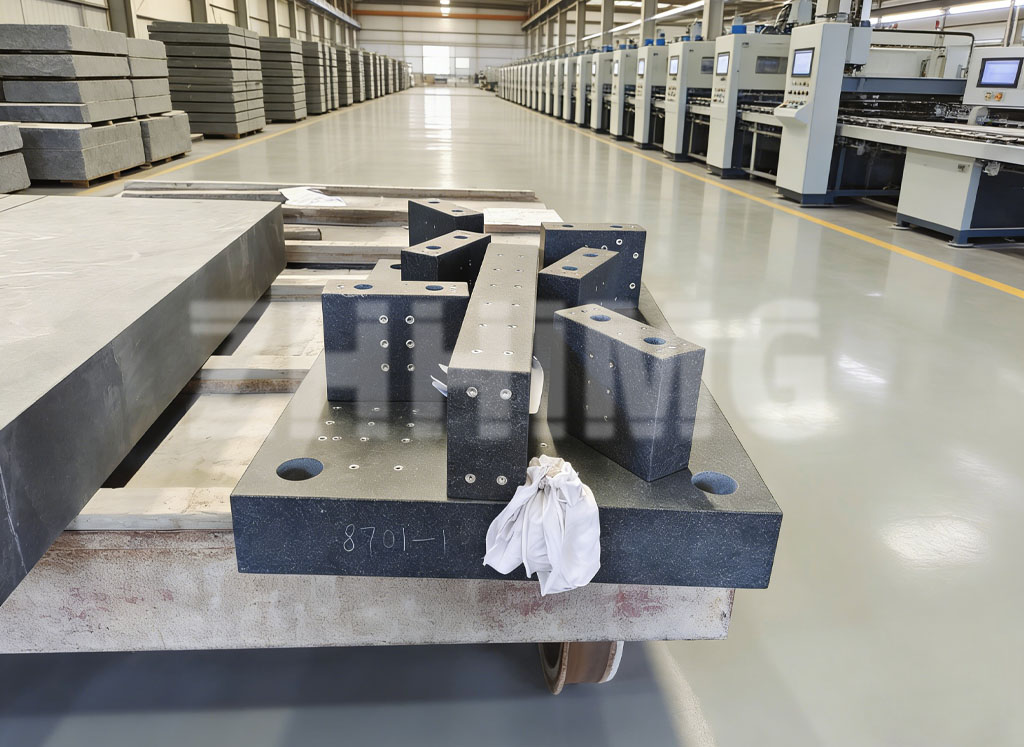
At ZHHIMG, we understand that a granite inspection base is more than a raw material—it’s a precision-engineered component that must meet exacting specifications from quarry to cleanroom. Our approach integrates material science, advanced manufacturing, and metrology expertise to deliver components that exceed industry standards:
Material Selection Excellence
We source only the highest-grade black granite, with specific attention to density requirements (≥3100 kg/m³), uniform crystal structure, and absence of internal flaws. Our proprietary ZHHIMG® Black Granite is selected from quarries where geological conditions produce material with exceptional homogeneity—a prerequisite for long-term dimensional stability.
Advanced Manufacturing Infrastructure
Our 200,000 m² production facility houses four dedicated production lines, including CNC machines capable of handling components up to 100 tons and 20 meters in length. This scale enables us to produce large, complex precision granite assemblies with consistent quality across all surfaces—critical for multi-axis inspection systems where geometric interrelationships matter as much as individual surface flatness.
Climate-Controlled Precision Environment
Our 10,000 m² constant-temperature and humidity workshop provides the ideal environment for final lapping and metrology. With a 1000mm thick military-grade concrete foundation and surrounding anti-vibration trenches, we achieve initial precision that exceeds typical requirements—maximizing the interval before resurfacing or recalibration is necessary.
Hand-Lapping Craftsmanship Meets Modern Metrology
While we leverage advanced CNC equipment, the final stages of finishing rely on our master lappers—with 30+ years of experience each. Their expertise enables flatness tolerances at the micron level across meter-scale surfaces. We validate every component with traceable metrology equipment, providing certification that meets DIN 876, ASME, and JIS standards.
Integrated Engineering Partnership
We don’t just deliver components—we work with OEM customers from design through validation. Our engineers collaborate on interface design, mounting strategy, and integration considerations to ensure that each semiconductor machine base performs optimally within the larger system architecture. This partnership approach reduces integration risk and accelerates time-to-market.
Conclusion: The Future is Built on Stability
As semiconductor manufacturing pushes toward the 2nm node and beyond, the industry’s precision requirements continue to escalate. At the same time, economic pressures demand higher throughput, longer equipment lifespans, and reduced total cost of ownership. These converging forces make the choice of structural material more strategic than ever.
Black granite, particularly the high-density (3100 kg/m³) grades engineered for precision applications, has emerged as the gold standard for inspection bases not through marketing hype, but through demonstrable performance advantages across every dimension that matters:
- Thermal stability that minimizes calibration drift
- Vibration damping that enables nanometer-scale resolution
- High density that provides passive inertia and stiffness
- Long-term precision retention that protects equipment investment
- Cleanroom compatibility that supports contamination control protocols
For semiconductor equipment manufacturers, optical inspection engineers, and procurement specialists, the conclusion is clear: in applications where precision cannot be compromised, black granite delivers performance that alternatives cannot match.
The choice of a granite inspection base is a commitment to long-term accuracy, operational reliability, and yield optimization. It’s a recognition that in the world of nanotechnology, the difference between “good enough” and “optimal” is measured in nanometers—and those nanometers determine success.
At ZHHIMG, we’re proud to partner with industry leaders who understand that the foundation of precision is, quite literally, the foundation. Our precision granite components aren’t just materials—they’re engineered solutions that enable the next generation of semiconductor innovation.
Ready to explore how black granite can enhance your inspection equipment’s performance? Contact our engineering team to discuss your specific requirements and learn why leading semiconductor manufacturers trust ZHHIMG for their most critical precision applications.
Post time: Mar-31-2026