
Selecting the right structural material is one of the most critical decisions in precision equipment design. Material choice directly influences rigidity, thermal stability, vibration damping, service life, and overall manufacturing cost.
From ultra-precision metrology platforms to semiconductor automation systems, different engineering scenarios require different material solutions. This guide provides a systematic comparison of seven commonly used precision structural materials to help R&D engineers and procurement decision-makers identify the optimal choice quickly and confidently.
Why Material Selection Matters in Precision Equipment
Precision structures serve as the mechanical foundation of high-end equipment such as:
- Coordinate measuring machines (CMMs)
- Semiconductor manufacturing systems
- PCB drilling platforms
- Laser processing machines
- Optical inspection equipment
- Automated dispensing systems
An inappropriate material can lead to:
- Thermal deformation affecting calibration
- Insufficient rigidity causing positioning drift
- Poor vibration damping reducing surface finish quality
- Excessive weight increasing motion control difficulty
- Unnecessary cost inflation
Selecting suitable materials ensures long-term dimensional stability, higher yield rates, and predictable lifecycle performance.
Overview of the 7 Major Precision Structural Materials
1. Natural Granite
Widely used in ultra-precision bases and metrology platforms, granite offers excellent natural stability.
Advantages
- Outstanding dimensional stability
- Very low thermal expansion
- Excellent vibration damping
- Non-magnetic and corrosion-resistant
Limitations
- Heavy weight
- Brittle under extreme impact
- Longer machining cycle
Typical Applications
Metrology equipment, precision machine bases, optical platforms
2. Mineral Casting (Epoxy Granite)
A composite of mineral aggregates and resin binders, engineered for superior dynamic performance.
Advantages
- Exceptional vibration absorption
- Low thermal expansion
- High design flexibility
- Complex shapes achievable via molding
Limitations
- Lower stiffness than metals
- Longer curing time
- Material formulation affects consistency
Typical Applications
Machine tool beds, dispensing machine frames, semiconductor automation structures
3. Engineering Ceramics
Advanced ceramic materials are used where extreme rigidity and wear resistance are required.
Advantages
- Extremely high stiffness
- Excellent wear resistance
- Very low thermal expansion
- Lightweight compared to granite
Limitations
- High manufacturing cost
- Brittle fracture risk
- Complex machining requirements
Typical Applications
Precision guide components, optical supports, semiconductor stages
4. Cast Iron & Steel Structures
Traditional materials widely used in industrial machinery.
Advantages
- High strength and toughness
- Mature supply chain
- Cost-effective for large structures
- Easy machining and assembly
Limitations
- High thermal expansion
- Susceptible to vibration transmission
- Prone to corrosion
- Heavy weight
Typical Applications
General machine tools, heavy industrial equipment
5. Optical Glass
Used in specialized precision assemblies requiring transparency and environmental stability.
Advantages
- High surface finish quality
- Chemical stability
- Good dimensional consistency
- Suitable for optical integration
Limitations
- Brittle
- Limited load-bearing capacity
- Higher processing cost
Typical Applications
Optical inspection platforms, imaging system structures
6. Carbon Fiber Composites
Advanced lightweight composites designed for high dynamic performance systems.
Advantages
- Extremely lightweight
- High specific stiffness
- Excellent fatigue resistance
- Minimal thermal deformation
Limitations
- Expensive raw materials
- Complex manufacturing process
- Anisotropic mechanical properties
Typical Applications
High-speed motion platforms, aerospace precision systems, robotic arms
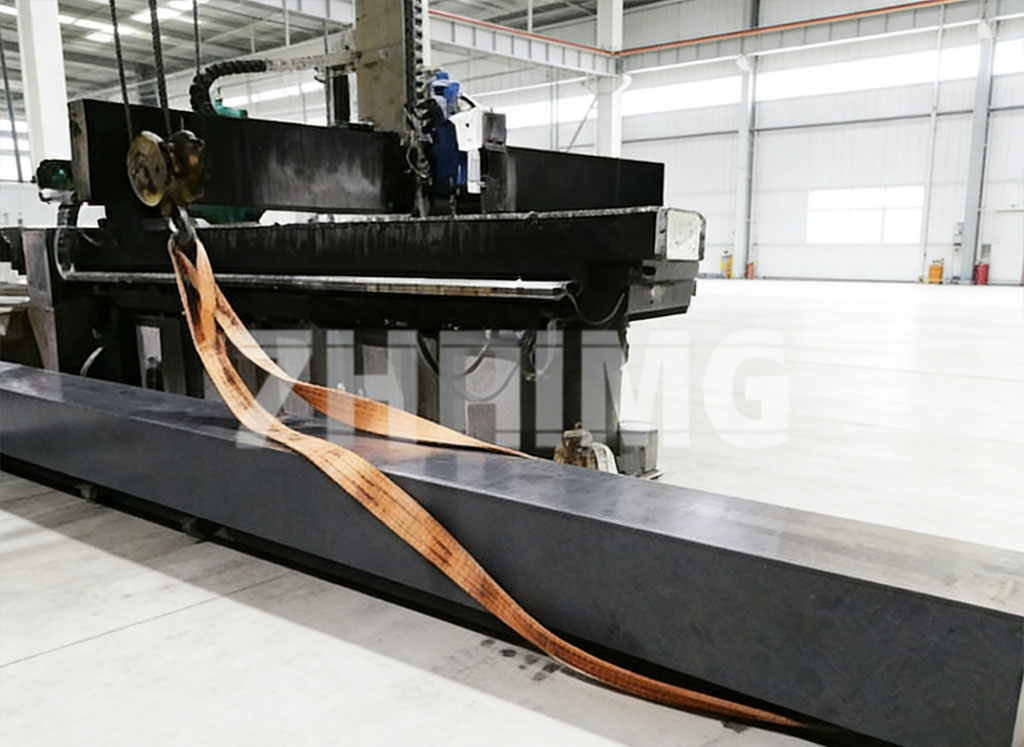
7. Ultra-High Performance Concrete (UHPC)
Next-generation composite material designed for large precision structures.
Advantages
- Excellent damping capacity
- High compressive strength
- Cost-effective for large components
- Good thermal stability
Limitations
- Heavy
- Lower tensile strength
- Surface finishing required for precision interfaces
Typical Applications
Large machine bases, heavy-duty precision platforms
Performance Comparison Table
| Material | Rigidity | Thermal Stability | Vibration Damping | Weight | Cost Level | Best For |
|---|---|---|---|---|---|---|
| Granite | Very High | Excellent | Excellent | Very Heavy | Medium-High | Ultra-precision metrology |
| Mineral Casting | High | Very Good | Outstanding | Heavy | Medium | Dynamic precision equipment |
| Ceramics | Extremely High | Excellent | Moderate | Light | Very High | Ultra-precision motion parts |
| Cast Iron/Steel | High | Moderate | Low | Very Heavy | Low-Medium | Heavy industrial machinery |
| Glass | Moderate | Good | Low | Medium | High | Optical structural systems |
| Carbon Fiber | High | Excellent | Good | Very Light | Very High | High-speed automation |
| UHPC | High | Very Good | Excellent | Very Heavy | Medium | Large precision platforms |
Granite vs Mineral Casting: The Most Requested Comparison
This comparison is especially relevant in precision machinery design.
Granite excels in:
- Long-term dimensional stability
- Superior natural damping
- Non-metallic corrosion resistance
- Ultra-precision metrology environments
Mineral casting excels in:
- Complex structural molding
- Integrated functional modules
- Higher vibration absorption
- Better suitability for dynamic equipment
Selection Guidance
- Choose granite for extreme precision and static stability.
- Choose mineral casting for dynamic machinery requiring vibration control and structural integration.
Carbon Fiber vs Ceramic Components
Carbon Fiber Advantages
- Ideal for high acceleration motion systems
- Lightweight structures reduce servo load
- Excellent fatigue life
Ceramic Advantages
- Higher stiffness for precision guides
- Superior wear resistance
- Better thermal dimensional control
Selection Guidance
- Carbon fiber suits high-speed automation axes.
- Ceramics suit ultra-precision measurement and wear-critical components.
How to Choose the Right Material for Your Equipment
Choose Granite if:
You manufacture metrology equipment or ultra-stable inspection platforms.
Choose Mineral Casting if:
Your equipment requires vibration damping and complex integrated structures.
Choose Ceramics if:
You need ultra-stiff, wear-resistant precision motion components.
Choose Metal if:
You prioritize cost-efficiency and heavy-load capacity.
Choose Glass if:
Your system integrates optical or imaging modules.
Choose Carbon Fiber if:
Your equipment demands lightweight, high-speed dynamic motion.
Choose UHPC if:
You build large-scale precision systems requiring damping and cost balance.
Conclusion: The Right Material Is the Foundation of Precision
No single material is universally superior. The optimal choice depends on equipment type, motion characteristics, environmental conditions, and budget constraints.
Understanding the strengths and limitations of each structural material enables engineers to design more stable systems, extend service life, and improve manufacturing precision.
With extensive expertise across granite, mineral casting, ceramics, carbon fiber, UHPC, and advanced composites, ZHHIMG provides customized precision structural solutions tailored to high-end equipment manufacturers worldwide.
Post time: Mar-23-2026