
In the high-stakes arena of nanometer-scale manufacturing, the physical limitations of contact-based mechanics have become a significant bottleneck. As industry leaders push for faster throughput and higher resolution in semiconductor lithography and aerospace inspection, the reliance on advanced air bearing technology has transitioned from a niche luxury to an industrial necessity. Understanding the different types of air bearings and the critical factor of air bearing guide stiffness is essential for any engineer designing the next generation of linear motion guide systems.
Understanding the Primary Types of Air Bearings
Air bearing technology operates on the principle of an ultra-thin film of pressurized air that supports a load, effectively eliminating the friction, wear, and heat generation associated with mechanical bearings. However, the method of air distribution defines the bearing’s performance characteristics.
Porous Media Air Bearings are often considered the gold standard for uniform pressure distribution. By using a porous material—typically carbon or specialized ceramics—the air is forced through millions of sub-micron holes. This results in a highly stable air film that is less prone to vibration and provides superior damping.
Orifice Air Bearings utilize precisely machined holes or grooves to distribute air. While these are often more straightforward to manufacture, they require expert engineering to manage the “pressure compensation” needed to prevent instability at high speeds.
Flat Pad Air Bearings are the workhorses of linear motion guide systems. These are typically mounted in opposing pairs to “pre-load” a granite rail, providing high constrained stiffness in multiple directions.
Rotary Air Bearings provide near-zero error motion for applications such as goniometry or spindle testing. Their ability to maintain a constant axis of rotation without the “rumble” of ball bearings makes them indispensable for optical centering.
The Engineering Metric of Success: Air Bearing Guide Stiffness
One of the most common misconceptions in metrology is that air bearings are “soft” compared to mechanical rollers. In reality, modern air bearing guide stiffness can exceed that of mechanical systems when properly designed.
Stiffness in an air bearing system refers to the change in air film thickness in response to a change in load. This is achieved through “pre-loading.” By using magnets or vacuum pressure—or by capturing a granite rail with opposing air pads—engineers can compress the air film. As the film becomes thinner, its resistance to further compression increases exponentially.
High stiffness is critical because it dictates the system’s natural frequency and its ability to resist external disturbances, such as the forces generated by a high-acceleration linear motor. At ZHHIMG, we utilize computational fluid dynamics (CFD) to optimize the gap between the bearing and the granite guide, ensuring that stiffness is maximized without compromising the frictionless nature of the motion.
Evolution of Linear Motion Guide Systems
The integration of air bearings into linear motion guide systems has redefined the architecture of modern machines. Traditionally, a linear guide consisted of a steel rail and a recirculating ball carriage. While robust, these systems suffer from “cogging” and thermal expansion.
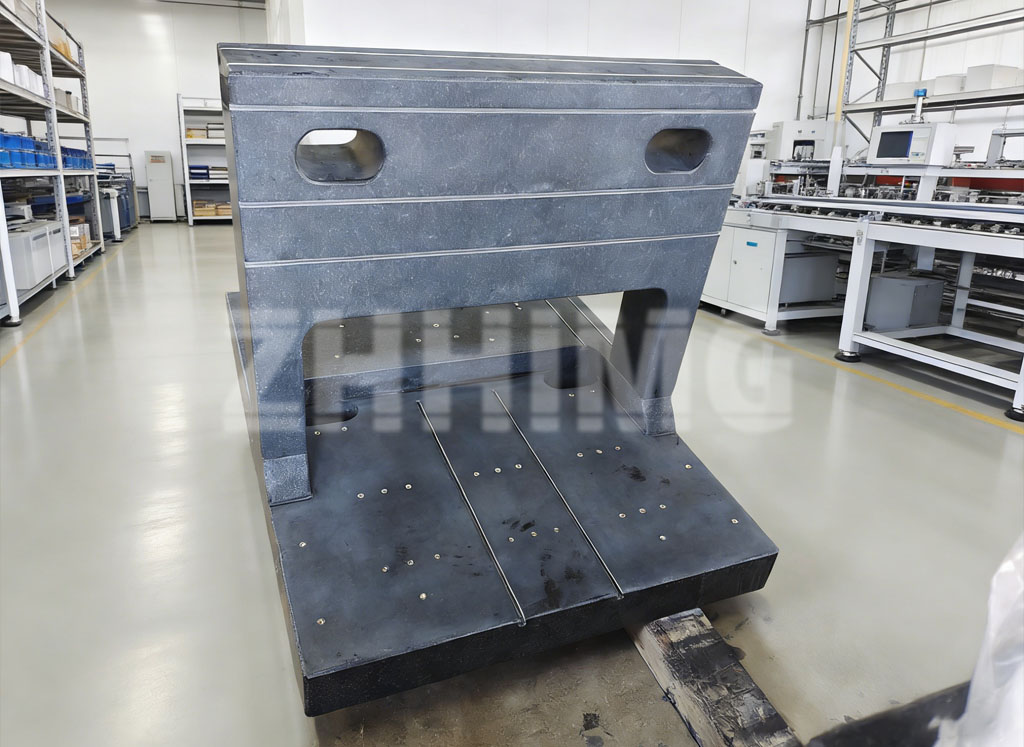
A modern, high-precision linear guide system now typically features a granite beam, which provides the necessary flatness and thermal inertia, paired with an air bearing carriage. This combination allows for:
-
Zero static friction (stiction), enabling microscopic incremental movements.
-
Infinite life, as there is no mechanical wear between the components.
-
Self-cleaning properties, as the constant outflow of air prevents dust from entering the bearing gap.
The Role of Air Bearing Technology Manufacturers in Industry 4.0
Choosing among air bearing technology manufacturers involves evaluating more than just the bearing itself. The most successful implementations are those that treat the bearing, the guide rail, and the support structure as a single, integrated system.
As a specialized manufacturer, ZHHIMG Group bridges the gap between material science and fluid dynamics. We specialize in the fabrication of the granite components that serve as the “runway” for these air films. Because an air bearing is only as accurate as the surface it flies over, our ability to lap granite to sub-micron flatness levels is what allows our linear motion systems to achieve nanometer-level repeatability.
The demand for these systems is surging in the semiconductor inspection sector, where the move to 2nm and 1nm nodes requires stages that can move with zero vibration. Similarly, in the aerospace sector, the measurement of large-scale turbine components requires the heavy-load capacity of granite combined with the delicate touch of air-supported probes.
Conclusion: Setting the Standard for Fluid Motion
The transition from mechanical contact to fluid-film support represents a paradigm shift in mechanical engineering. By understanding the specific strengths of various types of air bearings and focusing on the critical importance of air bearing guide stiffness, manufacturers can achieve levels of precision that were once thought impossible.
At ZHHIMG, we are committed to being more than just a component supplier. We are a partner in precision, providing the rock-solid foundations and the cutting-edge air bearing technology required to drive the future of global innovation. When motion becomes frictionless, the possibilities for accuracy become limitless.
Post time: Jan-22-2026