
As global manufacturing enters a new era of nanometer-scale requirements, the definition of a “stable foundation” has undergone a profound transformation. In 2026, the success of a semiconductor lithography tool or a high-speed inspection system is no longer determined solely by its software or motors, but by the physical integrity of its base and the friction profile of its motion. At ZHHIMG, we are witnessing a decisive industry shift: natural granite is no longer just a metrology accessory; it is the structural cornerstone of the next generation of industrial mother machines.
The Standard of Excellence: Understanding Granite Surface Plate Grades
For any precision environment, the granite surface plate serves as the “true zero” reference. However, not all plates are created equal, and selecting the wrong accuracy grade can lead to cumulative errors that compromise entire production cycles. Global standards, such as the German DIN 876, the American ASME B89.3.7, and the ISO 8512, provide the framework for this selection.
In modern high-end applications, ZHHIMG focuses on the three tiers most critical to precision engineering:
-
Grade 000 (The Laboratory Master): Reserved for national-level calibration laboratories and the most sensitive semiconductor inspection environments. A Grade 000 plate offers sub-micron flatness that acts as the ultimate reference for calibrating other measuring instruments.
-
Grade 00 (The Metrology Standard): The primary choice for Coordinate Measuring Machines (CMMs) and optical measurement systems. It offers the ideal balance of extreme flatness and long-term stability for climate-controlled quality rooms.
-
Grade 0 (The Inspection Workhorse): Designed for precision workshop use. While less accurate than Grade 00, it provides a stable, wear-resistant surface for checking machined components and aligning high-precision assemblies.
The performance of these grades is intrinsically linked to the material. ZHHIMG utilizes premium Black Jinan Granite (Gabbro), which possesses a tighter crystalline structure and lower water absorption than gray alternatives, ensuring that a Grade 000 surface remains “true” over years of heavy industrial use.
Motion Without Contact: Air Bearing vs. Mechanical Bearing Stages
Once a stable granite foundation is established, the method of motion becomes the next critical design hurdle. For years, the industry relied on mechanical bearing stages. Today, however, the frictionless performance of air bearings is becoming mandatory for ultra-precision applications.
The Mechanical Bearing Limitation Mechanical bearings, utilizing recirculating balls or rollers, are valued for their high load capacity and ruggedness. However, in the realm of sub-micron positioning, they face three inherent flaws:
-
Stiction and Hysteresis: The physical contact between the rolling elements and the rail creates static friction (stiction). This forces the motor to “hunt” for its final position, limiting the resolution of the system.
-
Vibration Resonance: The mechanical “rumble” of balls moving through a race generates high-frequency noise that can interfere with sensitive optical sensors or scanning probes.
-
Wear and Contamination: Mechanical contact inevitably creates particulates and requires lubrication—both of which are detrimental to cleanroom environments.
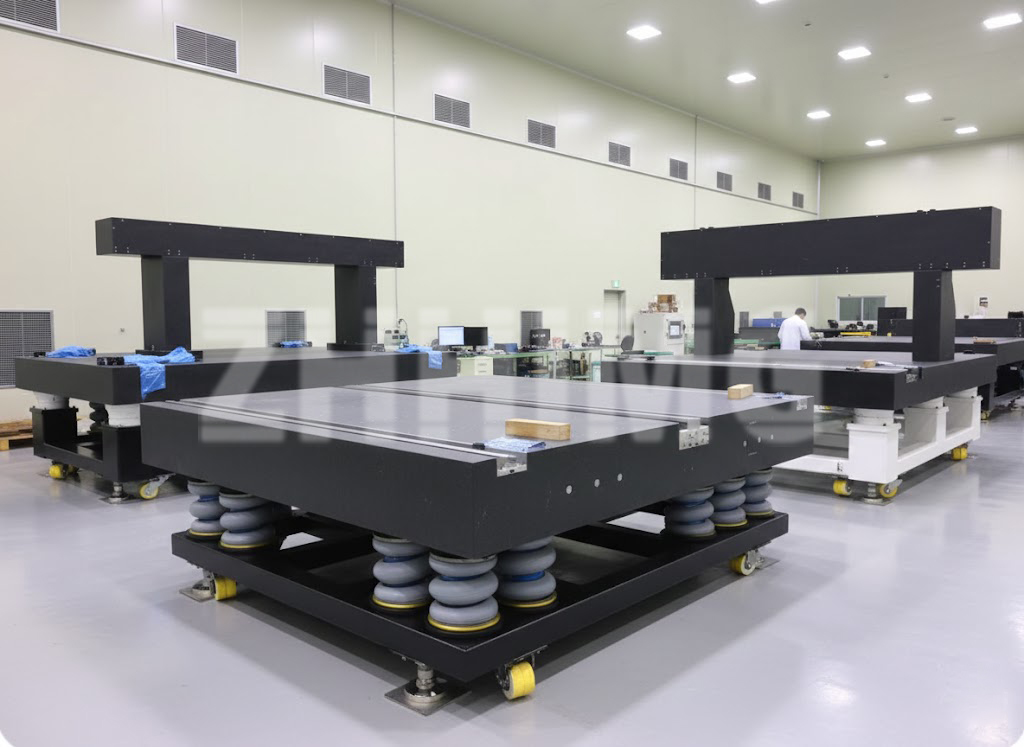
The Air Bearing Advantage A granite-based air bearing stage supports its load on a thin film of pressurized air (typically 5 to 10 microns). This creates a frictionless interface with transformative benefits:
-
Nanometer Repeatability: With zero friction, there is no hysteresis. The stage can settle at a commanded position with nanometer-level repeatability.
-
Surface Averaging Effect: One of the most significant advantages of air bearings is their ability to “average out” microscopic surface irregularities. While a mechanical bearing follows every tiny bump in a guide rail, the air film effectively smooths these out, providing a motion straightness that exceeds the physical flatness of the granite guide.
-
Unlimited Service Life: Because there is no contact, there is no wear. An air bearing stage maintained with clean, dry air will maintain its factory-new precision indefinitely.
The Synergy of Black Jinan Granite and Motion Systems
The integration of air bearings with granite is where the ZHHIMG advantage becomes clear. An air bearing is only as good as the surface it floats on. Granite provides the low thermal expansion (CTE) and high vibration damping required to keep the air gap consistent. Unlike aluminum or steel rails, granite guide ways do not “creep” or deform over time, ensuring that the air bearing’s flight height remains uniform across the entire travel length.
As Industry 4.0 demands more autonomous, self-correcting machines, the physical stability of granite components becomes the “passive intelligence” of the system. By reducing the need for software-based error compensation, ZHHIMG granite bases and air bearing stages allow for faster, more reliable, and more energy-efficient manufacturing.
Conclusion: Partnering for the Future of Accuracy
Choosing between material grades and bearing technologies is more than a procurement decision; it is an engineering commitment to the life of the machine. Whether you are building a new CMM or an EUV lithography system, the foundation must be absolute.
ZHHIMG Group remains at the forefront of this evolution, combining the geological stability of the world’s finest granite with the cutting edge of frictionless motion control. We invite you to explore how our custom granite components can serve as the bedrock for your next innovation.
Post time: Feb-04-2026