
In the global race toward higher precision and smaller tolerances, structural materials are no longer secondary considerations. For optical systems, laser equipment, and semiconductor manufacturing platforms, the base structure directly influences alignment stability, vibration behavior, and long-term dimensional accuracy. ZHHIMG Group continues to expand its expertise in optical granite, laser granite, semiconductor granite, and flat granite platforms to support the evolving needs of high-technology industries across Europe and North America.
As OEM manufacturers refine next-generation inspection systems, photonics equipment, wafer processing tools, and micro-machining platforms, demand is growing for engineered granite solutions that combine geometric precision with thermal stability and vibration damping. ZHHIMG’s strategic focus aligns with this shift, providing granite structures designed specifically for high-sensitivity and high-performance applications.
Optical Granite as a Foundation for Alignment Accuracy
Optical systems operate within extremely narrow tolerances. Whether used in interferometry, spectroscopy, microscopy, or advanced imaging platforms, these systems rely on stable reference surfaces to maintain alignment between lenses, mirrors, sensors, and positioning stages.
Optical granite provides a structurally stable, non-magnetic, and low-expansion foundation ideally suited to such environments. Its inherent vibration damping reduces micro-oscillations that can degrade image clarity or measurement repeatability. Unlike metallic structures that may transmit ambient vibration, granite absorbs energy within its crystalline matrix.
ZHHIMG manufactures optical granite platforms with precision-ground surfaces calibrated to meet stringent flatness requirements. Environmental control during machining and inspection ensures that dimensional verification reflects real operating conditions. Each granite component is processed to maintain tight parallelism and perpendicularity between critical reference planes.
For European and American laboratories, where laser interferometers and optical encoders measure displacement at micron or sub-micron scales, structural stability is indispensable. Optical granite bases reduce the influence of thermal drift and mechanical resonance, supporting consistent measurement integrity.
Laser Granite Structures for High-Energy Applications
Laser processing systems generate concentrated thermal energy and dynamic mechanical loads. In cutting, engraving, marking, or micro-fabrication applications, the interaction between laser optics and motion platforms must remain precisely aligned.
Laser granite structures provide the rigidity and stability required to maintain beam alignment over extended operational cycles. Granite’s low thermal expansion coefficient minimizes geometric distortion caused by localized heating from laser modules or adjacent equipment. Its high compressive strength supports heavy gantry assemblies and linear motor systems without deformation.
ZHHIMG’s laser granite solutions often incorporate precision inserts and mounting interfaces tailored to motion control components. Threaded bushings, alignment grooves, and datum surfaces are machined directly into the granite body using CNC technology, ensuring accurate positioning relative to the overall geometry.
In high-speed laser systems, vibration can influence beam focus and cutting accuracy. Granite’s natural damping properties help reduce oscillatory effects generated by rapid acceleration or deceleration of motion axes. For manufacturers seeking improved surface finish quality and reduced process variation, laser granite foundations offer measurable advantages.
Semiconductor Granite for Ultra-Precision Manufacturing
Semiconductor fabrication demands structural platforms capable of maintaining stability under extreme accuracy requirements. Wafer inspection, lithography alignment, bonding processes, and precision placement systems all rely on controlled motion and consistent reference geometry.
Semiconductor granite bases are engineered to meet these challenges. Unlike welded steel frames, which may experience residual stress or distortion, granite provides predictable dimensional behavior over time. Its corrosion resistance and chemical stability are particularly beneficial in cleanroom environments where exposure to process chemicals may occur.
ZHHIMG supplies semiconductor granite components designed for integration with air-bearing stages, linear motors, and precision guide systems. Careful attention is given to flat granite surfaces that serve as primary reference planes. Surface finish and flatness are verified using advanced measurement equipment, including laser-based inspection tools.
As chip geometries continue to shrink, alignment accuracy becomes increasingly critical. Even minor structural deflections can influence overlay precision and yield rates. Granite’s combination of rigidity and damping contributes to enhanced repeatability across production cycles.
Flat Granite and the Importance of Geometric Integrity
Flat granite surfaces form the backbone of many precision systems. Whether used as inspection plates, motion stage bases, or equipment foundations, flatness directly affects alignment and calibration outcomes.
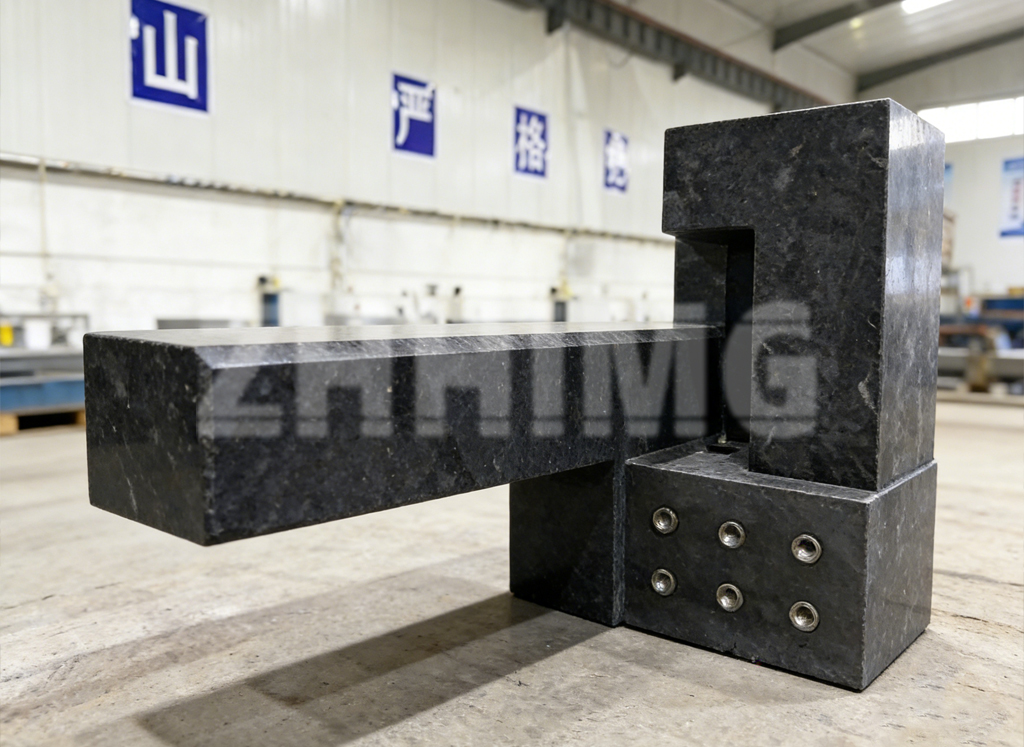
Achieving high flatness in granite requires more than surface grinding. ZHHIMG employs multi-stage processing that includes rough machining, stress stabilization, precision grinding, and final lapping in controlled conditions. Each flat granite surface is measured against specified tolerances before approval.
In metrology laboratories, flat granite plates serve as reference standards for dimensional verification. In automation platforms, flat granite bases ensure that linear guides and motion components operate within designed alignment parameters. Consistency across the entire surface area is essential to maintain geometric integrity.
The durability of granite allows flat surfaces to retain accuracy over extended service life. Unlike metallic surfaces that may warp or corrode, granite resists environmental degradation, reducing recalibration frequency and maintenance requirements.
Integrated Engineering and Customization Capabilities
Modern equipment manufacturers rarely require standard rectangular slabs. Instead, they seek customized granite structures engineered to match specific system configurations. ZHHIMG provides design support during early project stages to optimize geometry, load distribution, and insert placement.
By integrating CAD modeling with practical manufacturing considerations, engineers ensure that each optical granite or semiconductor granite component aligns with application-specific performance objectives. Embedded steel inserts and hybrid assemblies combine granite’s stability with mechanical fastening versatility.
This integration capability is particularly valuable in North American and European markets, where OEMs demand turnkey structural modules ready for direct system integration. Custom granite solutions reduce downstream machining and simplify assembly workflows.
Manufacturing Infrastructure and Quality Assurance
Producing high-performance granite structures requires controlled processing environments and rigorous inspection protocols. ZHHIMG maintains climate-stabilized workshops to minimize temperature-related dimensional variation during machining and calibration.
Quality assurance processes include raw material inspection, intermediate dimensional verification, and final geometric certification. Advanced measuring instruments confirm flatness, perpendicularity, and positional accuracy of inserts and reference features.
Documentation accompanies each shipment, providing transparency and traceability. For customers operating under strict quality management systems, consistent reporting reinforces supplier reliability.
Industry Trends Driving Demand
The expansion of photonics research, electric vehicle manufacturing, semiconductor fabrication, and advanced robotics has intensified demand for optical granite and laser granite solutions. As manufacturing tolerances tighten and system complexity increases, structural material selection becomes increasingly strategic.
Granite’s non-magnetic properties support sensitive sensor integration. Its vibration damping enhances dynamic stability. Its dimensional reliability reduces long-term maintenance costs. Together, these characteristics position granite as a preferred structural material for high-precision applications.
ZHHIMG’s focus on semiconductor granite and flat granite platforms reflects broader industry movement toward engineered stone foundations capable of supporting next-generation technologies.
A Foundation for the Future of Precision
Precision engineering begins with a stable base. Optical granite, laser granite, semiconductor granite, and flat granite platforms provide the structural backbone for systems operating at the limits of measurement and manufacturing capability.
Through continued investment in machining technology, inspection equipment, and engineering collaboration, ZHHIMG strengthens its capacity to deliver granite solutions tailored to advanced industrial needs. By aligning material expertise with customer-specific requirements, the company supports improved accuracy, reduced vibration, and enhanced system longevity.
As industries advance toward greater automation and higher sensitivity, the importance of structural stability will only increase. Granite, with its unique combination of thermal stability, damping capacity, and geometric reliability, remains central to that evolution.
In the pursuit of precision, stability is not optional. It is fundamental. Through refined optical, laser, semiconductor, and flat granite solutions, ZHHIMG contributes to the reliable foundations upon which modern high-technology systems depend.
Post time: Feb-13-2026