
In ultra-precision measurement environments, material selection is critical for ensuring repeatable accuracy, thermal stability, and long-term reliability. Among high-end metrology tools, alumina ceramic measuring tools and granite measuring tools are the two dominant choices for laboratory inspection and component calibration.
This article examines the trade-offs between these materials for extreme-precision applications, highlighting their physical properties and suitability for sensitive measurement scenarios such as aerospace and semiconductor components.
What Are Alumina Ceramic and Granite Measuring Tools?
Alumina Ceramic Tools
Alumina (Al₂O₃) ceramics are advanced engineering materials known for:
- Ultra-high hardness (3–4× that of granite)
- Extremely low coefficient of thermal expansion (CTE)
- Exceptional wear and scratch resistance
- Chemical inertness and corrosion resistance
Commonly manufactured into ceramic squares, blocks, and reference plates, alumina ceramics provide consistent geometry under extreme environmental conditions.
Granite Tools
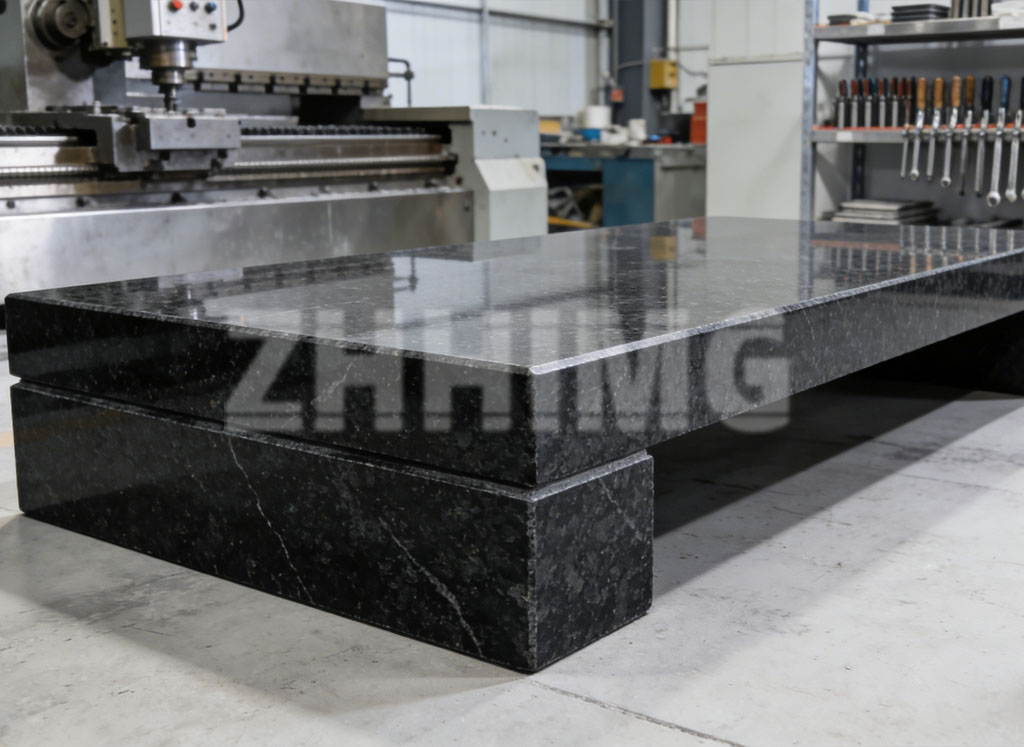
Granite measuring tools, made from high-density black granite, remain widely used due to:
- High natural flatness stability
- Excellent vibration damping
- Non-magnetic behavior
- Cost-effectiveness compared with advanced ceramics
Granite is traditionally used for 000-grade precision applications in quality control labs and calibration facilities.
1. Hardness and Wear Resistance
Alumina ceramics exhibit a hardness of approximately 1200–1400 HV, compared with granite’s 400–500 HV.
Implications for metrology:
- Ceramic tools resist scratches, dents, and micro-deformations caused by repeated contact with metal parts or precision instruments.
- Granite surfaces are more susceptible to wear in high-traffic or high-load inspection environments, potentially affecting flatness over time.
For laboratories measuring aerospace components, engine parts, or semiconductor substrates, ceramic tools maintain long-term geometric integrity.
2. Thermal Expansion: Minimizing Measurement Error
Temperature fluctuations in inspection labs can induce dimensional changes in reference surfaces.
| Property | Alumina Ceramic | Granite |
|---|---|---|
| Coefficient of Thermal Expansion | 4–6 × 10⁻⁶ /°C | 7–9 × 10⁻⁶ /°C |
| Dimensional Stability | Excellent | High |
| Suitability for Temperature-Sensitive Measurement | Ideal | Moderate |
Advantage: Lower thermal expansion in alumina ceramics ensures sub-micron repeatability, particularly crucial when measuring high-precision aerospace or optical components where even minor thermal shifts can compromise tolerances.
3. Chemical Resistance and Surface Stability
Alumina ceramics are chemically inert, unaffected by:
- Coolants and oils
- Laboratory cleaning agents
- Humidity and airborne contaminants
Granite, while resistant to many chemicals, can be affected by prolonged exposure to acidic or alkaline substances, which may gradually alter surface flatness.
4. Flatness and Grade Selection
Both alumina ceramic and granite tools are available in 000-grade precision, suitable for ultra-precision inspections.
Ceramic Squares (精密陶瓷方箱) from alumina offer:
- Extremely stable contact surfaces for gauge calibration
- Superior long-term flatness retention
- Reduced need for frequent re-grading
Granite 000-grade tools, while highly accurate, may require more frequent recalibration in environments with high tool usage or temperature variability.
5. Application Scenarios: Where Ceramic Excels
Alumina ceramic measuring tools are particularly advantageous for:
- Aerospace component inspection
- Precision optical and semiconductor metrology
- Laboratories where ambient temperature fluctuates
- High-contact environments requiring extreme wear resistance
Granite tools remain highly suitable for:
- Standard laboratory inspections
- General-purpose precision tool calibration
- Scenarios where cost-efficiency outweighs marginal gains in thermal stability and hardness
ZHHIMG Ceramic and Granite Solutions
ZHHIMG manufactures high-grade alumina ceramic squares and precision granite measuring tools for ultra-precision laboratories.
ZHHIMG Advantages:
- Advanced processing ensures 000-grade flatness
- Strict material selection guarantees thermal stability and high hardness
- Customizable sizes and shapes for gauges, squares, and reference blocks
- Ideal for aerospace, semiconductor, and high-precision manufacturing inspection
By providing both ceramic and granite solutions, ZHHIMG enables engineers to select the material best suited to environmental conditions, component sensitivity, and desired inspection longevity.
Conclusion: Choosing the Right Material
For ultra-precision inspection in temperature-sensitive or high-contact environments:
- Alumina ceramic tools provide superior hardness, lower thermal expansion, and long-term flatness stability.
- Granite tools remain a reliable, cost-effective solution for conventional 000-grade measurement tasks.
Ultimately, the choice between ceramic vs granite measuring tools should consider environmental factors, required precision, and component criticality. For applications where every micron counts, alumina ceramic is the preferred material for maintaining measurement integrity and reducing re-calibration cycles.
Post time: Mar-25-2026