
As manufacturing technologies advance toward higher accuracy, faster throughput, and greater automation, the demand for mechanically stable reference structures has intensified. In precision-driven industries such as semiconductor fabrication, optical inspection, aerospace manufacturing, and advanced automation, system performance is increasingly defined by structural integrity rather than sensor resolution alone.
Within this context, precision granite has evolved from a traditional metrology material into a core structural solution for modern manufacturing equipment. Its role now extends far beyond surface plates, encompassing machine bases, motion platforms, air bearing systems, and integrated vibration isolation structures.
This article explores the applications of precision granite, examines emerging metrology equipment trends, analyzes the role of vibration isolation in manufacturing, and compares black granite versus pink granite from a practical engineering perspective. The objective is to provide system designers, OEMs, and metrology professionals with a clear understanding of why granite continues to define accuracy standards in high-precision environments.
Precision Granite as a Structural Material
Precision granite is selected not for aesthetic reasons, but for a unique combination of mechanical and thermal properties that directly support accuracy and repeatability. High-quality metrology granite offers high mass density, low thermal expansion, excellent internal damping, and long-term dimensional stability.
Unlike metallic structures, granite does not suffer from residual stress introduced during manufacturing. Its isotropic crystalline structure ensures that deformation under load is predictable and minimal. These characteristics make granite particularly suitable for applications where micron-level stability must be maintained over extended periods.
In modern equipment design, granite is increasingly treated as a functional component rather than a passive support, with engineered interfaces, embedded inserts, and integrated motion features.
Applications of Precision Granite in Metrology Systems
Metrology remains the most established application field for precision granite. Coordinate measuring machines (CMMs), optical comparators, form measurement systems, and laser interferometer platforms all rely on granite structures to provide a stable geometric reference.
Granite surface plates continue to serve as the foundation for both standalone measurement and integrated inspection systems. Their ability to maintain flatness under varying loads and temperatures makes them indispensable in quality control environments.
Beyond surface plates, granite is widely used in CMM bases, bridges, and guideways. Its compatibility with air bearing technology allows for near-frictionless motion while maintaining excellent vibration damping. This combination enables high-speed probing without compromising measurement accuracy.
Precision Granite in Advanced Manufacturing Equipment
The application of precision granite has expanded significantly into manufacturing systems where accuracy and stability are equally critical. In semiconductor equipment, granite bases support lithography stages, wafer inspection tools, and alignment systems that operate at nanometer-level tolerances.
In precision machining and laser processing equipment, granite machine bases provide a stable platform for high-dynamic motion systems. Their mass and damping characteristics reduce the transmission of cutting forces and motor-induced vibration, improving surface finish and positional accuracy.
Automation and assembly systems also benefit from granite structures, particularly in applications involving vision-guided positioning and micro-assembly. Granite frames help maintain alignment between cameras, actuators, and workpieces over long production cycles.
Metrology Equipment Trends Shaping Material Selection
Current trends in metrology equipment highlight a shift toward higher throughput, multi-sensor integration, and in-line inspection. These trends place increasing demands on structural materials.
Modern systems often combine tactile probes, optical sensors, and scanning technologies within a single platform. Maintaining alignment between these subsystems requires a base material with minimal thermal drift and excellent vibration control.
At the same time, manufacturers are pushing for compact designs and higher axis speeds. This has driven the integration of active vibration isolation and air bearing systems, both of which perform optimally when paired with granite structures.
As a result, precision granite is no longer limited to laboratory environments but is now widely used directly on the production floor.
Vibration Isolation in Manufacturing Environments
Vibration is one of the most persistent challenges in precision manufacturing. Sources include nearby machinery, material handling systems, building resonance, and even human activity.
Granite contributes to vibration control in two primary ways. First, its inherent internal damping absorbs high-frequency vibrations more effectively than metals or ceramics. Second, its high mass lowers the natural frequency of the overall system, enhancing the effectiveness of isolation measures.
Precision granite structures are commonly combined with passive vibration isolation systems such as pneumatic isolators or elastomer mounts. In more demanding applications, active vibration isolation systems are used to counter low-frequency disturbances.
Granite bases can be machined to integrate isolation interfaces directly, ensuring precise load distribution and alignment. This system-level integration simplifies installation and improves long-term stability.
Black Granite vs. Pink Granite: Engineering Considerations
Not all granite is created equal. From an engineering perspective, the choice between black granite and pink granite has significant implications for precision performance.
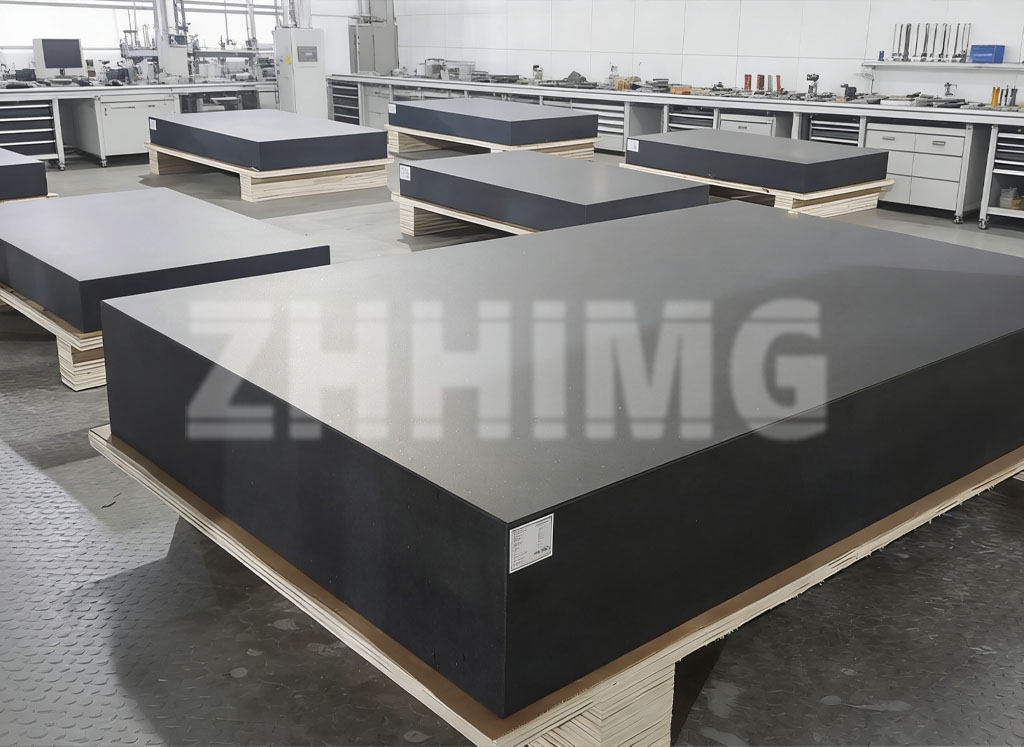
Black granite, often sourced from specific geological formations, is characterized by fine grain structure, high density, and excellent homogeneity. These properties result in superior wear resistance, better vibration damping, and more consistent thermal behavior. Black granite is therefore widely used in high-end metrology and precision machine bases.
Pink granite, while suitable for general surface plates and less demanding applications, typically exhibits coarser grain structure and lower density. This can lead to slightly reduced damping performance and greater variability in long-term stability.
For applications involving air bearings, ultra-flat surfaces, or sub-micron accuracy requirements, black granite is generally the preferred material.
Manufacturing and Machining of Precision Granite
Advances in CNC grinding, lapping, and coordinate measurement have significantly expanded the design possibilities for precision granite components. Complex geometries, tight tolerances, and integrated functional features can now be achieved with high repeatability.
Precision machining allows for the incorporation of threaded inserts, reference datums, air bearing pads, and fluid channels directly into granite structures. This reduces assembly error and enhances overall system rigidity.
Quality control during granite manufacturing is critical. Dimensional inspection, material selection, and environmental control throughout the machining process ensure that finished components meet stringent performance requirements.
Long-Term Performance and Sustainability
One of the most significant advantages of precision granite is its long-term stability. Granite does not fatigue, corrode, or creep under normal operating conditions. Surface re-lapping can restore accuracy without compromising structural integrity, extending service life significantly.
From a sustainability perspective, granite’s durability and low maintenance requirements reduce the need for frequent replacement or refurbishment. This aligns with industry trends toward lifecycle optimization and reduced environmental impact.
Conclusion
The expanding applications of precision granite reflect broader trends in metrology and manufacturing toward higher accuracy, greater integration, and improved stability. From CMM systems and optical inspection platforms to semiconductor equipment and advanced automation, granite continues to provide a reliable structural foundation.
When combined with effective vibration isolation strategies and appropriate material selection—such as the use of high-quality black granite—precision granite enables manufacturers to meet increasingly demanding performance requirements.
As metrology equipment evolves and manufacturing environments become more complex, precision granite remains a cornerstone material for achieving consistent, long-term accuracy in modern industrial systems.
Post time: Jan-28-2026