
As advanced manufacturing sectors evolve, structural materials are being evaluated not only for strength and rigidity but also for environmental compatibility, vibration control, and long-term dimensional stability. In industries such as semiconductor fabrication, lithium battery testing, precision optics, and high-end automation, the structural base is no longer a passive support element. It has become a defining factor in system accuracy and operational reliability.
Within this context, cleanroom compatible granite structures and granite bases for battery testing are gaining increased attention across European and North American markets. At the same time, technical discussions comparing epoxy granite vs natural granite are shaping engineering decisions in equipment design.
ZHHIMG Group has observed this shift through growing global demand for high-stability granite systems designed specifically for controlled environments and next-generation energy applications.
The Structural Demands of Cleanroom Environments
Cleanroom environments impose strict requirements on every component installed within them. Airborne particle generation, chemical emissions, and surface contamination must be minimized. Structural materials must not degrade, oxidize, or release volatile compounds that could compromise sensitive processes.
Natural granite offers inherent advantages in such environments. A properly processed cleanroom compatible granite structure is chemically stable, non-corrosive, and resistant to environmental degradation. Unlike ferrous materials, it does not rust or require protective coatings that may flake or emit particles over time.
Surface finishing plays a critical role. Precision lapping produces a dense, smooth surface that minimizes particle retention and facilitates cleaning. In semiconductor or optical cleanrooms, this characteristic contributes directly to contamination control strategies.
Furthermore, granite exhibits low thermal expansion and excellent dimensional stability, ensuring that precision equipment installed on a granite base maintains alignment despite minor temperature fluctuations typical in controlled facilities.
Why Granite Bases Are Increasingly Used in Battery Testing Systems
The rapid growth of electric vehicles and energy storage technologies has accelerated investment in battery research, module assembly, and performance testing. Battery testing systems often involve high-precision measurement equipment, environmental simulation chambers, and dynamic load application.
A granite base for battery testing provides multiple engineering advantages.
First, it offers high mass and rigidity, which are essential when supporting heavy battery modules or test fixtures. Structural deflection must be minimized to ensure accurate stress and deformation measurement.
Second, vibration damping is critical. Battery testing frequently includes dynamic cycling and mechanical load variation. A granite base absorbs and dissipates vibrational energy more effectively than many metallic structures, reducing measurement noise and improving repeatability.
Third, chemical stability is essential. Battery development environments may involve exposure to electrolytes, solvents, or temperature cycling. Natural granite demonstrates strong resistance to corrosion and chemical degradation, supporting long-term use in demanding research facilities.
As global battery production scales, precision in testing and validation processes becomes increasingly important. Structural stability directly influences measurement accuracy and system longevity.
Epoxy Granite vs Natural Granite: Engineering Considerations
The debate surrounding epoxy granite vs natural granite is common among equipment designers. Both materials offer vibration damping properties, yet their performance characteristics differ significantly.
Epoxy granite, also known as mineral casting, is a composite material consisting of aggregates bonded by polymer resin. It offers good damping behavior and can be molded into complex shapes. However, its thermal expansion characteristics depend on the resin composition and curing process. Long-term dimensional stability may be influenced by aging or environmental exposure.
Natural granite, by contrast, is a crystalline stone formed over geological timescales. When properly selected and processed, it exhibits highly predictable thermal behavior and exceptional long-term dimensional stability. It contains no synthetic binders that may degrade over time.
In cleanroom applications, natural granite presents additional advantages. It emits no volatile organic compounds and requires no polymer stabilization. For high-precision environments where contamination control is critical, this can be a decisive factor.
Load-bearing capacity also differs. Granite’s high compressive strength supports heavy equipment without structural creep. Epoxy granite structures may require reinforcement for comparable stiffness.
Ultimately, the choice between epoxy granite vs natural granite depends on application requirements. For ultra-precision measurement, cleanroom compatibility, and long lifecycle expectations, natural granite remains a preferred material across many Western markets.
Manufacturing Discipline and Quality Control
Material selection alone does not guarantee performance. Manufacturing methodology determines whether a granite structure meets stringent technical standards.
At ZHHIMG, raw granite blocks are carefully inspected for density consistency and structural integrity. After initial cutting and shaping, components undergo stabilization to eliminate residual stress before final precision machining.
Grinding and lapping operations are conducted under controlled environmental conditions. Temperature stability during machining and inspection is essential to achieving micrometer-level flatness.
Each cleanroom compatible granite component is subject to detailed dimensional verification. Flatness, parallelism, and geometric tolerances are measured using calibrated electronic levels and coordinate measurement systems. For granite bases designed for battery testing, load simulation and structural assessment are performed to ensure performance under operational conditions.
This systematic approach ensures that every granite base delivered to customers meets defined engineering specifications.
Customization for Emerging Technologies
Advanced industries rarely operate with standardized structural requirements. Customization has become a defining feature of granite engineering.
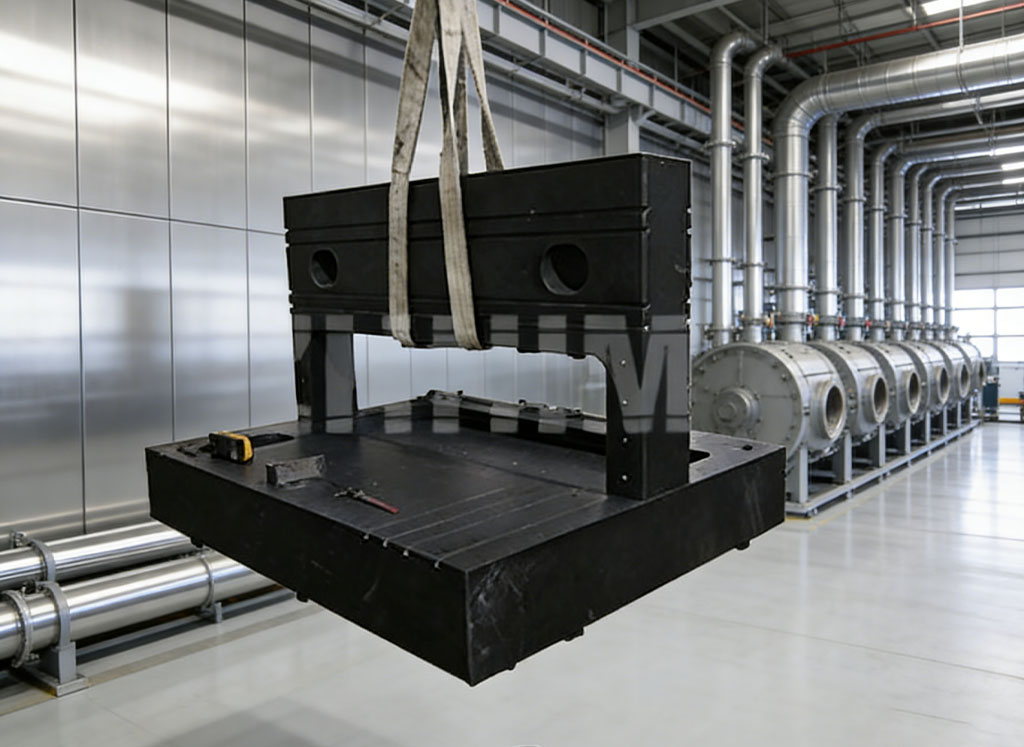
A granite base for battery testing may require embedded inserts, cable routing channels, cooling system interfaces, or integrated sensor mounting features. Cleanroom compatible granite structures may demand specific surface finishes or sealed interfaces to comply with contamination control protocols.
ZHHIMG collaborates with equipment manufacturers during the design stage to ensure structural alignment with system objectives. Finite element considerations, load path analysis, and mounting interface planning are incorporated into project development.
This engineering partnership reduces integration risk and enhances equipment performance from the outset.
Long-Term Performance and Lifecycle Value
In capital-intensive industries, structural longevity directly impacts return on investment. Granite’s resistance to corrosion and internal stress relaxation contributes to long-term dimensional stability.
Unlike certain composite materials, natural granite does not degrade chemically over time. If surface wear occurs, re-lapping can restore flatness without replacing the entire structure. This significantly reduces lifecycle cost.
For battery testing laboratories and cleanroom manufacturing facilities, minimizing downtime is essential. Granite structures support extended operational reliability, reducing recalibration frequency and structural maintenance.
Environmental sustainability considerations further reinforce granite’s value. Its durability reduces material waste, and the absence of chemical coatings simplifies disposal and compliance processes.
Global Market Trends Supporting Granite Adoption
European and North American manufacturers increasingly prioritize structural precision during early-stage equipment design. Rather than retrofitting vibration isolation or compensating for structural instability through software correction, engineers are selecting inherently stable base materials.
The expansion of electric vehicle manufacturing and energy storage research amplifies demand for granite bases tailored to battery testing applications. Simultaneously, semiconductor and microelectronics facilities continue to require cleanroom compatible granite solutions to support advanced fabrication systems.
These parallel industry developments contribute to sustained growth in demand for high-quality natural granite structures.
Looking Ahead
Technological evolution continues to redefine precision requirements. As battery energy density increases and semiconductor nodes shrink, structural tolerances become even more critical.
Granite’s inherent properties—thermal stability, vibration damping, chemical resistance, and long-term dimensional reliability—position it as a foundational material for future high-precision systems.
Discussions comparing epoxy granite vs natural granite will continue, particularly as composite technologies evolve. However, for applications where environmental compatibility and long-term geometric stability are paramount, natural granite maintains clear advantages.
ZHHIMG Group remains committed to refining manufacturing processes, expanding customization capabilities, and supporting global clients in energy storage, cleanroom manufacturing, and advanced metrology sectors.
Conclusion
The growing adoption of cleanroom compatible granite structures and granite bases for battery testing reflects a broader recognition within advanced manufacturing: structural integrity defines measurement integrity.
As industries demand higher precision, lower contamination risk, and extended equipment lifespan, material selection becomes a strategic engineering decision. While composite alternatives offer certain advantages, natural granite continues to provide unmatched stability and environmental reliability.
For manufacturers seeking dependable structural platforms in demanding technological landscapes, granite remains not only relevant but essential.
Post time: Mar-02-2026