
In high-precision manufacturing environments across North America and Europe, dimensional control is no longer a secondary quality check—it is a strategic capability. As industries such as semiconductors, aerospace, advanced optics, and precision robotics push tolerances into the micron and sub-micron range, the stability of the metrology foundation becomes mission-critical. This has led to a growing demand for granite metrology tables with NIST traceable certification and black granite base G682 grade AA flatness 0.002mm specifications.
For manufacturers seeking reliable, vibration-resistant, and thermally stable platforms, precision granite surface plates and metrology tables are increasingly viewed not merely as inspection accessories, but as core infrastructure for measurement assurance.
Granite as a Metrology Foundation in High-Precision Industries
Granite has long been recognized as a superior material for dimensional metrology applications. Unlike steel or cast iron, granite does not rust, exhibits minimal thermal expansion, and offers excellent vibration damping characteristics. In high-end inspection rooms and calibration laboratories, a granite metrology table provides a stable reference plane for coordinate measuring machines (CMMs), optical systems, laser interferometers, and robotic calibration stations.
The material structure of black granite, particularly G682 grade granite, provides a fine and uniform crystalline composition. This homogeneity ensures consistent flatness performance and structural integrity over time. When manufactured to grade AA flatness 0.002mm, the surface deviation is tightly controlled, making it suitable for demanding dimensional inspection tasks.
In modern quality systems, surface plates and metrology tables are no longer generic commodities. They are engineered precision granite bases, often customized for integration with air bearings, linear motion stages, or vacuum fixtures. This shift reflects a broader industry trend: metrology platforms must evolve alongside the equipment they support.
The Importance of NIST Traceable Certification in Global Supply Chains
For manufacturers supplying to aerospace primes, semiconductor fabs, or medical device OEMs, measurement traceability is non-negotiable. A granite metrology table with NIST traceable certification provides documented assurance that flatness calibration aligns with internationally recognized standards.
NIST traceable certification ensures that measurement results can be linked through an unbroken chain of comparisons to national measurement standards. For companies operating under ISO9001 or AS9100 quality systems, this traceability supports audit compliance and strengthens customer confidence.
In practical terms, a NIST traceable granite surface plate is periodically calibrated using certified instruments. The calibration report specifies flatness deviation, measurement uncertainty, environmental conditions, and traceability references. This documentation is essential for regulated industries and high-value manufacturing environments.
As global supply chains become more interconnected, European and North American buyers increasingly require clear evidence of calibration traceability. Therefore, precision granite manufacturers capable of delivering certified documentation gain a competitive advantage.
G682 Black Granite Grade AA Flatness 0.002mm: What Does It Mean Technically?
The specification black granite base G682 grade AA flatness 0.002mm represents a high-precision performance level. G682 granite is known for its dense structure and favorable mechanical properties. When processed under controlled grinding and lapping procedures, it can achieve extremely tight flatness tolerances.
Grade AA flatness 0.002mm indicates that the maximum deviation across the working surface does not exceed two microns. Achieving this tolerance requires advanced grinding technology, controlled temperature environments, and rigorous quality inspection protocols.
Flatness at this level is critical for applications such as:
CMM base platforms
Optical alignment benches
Laser calibration systems
Semiconductor inspection fixtures
Robotic calibration stations
In these contexts, even slight surface deviations can propagate measurement errors. A stable, ultra-flat granite base minimizes systematic error and enhances repeatability.
Thermal Stability and Vibration Damping: Why Granite Outperforms Metal
Dimensional metrology is highly sensitive to environmental fluctuations. Thermal expansion, even at small scales, can distort measurement results. Granite exhibits lower thermal conductivity than metals, meaning it responds more slowly to temperature changes. This property enhances dimensional stability in climate-controlled metrology labs.
Additionally, granite offers superior vibration damping. In facilities with nearby machining centers or production lines, micro-vibrations can influence measurement accuracy. A heavy black granite metrology table absorbs and dissipates vibration energy more effectively than steel structures.
For robotic calibration systems and optical measurement setups, this damping characteristic is especially valuable. Stability at the foundation level translates directly into improved measurement repeatability and reduced uncertainty.
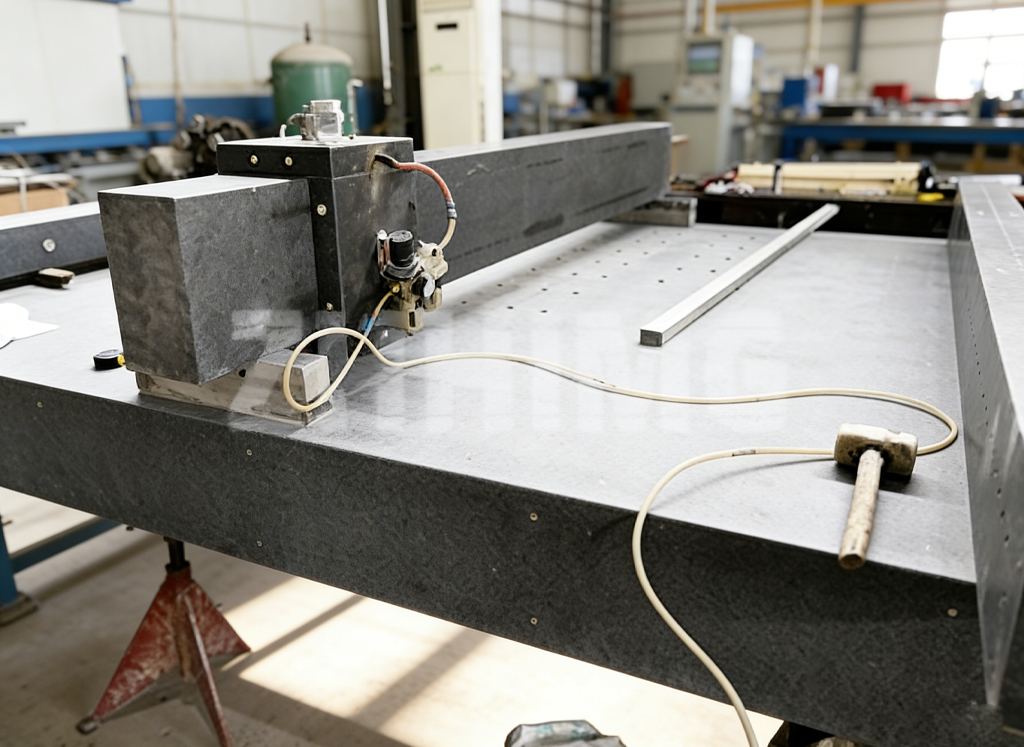
Customization for Integrated Measurement Systems
In today’s precision manufacturing ecosystem, granite metrology tables are rarely standalone products. They are often integrated into automated inspection cells or custom measurement platforms.
Typical customization options include:
Threaded inserts and T-slot configurations
Embedded reference bushings
Air bearing interface surfaces
Vacuum channels and sealing grooves
Mounting interfaces for motion stages
For robotic calibration stations, a granite base must maintain geometric stability while accommodating fixture systems and sensor arrays. The combination of G682 grade AA flatness 0.002mm and NIST traceable certification ensures both mechanical performance and documentation compliance.
This level of integration transforms the granite platform from a passive surface plate into a precision engineering component.
Meeting the Demands of Semiconductor and Advanced Manufacturing Sectors
The semiconductor industry, in particular, demands extreme precision. Wafer inspection systems, lithography alignment tools, and laser metrology devices all rely on stable reference surfaces. A granite metrology table with NIST traceable certification supports process validation and tool calibration within these environments.
Similarly, aerospace component manufacturers depend on certified granite surface plates to verify complex geometries. When tolerances approach a few microns, the flatness integrity of the underlying platform becomes critical.
European and North American OEMs increasingly specify grade AA granite surface plates in procurement documents. The combination of black granite base G682 material and certified calibration has become a benchmark for premium metrology infrastructure.
Quality Assurance and Manufacturing Capabilities
Producing ultra-flat granite metrology tables requires specialized equipment and environmental control. Precision grinding, hand lapping, and laser interferometric inspection are typically employed to achieve sub-micron flatness performance.
Temperature-controlled workshops prevent thermal distortion during processing. After machining and lapping, the granite surface undergoes rigorous inspection. Calibration data is recorded, verified, and compiled into a traceable certification report.
For customers in regulated industries, documentation quality is as important as physical performance. A complete package typically includes:
Flatness mapping results
Measurement uncertainty analysis
Environmental calibration data
Traceability references
These elements reinforce the credibility of the metrology solution.
Why Precision Granite Remains Relevant in the Age of Advanced Materials
With the rise of engineered composites and mineral castings, some may question whether natural granite remains the optimal choice. However, granite continues to demonstrate unmatched dimensional stability and long-term reliability.
Unlike certain synthetic materials, granite does not creep under sustained load. It maintains structural integrity over decades when properly supported. For metrology laboratories seeking long-term investment stability, a precision granite surface plate remains a dependable foundation.
Moreover, the natural vibration damping characteristics of granite are difficult to replicate economically with alternative materials.
Supporting International Quality Standards and Industry Certifications
Manufacturers operating under ISO quality systems require metrology equipment that aligns with audit expectations. A granite metrology table with NIST traceable certification simplifies compliance by providing verifiable documentation.
In cross-border collaborations, traceability reduces disputes related to dimensional validation. It establishes a common reference framework, especially when components are inspected in different facilities across continents.
As regulatory scrutiny intensifies in sectors such as aerospace, medical devices, and semiconductor manufacturing, traceable measurement infrastructure is no longer optional. It is a prerequisite for participation in global supply networks.
A Strategic Investment in Measurement Integrity
The growing interest in black granite base G682 grade AA flatness 0.002mm solutions reflects a broader shift in manufacturing philosophy. Precision is not merely a quality control function; it is a strategic enabler of innovation.
Advanced robotics, laser systems, and high-resolution inspection technologies all depend on stable physical references. A high-performance granite metrology table provides that foundation.
For organizations aiming to enhance measurement repeatability, reduce uncertainty, and maintain international compliance, investing in certified precision granite platforms is a forward-looking decision.
As industries continue to demand tighter tolerances and higher reliability, the question is no longer whether to use granite. Instead, it becomes whether your metrology infrastructure meets the highest standards of flatness, traceability, and long-term stability.
In that context, granite metrology tables with NIST traceable certification and G682 grade AA flatness 0.002mm are not simply products—they represent a commitment to measurement excellence.
Post time: Feb-27-2026