
The rapid expansion of the electric vehicle industry has redefined manufacturing precision standards. EV motors demand micron-level calibration accuracy to ensure efficiency and durability, while battery systems require rigorous dimensional and structural inspection to meet safety regulations. In both domains, structural stability is no longer a background variable—it is a measurable contributor to product performance.
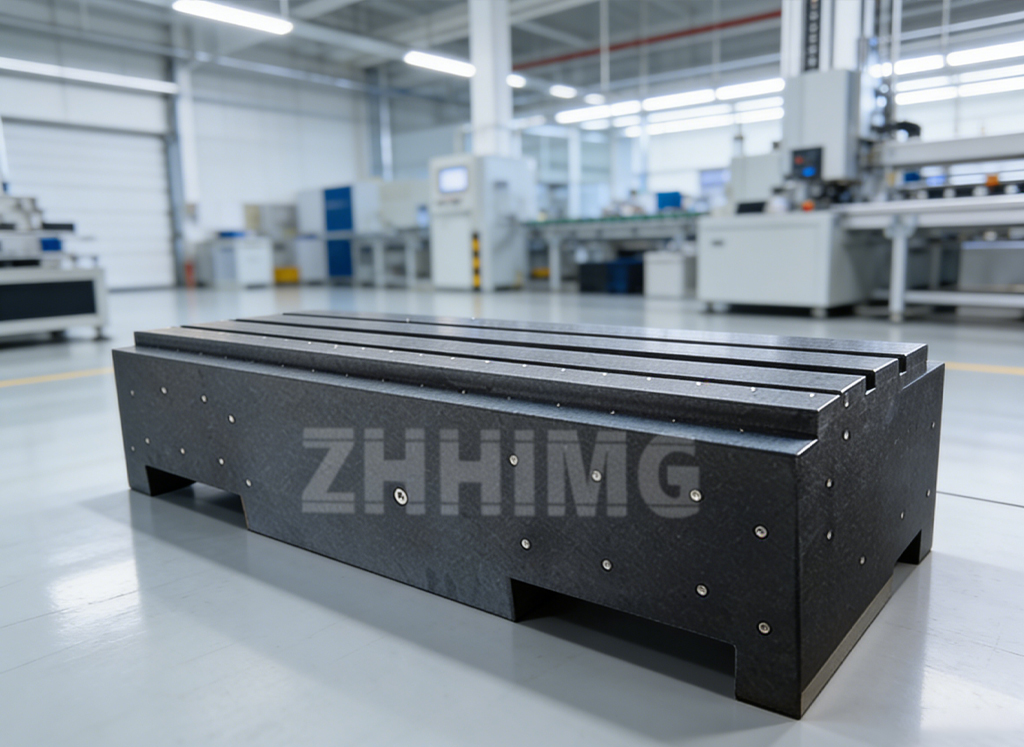
Across North America and Europe, manufacturers are increasingly specifying precision granite base for EV motor calibration systems and granite inspection table for battery quality control applications. This development reflects a broader transformation: EV production is evolving into an ultra-precision engineering environment where metrology-grade foundations are integrated directly into industrial workflows.
Structural Demands in EV Motor Calibration
Electric vehicle motors rely on precise rotor-stator alignment, balanced magnetic gaps, and optimized rotational geometry. Calibration processes frequently involve laser measurement, coordinate metrology systems, torque verification equipment, and high-speed balancing devices.
Any instability in the supporting platform can introduce:
Misalignment in encoder positioning
Inconsistent air-gap measurements
Vibration-induced measurement noise
Drift during thermal testing cycles
Traditional welded steel frames may deform slightly under load or transmit vibration from nearby equipment. Even minimal deflection can compromise calibration repeatability.
A precision granite base for EV motor calibration offers a fundamentally different mechanical behavior. Granite’s high compressive strength, natural internal damping, and low thermal expansion coefficient provide a stable reference structure that resists geometric drift.
As calibration tolerances tighten in next-generation high-efficiency motors, platform precision becomes inseparable from system accuracy.
Granite Inspection Tables in Battery Quality Control
Battery manufacturing includes multiple inspection stages: cell dimension verification, module alignment checks, enclosure flatness measurement, and end-of-line quality assessment.
Granite inspection tables for battery quality control serve as metrology-grade reference surfaces for:
Coordinate measuring systems
Laser scanning devices
Dial indicator and gauge measurements
Visual inspection under controlled geometry
Flatness, parallelism, and long-term dimensional stability are essential. Steel surfaces can warp over time due to internal stress or thermal fluctuation. Granite, by contrast, is naturally aged and highly resistant to deformation.
In high-volume battery production, consistent inspection geometry reduces measurement variability and strengthens traceability across batches. As safety regulations become stricter worldwide, inspection accuracy directly influences compliance and brand reputation.
Search behavior in Western markets shows rising queries for “granite table for EV inspection,” “precision granite motor calibration base,” and “granite metrology table battery manufacturing,” indicating a shift toward structural optimization.
Thermal Stability and Vibration Control
EV motor calibration often involves temperature cycling to simulate real-world operating conditions. Thermal expansion can subtly alter alignment references if the base material is sensitive to heat variation.
Granite offers:
Low thermal expansion coefficient
Uniform material structure
Resistance to localized heat distortion
Superior vibration damping compared to metal
In automated battery inspection environments, vibration from conveyors, robotic arms, and cooling systems can affect sensitive measurement instruments. Granite’s mass and crystalline structure absorb rather than transmit these disturbances.
By integrating precision granite structures into both calibration and inspection stations, manufacturers achieve a stable metrological baseline throughout production cycles.
Custom Engineering for EV Manufacturing Systems
Every EV production facility has distinct process flows and equipment configurations. ZHHIMG works closely with automation integrators and OEM manufacturers to design granite platforms tailored to specific applications.
For EV motor calibration bases, customization may include:
Threaded inserts for torque benches
Precision-ground mounting interfaces
Integrated cable routing channels
Reinforced thickness for heavy rotational loads
For battery inspection tables, configurations often require:
High-grade flatness surfaces
Fine surface finishing to meet metrology standards
Edge chamfering for operator safety
Compatibility with coordinate measuring machines
Our high-density black granite, processed in temperature-controlled facilities, ensures superior mechanical performance. Precision grinding and lapping operations achieve flatness levels consistent with international metrology classifications.
In addition, ZHHIMG’s integrated capabilities in ceramic components, mineral casting, and precision metal machining allow hybrid solutions for complex EV manufacturing environments.
Case Insight: Motor Calibration Stability Upgrade
A European EV motor manufacturer recently replaced a fabricated steel base in its calibration station with a precision granite platform.
Before the upgrade, minor vibration from adjacent assembly equipment contributed to measurement noise during high-speed rotor balancing.
After installing the granite base, the company reported:
Improved repeatability in torque calibration
Reduced vibration interference
More consistent encoder alignment results
Lower recalibration frequency
The structural stability of the granite foundation provided a consistent mechanical reference, enhancing overall process reliability.
Case Insight: Enhancing Battery Inspection Accuracy
In North America, a battery module producer integrated granite inspection tables into its end-of-line quality control system.
The goal was to improve dimensional verification of module casings and cell arrays.
Following implementation, measurable benefits included:
Greater consistency in flatness measurement
Reduced dimensional deviation variability
Improved correlation between inspection stations
Enhanced compliance documentation reliability
These improvements reinforced quality assurance processes and reduced downstream warranty risks.
Manufacturing Discipline and Quality Assurance
Precision granite production requires strict process management to meet EV industry standards.
ZHHIMG’s production workflow includes:
Temperature-controlled grinding and lapping
High-accuracy CNC machining for inserts and interfaces
Laser interferometry flatness verification
Surface roughness measurement
Quality management under ISO9001, ISO14001, and ISO45001 standards
This level of manufacturing discipline ensures that each granite base or inspection table meets stringent geometric and performance requirements.
Industry Outlook: Precision Infrastructure for Electrification
The electrification of transportation is accelerating, and competition in EV markets is intensifying. Manufacturers are under pressure to deliver higher efficiency motors and safer battery systems while maintaining cost competitiveness.
Precision infrastructure—including calibration and inspection platforms—plays a direct role in achieving these objectives.
Granite structures, once primarily associated with metrology laboratories, are now becoming integral components of advanced manufacturing lines. As motor efficiency targets rise and battery safety standards tighten, stable mechanical references will remain critical.
Growing search interest in “precision granite base for EV motor calibration” and “granite inspection table for battery quality control” reflects this industrial transition toward structural precision.
Conclusion: Engineering Stability for the Electric Future
In EV production, accuracy is cumulative. Motor calibration precision influences performance and efficiency, while battery inspection reliability safeguards safety and compliance.
By integrating precision granite bases into motor calibration systems and granite inspection tables into battery quality control processes, manufacturers establish a stable mechanical foundation for consistent results.
As the global shift toward electric mobility continues, the infrastructure supporting production must meet the same high standards as the vehicles themselves. In this evolving landscape, structural stability is not an accessory—it is a competitive advantage built from the ground up.
Post time: Mar-04-2026