
Precision granite platforms have become an essential foundation in ultra-precision manufacturing, serving as machine bases, measurement surfaces, and assembly platforms for high-end industrial equipment. Their unmatched stability, flatness, and vibration-damping characteristics make them indispensable in semiconductor production, optical inspection, coordinate measuring machines, and laser systems. However, a common concern among engineers and facility managers is whether these granite platforms are resistant to chemical corrosion and if exposure to acids, alkalis, or other reagents can compromise their precision over time.
Granite is a naturally hard and dense material composed mainly of quartz, feldspar, and mica. Its chemical composition makes it highly resistant to most acids and bases under normal laboratory or industrial conditions. Unlike metals, which can corrode or oxidize, granite does not undergo significant chemical reactions when exposed to common industrial chemicals. ZHHIMG® Black Granite, for instance, combines high density (~3100 kg/m³) with uniform mineral distribution, providing superior chemical stability compared to standard granite varieties. This inherent resistance ensures that platforms maintain their flatness and dimensional stability even when used in environments where occasional exposure to reagents may occur.
Despite granite’s natural resistance, prolonged or concentrated exposure to strong acids or alkalis can etch the surface over time. In precision applications, even minimal surface degradation could affect the flatness or introduce micro-level deviations, which are critical in nanometer-level measurement or alignment tasks. To address this, leading manufacturers implement protective protocols. ZHHIMG, for example, advises users to avoid direct contact with aggressive chemicals and recommends immediate cleaning if accidental spillage occurs. By combining careful handling with the granite’s intrinsic chemical resistance, the platforms can maintain their accuracy for decades.
The impact of chemical reagents on precision is not limited to surface degradation. Granite platforms often serve as reference surfaces for high-precision measuring instruments, such as coordinate measuring machines or optical inspection devices. Any change in surface topography can introduce measurement errors or misalignment during equipment calibration. This is why ZHHIMG applies rigorous finishing techniques, including ultra-fine grinding and hand lapping, to create surfaces with nanometer-level flatness. Even if minor chemical exposure occurs, the resilient nature of high-quality ZHHIMG® granite ensures that the platform retains its dimensional integrity and continues to provide a stable reference for critical instruments.
Moreover, ZHHIMG’s production facilities incorporate temperature- and humidity-controlled environments, vibration-isolated floors, and climate-regulated storage areas. These measures protect granite components from environmental factors that could exacerbate chemical effects, such as moisture absorption or thermal expansion, which might otherwise amplify surface changes. In combination with continuous metrology checks using devices such as Renishaw laser interferometers, WYLER electronic levels, and high-precision roughness testers, the company guarantees that each precision granite platform meets exacting standards for stability and chemical resistance.
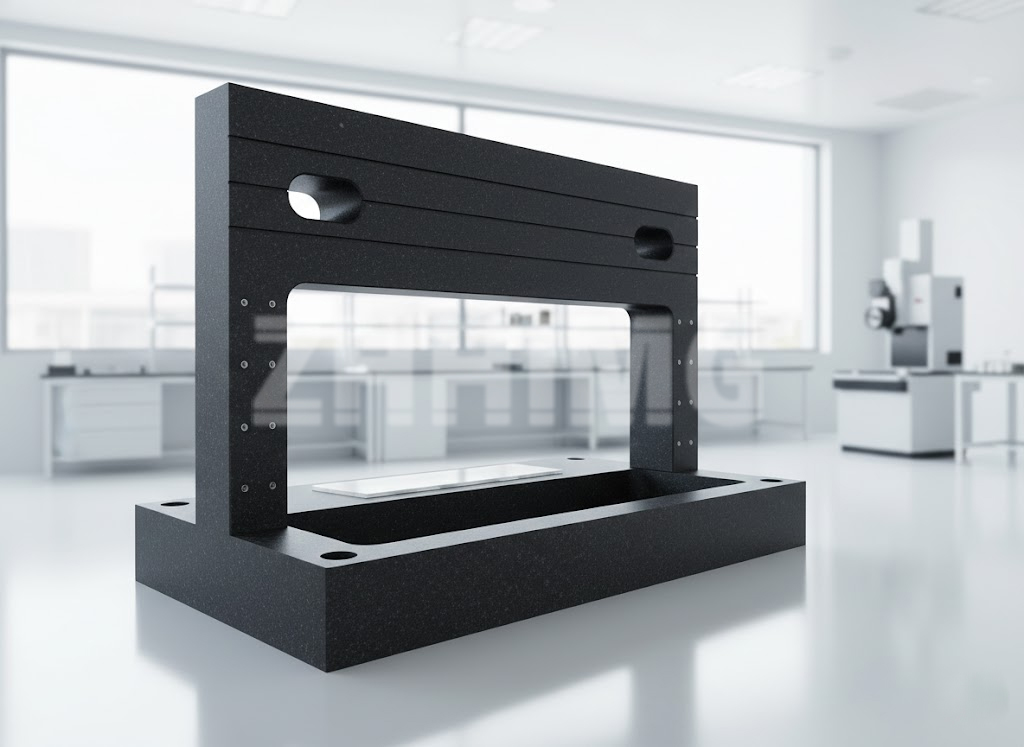
For industrial users, the takeaway is clear: while precision granite platforms are inherently resistant to most chemical agents, their longevity and accuracy depend on material quality, handling, and environment. ZHHIMG’s choice of high-density black granite, coupled with advanced processing and strict quality control, ensures that platforms can withstand incidental chemical exposure without compromising performance. This reliability has made ZHHIMG a preferred supplier for Fortune 500 companies, precision metrology labs, semiconductor manufacturers, and optical equipment producers worldwide.
Ultimately, precision granite’s resilience against acids, alkalis, and other reagents reinforces its role as the backbone of ultra-precision manufacturing. By understanding the material properties, following best handling practices, and relying on expertly engineered platforms from ZHHIMG, industries can maintain the highest standards of accuracy, stability, and reliability even in challenging chemical environments.
Post time: Dec-11-2025