
In precision metrology, symmetry isn’t just a design aesthetic—it’s a functional imperative. The Bilateral Measuring Machine stands as one of the most sophisticated solutions for high-throughput, high-accuracy inspection of symmetrical or paired components: brake discs, flanges, turbine blades, transmission housings, and more. Yet too often, users focus solely on probe resolution or software algorithms while overlooking a silent but decisive factor: the integrity of the machine’s physical architecture—especially its base and core structural elements.
At ZHHIMG, we’ve spent over two decades refining not just how bilateral measurement systems think, but how they stand. Because no matter how advanced your sensors are, if your Bilateral Measuring Machine Base lacks rigidity, thermal neutrality, or geometric fidelity, your data will carry hidden biases that compromise repeatability, traceability, and ultimately, trust.
Unlike conventional coordinate measuring machines (CMMs) that scan from a single axis, a true Bilateral Measuring Machine captures dimensional data simultaneously from both sides of a part. This dual-axis approach slashes cycle time and eliminates errors caused by repositioning—but only if both probing arms share a common, unshifting reference plane. That’s where the base becomes mission-critical. A warped cast-iron frame or a poorly stress-relieved steel weldment may appear stable at first glance, but under daily thermal cycling or floor vibrations, it introduces micro-deflections that skew bilateral comparisons. In aerospace or medical manufacturing, where tolerances dip below 5 microns, such deviations are unacceptable.
This is why every ZHHIMG Bilateral Measuring Machine is anchored to a monolithic foundation engineered for metrological truth. Our bases aren’t bolted assemblies—they’re integrated structures where every element, from support columns to guide rails, is harmonized with the central datum. And increasingly, that datum is granite—not as an afterthought, but as a deliberate choice rooted in physics.
Granite’s near-zero coefficient of thermal expansion (typically 7–9 × 10⁻⁶ /°C) makes it uniquely suited for environments where ambient temperature fluctuates by even a few degrees. More importantly, its isotropic damping properties absorb high-frequency vibrations far more effectively than metal. When paired with our proprietary mounting system, this ensures that both left and right measurement carriages operate in perfect mechanical synchrony—critical for evaluating parallelism, concentricity, or face runout across large workpieces.
But the story doesn’t end with the base. True performance emerges from the synergy of all Bilateral Measuring Machine components. At ZHHIMG, we design these components as a unified ecosystem—not as off-the-shelf add-ons. Our linear guides, air bearings, encoder scales, and probe mounts are all calibrated relative to the same granite reference surface during final assembly. This eliminates cumulative stack-up errors that plague modular systems sourced from multiple vendors. Even the electrical grounding scheme is optimized to prevent electromagnetic interference from distorting analog probe signals—a subtle but real issue in modern factories filled with servo drives and welding robots.
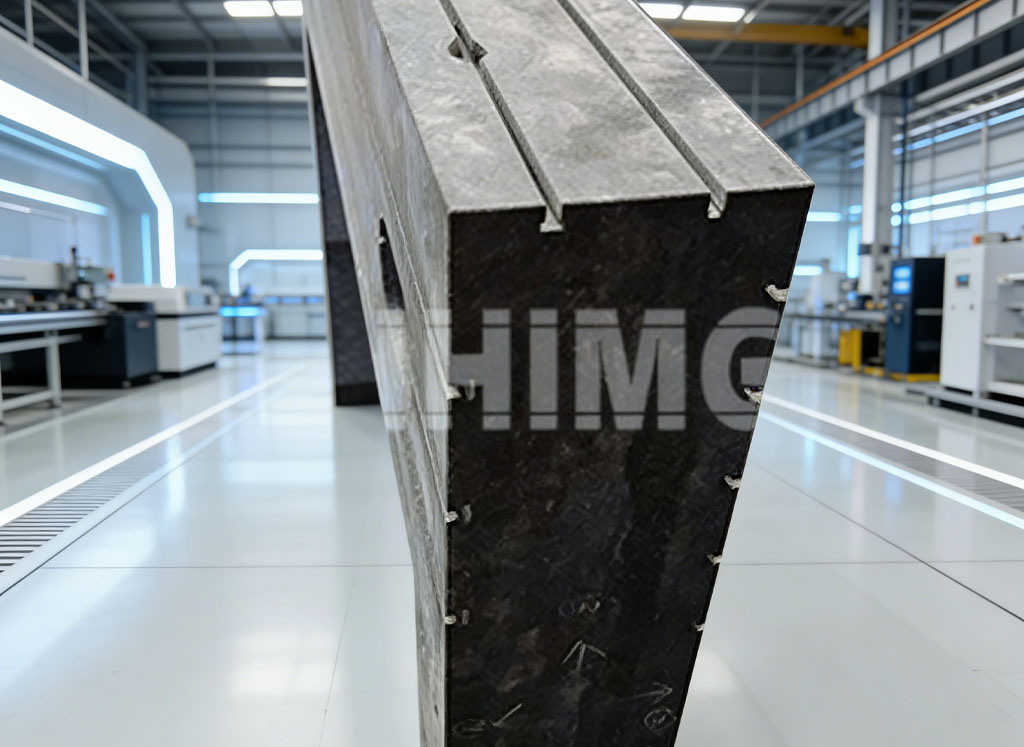
One of our recent innovations involves embedding metrology-grade granite directly into key structural nodes. These Bilateral Measuring Machine granite components—such as granite crossbeams, granite probe nests, and even granite-mounted optical encoders—extend the thermal stability of the base upward into the moving architecture. For example, in our HM-BL8 series, the Y-axis bridge itself incorporates a granite core wrapped in lightweight composite sheathing. This hybrid design retains the stiffness and damping of stone while reducing mass for faster acceleration—without sacrificing accuracy.
Clients often ask: “Why not use ceramic or polymer composites?” While those materials have niche applications, none match granite’s combination of long-term stability, machinability, and cost-effectiveness at scale. Moreover, natural granite ages gracefully. Unlike resins that creep under load or metals that fatigue, a properly supported granite structure can maintain its form for decades—our earliest installations from the early 2000s still meet original flatness specs with zero maintenance.
We take pride in transparency. Every Bilateral Measuring Machine we ship includes a full metrology report detailing base flatness (typically ≤3 µm over 2.5 m), vibration response curves, and thermal drift characteristics under ISO 10360-2 protocols. We don’t hide behind “typical” performance claims—we publish actual test data so engineers can validate suitability for their specific use case.
This rigor has earned us partnerships with tier-one suppliers in automotive, renewable energy, and defense sectors. One European EV manufacturer recently replaced three legacy CMMs with a single ZHHIMG bilateral system for inspecting motor stator housings. By leveraging simultaneous dual-side probing on a thermally inert granite base, they cut inspection time by 62% while improving Gage R&R from 18% to under 6%. Their quality manager put it simply: “The machine doesn’t just measure parts—it measures truth.”
Of course, hardware alone isn’t enough. That’s why our systems come with intuitive software that visualizes bilateral deviations in real time—highlighting asymmetries in color-coded 3D overlays so operators can spot trends before they become failures. But even the smartest software needs a trustworthy foundation. And that begins with a base that doesn’t lie.
So as you evaluate your next metrology investment, consider this: a Bilateral Measuring Machine is only as honest as its foundation. If your current system relies on a welded steel frame or a composite bed, you may be paying for resolution you never actually achieve. At ZHHIMG, we believe precision should be inherent—not compensated for.
Visit www.zhhimg.com to see how our integrated approach to Bilateral Measuring Machine components, anchored by purpose-built bases and enhanced with strategic granite components, is redefining what’s possible in industrial metrology. Because when symmetry matters, compromise doesn’t.
Post time: Jan-05-2026