
In precision manufacturing, aerospace assembly, and high-end tool and die shops across Europe and North America, there’s a quiet but critical truth that seasoned metrologists live by: no matter how advanced your instruments are, your measurements are only as reliable as the surface they’re referenced against. And when it comes to foundational accuracy, nothing—not cast iron, not steel, not composite—matches the enduring stability of a granite inspection surface plate. Yet despite its pivotal role, this essential artifact is often treated as a passive workbench rather than the active metrology standard it truly is.
The consequences of that oversight can be subtle but costly. A machinist aligns a complex fixture using height gauges on a worn or uncertified plate. An inspector verifies flatness of a sealing surface with a dial indicator mounted on a warped base. A quality engineer approves a batch based on CMM data that was never validated against a known reference plane. In each case, the tools may be functioning perfectly—but the foundation beneath them is compromised. That’s why understanding the capabilities, limitations, and proper use of your granite inspection surface plate, especially when working with large granite surface plate systems, is not just good practice—it’s a necessity for maintaining traceable, defensible quality.
Granite has been the material of choice for precision reference surfaces since the mid-20th century, and for compelling scientific reasons. Its dense, fine-grained crystalline structure offers exceptional rigidity, minimal thermal expansion (typically 6–8 µm/m·°C), and natural vibration damping—all critical for repeatable measurements. Unlike metal plates, which corrode, retain stress, and expand noticeably with ambient temperature shifts, granite remains dimensionally stable under normal workshop conditions. This is why standards like ASME B89.3.7 and ISO 8512-2 specify granite—not as a preference, but as the baseline requirement—for Grade 00 through Grade 1 surface plates used in calibration and inspection.
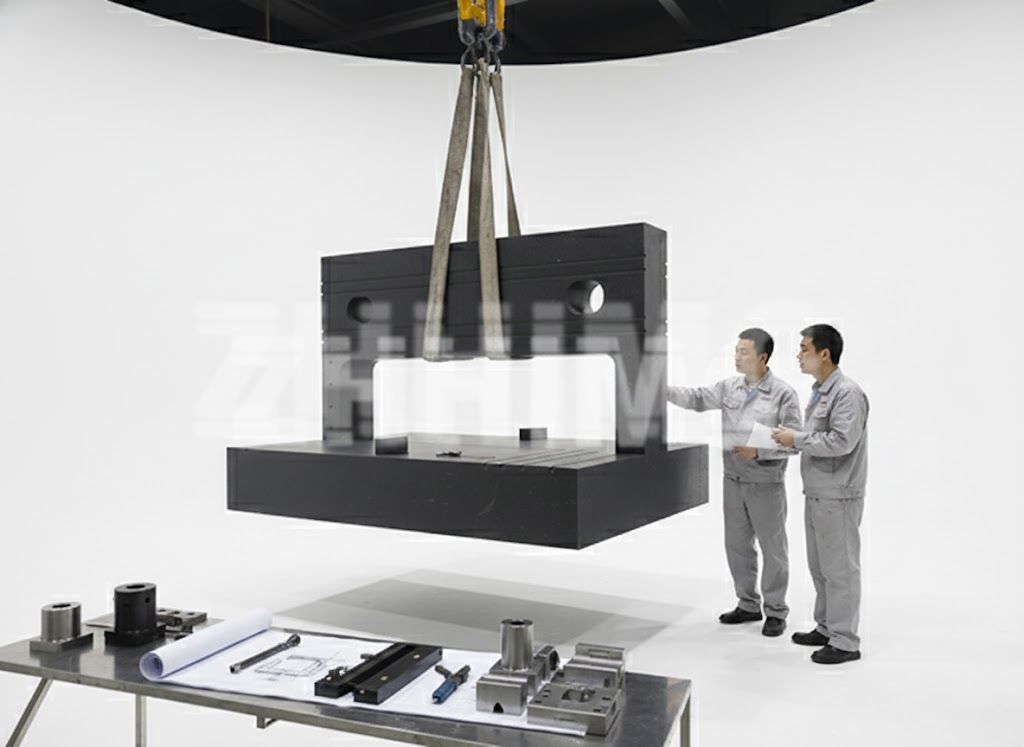
But size introduces new challenges. A large granite surface plate—say, 2000 x 1000 mm or larger—isn’t just a scaled-up version of a benchtop plate. Its weight (often exceeding 800 kg) demands precise support geometry to prevent sagging. Thermal gradients across its mass can create micro-curvatures if not acclimated properly. And because flatness tolerances scale with size (e.g., ±13 µm for a 2000 x 1000 mm Grade 0 plate per ISO 8512-2), even minor deviations become significant over long distances. This is where craftsmanship meets engineering: true large-format granite plates are not simply cut and polished—they are stress-relieved for months, hand-lapped over weeks, and validated using laser interferometers or electronic levels at hundreds of points across the surface.
Equally important is how these plates integrate with surface plate measuring tools. Height gauges, dial test indicators, sine bars, precision squares, gage blocks, and optical comparators all assume the underlying surface is a perfect plane. If it isn’t, every reading inherits that error. For example, when using a digital height gauge to measure step heights on an engine block, a 10-micron dip in the plate translates directly into a 10-micron error in your reported dimension—even if the gauge itself is perfectly calibrated. That’s why top-tier labs don’t just own a granite plate; they treat it as a living standard, scheduling regular recalibrations, controlling environmental exposure, and documenting every use.
At ZHHIMG, we’ve seen firsthand how a shift to a certified granite inspection surface plate transforms quality outcomes. One European mold-maker replaced their aging cast iron table with a 1500 x 1000 mm Grade 0 granite plate and saw inter-operator measurement variation drop by 40%. Their tools hadn’t changed—but their reference had. Another client in the medical device sector passed a stringent FDA audit only after providing full calibration certificates for their large granite surface plate, proving traceability to national standards. These aren’t isolated wins; they’re predictable results when you anchor your metrology in physical truth.
It’s also worth dispelling a common myth: that granite is fragile. While it can chip if struck sharply with hardened steel, it’s remarkably durable under normal use. It doesn’t rust, doesn’t require oiling, and won’t warp from humidity or moderate temperature swings. With basic care—regular cleaning with isopropyl alcohol, avoiding direct impacts, and proper support—a high-quality granite plate can last 30 years or more. Many plates installed in the 1970s are still in daily service today, their flatness unchanged.
When selecting a granite inspection surface plate, look beyond aesthetics. Verify the grade (Grade 00 for calibration labs, Grade 0 for high-precision inspection), confirm the certification includes a flatness map (not just a pass/fail stamp), and ensure the supplier provides guidance on setup, handling, and recalibration intervals. For large granite surface plate installations, ask about custom stands with adjustable leveling feet and vibration isolation—critical for maintaining accuracy in production environments.
And remember: your surface plate measuring tools are only as honest as the surface they sit on. A 10,000heightgaugeonawarpedtableisnomoreaccuratethana100 one on a certified granite plate. Precision isn’t about the most expensive instrument—it’s about the most trustworthy reference.
At ZHHIMG, we partner with master workshops that blend artisanal lapping techniques with modern metrology validation. Every plate we supply is individually tested, serialized, and accompanied by a full NIST-traceable certificate. We don’t believe in “close enough.” In metrology, there is no such thing.
So ask yourself: when your most critical part passes final inspection, do you trust the number—or question the surface beneath it? The answer could determine whether your next audit is a success or a setback. Because in the world of precision, integrity starts from the ground up. And at ZHHIMG, we’re committed to making sure that ground is solid, stable, and scientifically sound.
Post time: Dec-09-2025