
In advanced manufacturing and metrology, performance begins at the foundation. As industries across Europe and North America push toward tighter tolerances, higher speeds, and more sensitive measurement technologies, the structural platform beneath the system has become a decisive engineering factor. ZHHIMG Group is strengthening its capabilities in stable granite structures, non-magnetic granite components, vibration-free base systems, and engineered granite foundation solutions designed to support next-generation automation and precision equipment.
Across semiconductor fabrication, photonics research, aerospace inspection, and laboratory metrology, equipment designers are re-evaluating how structural materials influence accuracy, repeatability, and long-term reliability. Granite, long valued for its dimensional stability, is now widely recognized as a high-performance structural material capable of meeting these evolving demands.
The Engineering Value of Stable Granite in Precision Systems
Stable granite is not simply natural stone shaped into a slab. In high-precision environments, stability refers to the material’s ability to maintain geometry under mechanical load, thermal variation, and dynamic excitation over extended operational periods.
Compared with welded steel frames or cast iron bases, granite exhibits several performance advantages. Its low coefficient of thermal expansion reduces dimensional drift caused by temperature fluctuations. Its high compressive strength supports heavy mechanical assemblies without plastic deformation. Most importantly, granite provides exceptional internal damping, absorbing vibrational energy rather than transmitting or amplifying it.
For manufacturers operating in climate-controlled facilities yet facing localized thermal gradients from motors, spindles, or laser systems, this stability directly affects system calibration intervals and measurement reliability. ZHHIMG’s engineered granite foundation solutions are developed with these realities in mind, ensuring that structural stability is preserved under real-world operating conditions.
Non-Magnetic Granite for Sensitive Applications
Modern precision equipment increasingly incorporates sensors, interferometers, optical encoders, and electromagnetic actuators. In such systems, stray magnetic fields can introduce measurement distortion or interfere with signal integrity. Non-magnetic granite provides a neutral structural environment that minimizes these risks.
Unlike ferrous materials, granite contains no magnetic domains. This property makes it particularly suitable for coordinate measuring machines, electron microscopy platforms, semiconductor wafer inspection systems, and optical alignment stages. When paired with air-bearing assemblies or linear motor drives, non-magnetic granite structures help maintain consistent system behavior.
ZHHIMG carefully selects raw granite blocks with homogeneous mineral composition to ensure predictable mechanical and thermal performance. Through controlled machining and precision grinding, each granite component retains its intrinsic non-magnetic properties while achieving tight geometric tolerances.
As OEMs in Western markets refine high-sensitivity equipment, non-magnetic granite is increasingly specified in procurement documentation as a functional requirement rather than an optional feature.
Vibration-Free Base Solutions for Dynamic Equipment
High-speed automation, precision machining, and metrology processes all generate mechanical vibration. If not properly controlled, these vibrations can degrade positioning accuracy, introduce surface finish defects, or compromise measurement repeatability.
A vibration-free base does not imply the complete elimination of motion; rather, it refers to a structural platform engineered to attenuate and dissipate vibrational energy effectively. Granite’s crystalline structure naturally dampens high-frequency oscillations, reducing resonance effects common in metallic frames.
ZHHIMG designs vibration-free base systems tailored to the load distribution and motion characteristics of customer equipment. By optimizing mass, thickness, and support geometry, engineers can influence natural frequency behavior and reduce susceptibility to excitation from motors or environmental sources.
In semiconductor manufacturing environments, where nanometer-scale alignment matters, vibration control at the base level can significantly improve yield and process consistency. Similarly, in optical laboratories, vibration isolation contributes to stable interferometric measurements and accurate calibration results.
Granite Foundation Engineering for Heavy and Precision Loads
Granite foundation structures extend beyond surface plates and inspection tables. They form the core structural backbone of advanced machinery, supporting multi-axis motion systems, gantry assemblies, and integrated automation platforms.
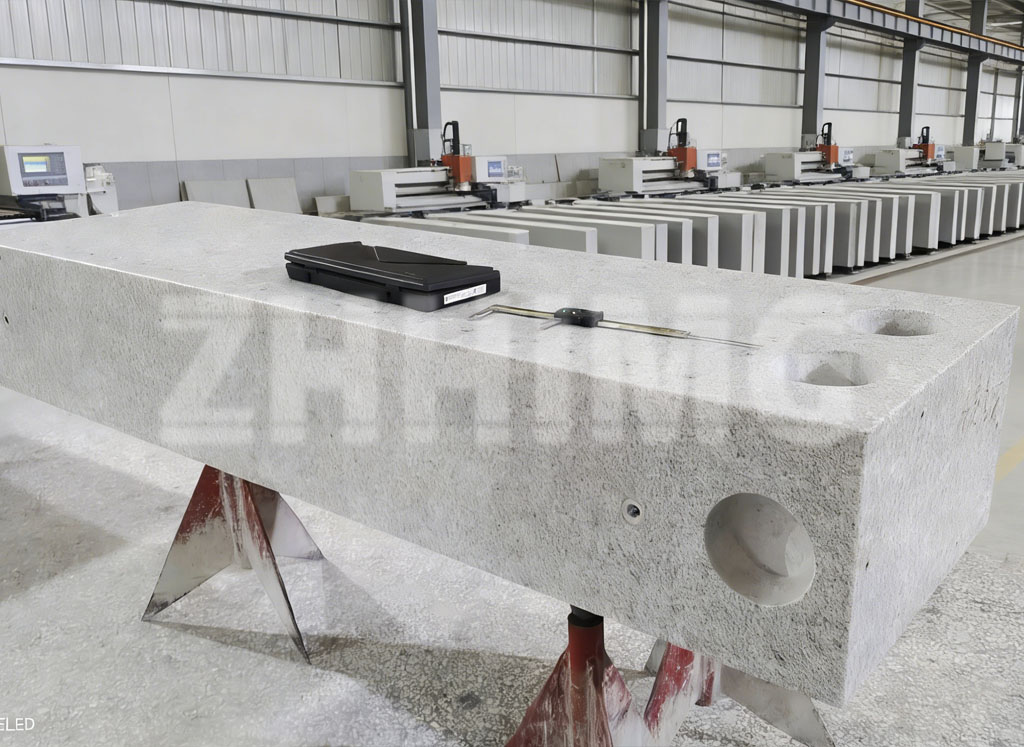
Designing a granite foundation requires careful consideration of load paths, stress distribution, and long-term creep resistance. ZHHIMG employs a systematic engineering approach that integrates CAD modeling, mechanical analysis, and dimensional verification throughout the production cycle.
Raw granite blocks undergo stabilization processes before machining. CNC equipment defines mounting interfaces, embedded inserts, and precision datum surfaces. Grinding and lapping operations then refine flatness and parallelism to meet stringent specifications.
In many applications, granite foundations incorporate steel bushings or threaded inserts for secure mechanical fastening. Hybrid assemblies combine the damping advantages of granite with the fastening flexibility of metallic components. Each insert is positioned with micron-level accuracy to align with customer-specified tolerance schemes.
The result is a granite foundation capable of supporting both heavy static loads and dynamic operational forces without compromising geometric stability.
Meeting Western Market Expectations
Customers in Europe and North America typically evaluate suppliers based on technical capability, documentation transparency, and quality assurance rigor. ZHHIMG has aligned its manufacturing and inspection processes with these expectations.
Production workshops operate under environmental control to minimize dimensional variability during machining and calibration. Laser interferometry, electronic levels, and precision measurement instruments verify geometry before shipment. Dimensional reports and inspection certificates accompany each project, supporting compliance with international standards.
Traceability and repeatability are central to long-term partnerships. By maintaining consistent raw material selection criteria and standardized processing workflows, ZHHIMG ensures that each stable granite or vibration-free base component meets defined performance benchmarks.
Industry Applications Driving Demand
Growth in semiconductor equipment manufacturing has intensified demand for granite foundation systems capable of supporting wafer handling robots, lithography alignment modules, and inspection platforms. As device geometries shrink, structural precision becomes increasingly critical.
In aerospace and automotive industries, advanced measurement systems rely on stable granite structures to verify dimensional conformity of complex components. Calibration laboratories depend on non-magnetic granite bases to provide neutral reference environments for high-accuracy instruments.
Research institutions and photonics laboratories require granite stage assemblies and vibration-free bases to support laser alignment and optical experimentation. Across these sectors, the performance characteristics of granite align closely with operational needs.
ZHHIMG’s engineering team works collaboratively with customers during early design stages, helping define structural geometry and insert placement to match application-specific requirements. This partnership approach enhances integration efficiency and reduces redesign cycles.
Sustainability and Longevity Considerations
Granite’s durability contributes to long service life. Unlike coated steel frames that may corrode or require refinishing, granite maintains structural integrity without protective treatments. Its resistance to chemical exposure makes it suitable for laboratory and industrial environments where coolants or cleaning agents are present.
Long lifecycle performance reduces replacement frequency and lowers overall material consumption. For manufacturers incorporating environmental considerations into procurement decisions, granite foundation systems provide both performance and durability advantages.
ZHHIMG emphasizes responsible sourcing and efficient material utilization, reinforcing its commitment to sustainable manufacturing practices.
Advancing Structural Precision for the Future
As automation systems evolve toward higher speed and greater sensitivity, the importance of structural design will continue to grow. Stable granite, non-magnetic granite, vibration-free base systems, and engineered granite foundation solutions represent a convergence of material science and precision engineering.
ZHHIMG’s continued investment in machining technology, inspection infrastructure, and engineering expertise positions the company to support this progression. By delivering granite structures tailored to advanced industrial and laboratory applications, ZHHIMG contributes to improved accuracy, reduced vibration, and long-term dimensional reliability.
In precision manufacturing, performance is cumulative. Every micron of stability preserved at the foundation level supports accuracy at the tool tip, sensor head, or measurement probe. Through refined granite engineering and disciplined quality control, ZHHIMG reinforces the structural integrity upon which high-performance systems depend.
For organizations designing next-generation equipment, structural stability is not an afterthought—it is a strategic requirement. Granite foundation solutions engineered for stability and vibration control provide a robust starting point for innovation in robotics, semiconductor manufacturing, metrology, and beyond.
Post time: Feb-13-2026