
In the contemporary landscape of industrial automation, the difference between a high-performing system and a frequent source of downtime often rests on the physical foundation of the machine itself. As manufacturing processes in Europe and North America pivot toward nanometer-scale precision, the structural integrity of the base becomes a critical variable. Engineers are increasingly finding that while software and sensors can compensate for many errors, they cannot fully fix a fundamental lack of mechanical stability. This realization has brought a renewed focus on the High-Precision Base – ±0.001mm Flatness Tolerance as the ultimate starting point for any high-stakes assembly project.
At ZHHIMG, we have observed that the most successful automation integrators prioritize the selection of materials that offer not just strength, but an almost transcendental level of dimensional stability. When dealing with a Granite Structure for Automation & Assembly, the stone is not merely a weight; it is a passive dampener and a thermally inert platform that ensures the mechanical “zero point” remains absolute throughout years of operation.
The Engineering Reality of Sub-Micron Flatness
Achieving a flatness tolerance of ±0.001mm is a feat that moves beyond standard machining into the realm of metrology. This level of precision is essential for applications involving air-bearing stages or high-speed robotic pick-and-place systems. In an air-bearing system, the film of air is typically only a few microns thick. If the granite base deviates even slightly beyond its specified tolerance, the air film can fail, leading to catastrophic mechanical contact.
To maintain such a High-Precision Base, the material must possess a uniform mineral structure. ZHHIMG utilizes premium Black Jinan Granite, which is characterized by its high density and low porosity. Unlike synthetic composites or metallic alloys, natural granite does not internalize the stresses of a casting or welding process. Once a piece of granite has been properly aged and lapped, it remains in that state of precision indefinitely, provided it is handled correctly. This provides a “set-and-forget” level of reliability that is highly prized in the semiconductor and medical device sectors.
Integrating Granite Structures into Modern Automation and Assembly
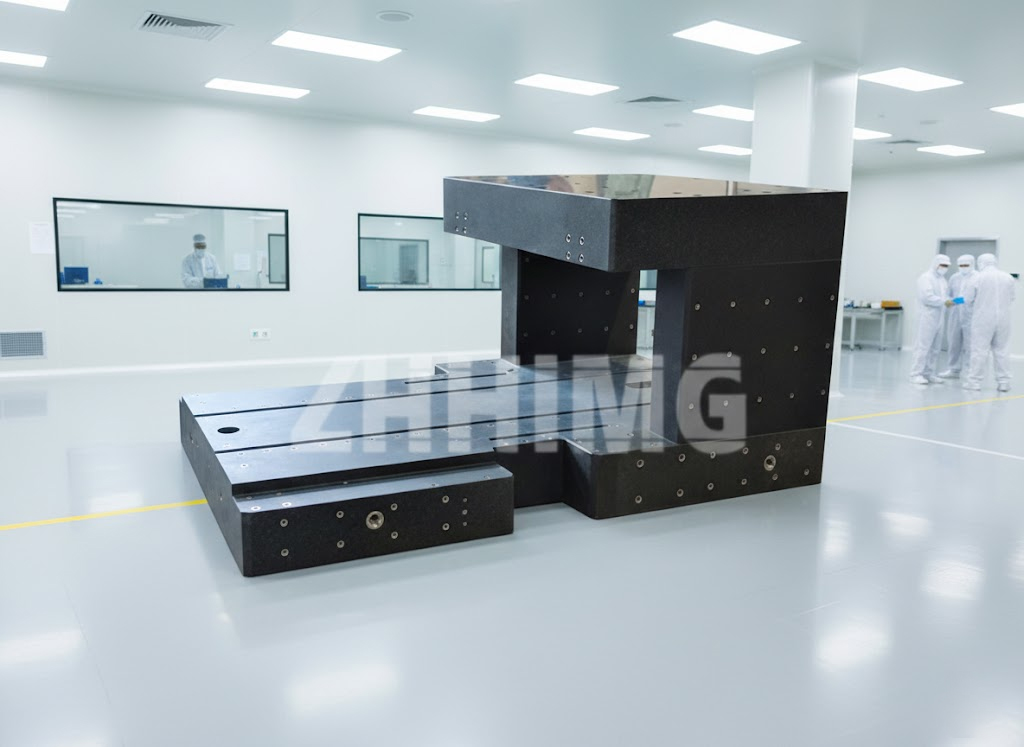
The transition from traditional steel frames to a Granite Structure for Automation & Assembly is driven by the need for vibration isolation. In a modern assembly line, robots move with high acceleration and deceleration. These movements create kinetic energy that can ripple through a steel frame, causing micro-oscillations that blur optical sensors or cause misalignment in delicate components.
Granite’s high damping ratio means that these vibrations are absorbed within the material almost instantly. This allows the automation system to settle faster, directly translating into shorter cycle times and higher throughput. Furthermore, the ability to machine complex features directly into the granite—such as threaded inserts, T-slots, and precision-lapped guide rails—allows for a level of modularity that was previously difficult to achieve with stone. ZHHIMG’s engineering team works closely with global OEMs to design custom granite machine frames that integrate these features without compromising the structural integrity of the platform.
Thermal Inertia: The Hidden Advantage for Global Manufacturers
One of the most significant challenges for facilities operating in diverse climates is thermal expansion. A steel base can expand significantly with just a few degrees of temperature change, throwing a high-precision system out of calibration. In contrast, the low coefficient of thermal expansion found in metrology-grade granite provides a form of “thermal inertia.”
This property is particularly beneficial for our clients in the aerospace industry, where components are often measured and assembled over long periods. A Granite Structure for Automation & Assembly acts as a heat sink, maintaining its geometry even as the surrounding environment fluctuates. This ensures that the ±0.001mm flatness tolerance achieved at our facility remains a reality on your factory floor, regardless of the geographic location of your manufacturing hub.
The Role of ZHHIMG in Advancing Industrial Standards
As ZHHIMG continues to expand its footprint in the Western market, our focus remains on the marriage of traditional craftsmanship and digital metrology. Every High-Precision Base we produce is verified using laser interferometers and electronic levels that are traceable to international standards. We understand that our European and American partners require documented certainty; therefore, every component is accompanied by a comprehensive calibration report.
The future of automation is one of increasing complexity and shrinking tolerances. By providing a High-Precision Base – $\pm0.001mm$ Flatness Tolerance and specialized Granite Structures for Automation & Assembly, ZHHIMG is providing the physical certainty required for the next generation of industrial breakthroughs. We are not just supplying stone; we are supplying the foundation of innovation.
In an era where every micron counts, the choice of your machine foundation is the most important decision you will make. We invite our global partners to experience the stability of ZHHIMG granite—a material that has stood the test of time, engineered for the demands of tomorrow.
Post time: Feb-28-2026