
The relentless pursuit of micron-level accuracy in modern manufacturing has pushed traditional materials to their absolute physical limits. As industries ranging from semiconductor fabrication to high-end optics demand tighter tolerances, the conversation has shifted away from conventional metals and toward the extraordinary capabilities of technical ceramics. At the heart of this evolution lies a fundamental question: how can manufacturers achieve perfect stability and frictionless movement in an environment where even a microscopic particle can lead to catastrophic failure? The answer is increasingly found in the integration of porous ceramics and high-density zirconia components.
When we examine the challenges faced by engineers operating high-precision grinding machines, the primary hurdle is often the management of physical contact and heat. Traditional mechanical clamping or standard vacuum chucks often introduce minute stresses into a workpiece, leading to deformation that is only visible under a microscope but devastating to the final product’s integrity. This is where the innovation of the suction plate for grinding machine applications has undergone a radical transformation. By utilizing specialized ceramic structures, these plates provide a level of uniform pressure distribution that was previously unattainable, ensuring that the workpiece remains perfectly flat without the localized stress points common in metallic fixtures.
The true “magic” happens when we look closer at the material science of a porous ceramics air floating piece. Unlike solid materials, engineered porous ceramics feature a controlled, interconnected network of microscopic pores. When compressed air is introduced through this structure, it creates a thin, incredibly stiff “air cushion.” This allows for the non-contact handling of delicate wafers or ultra-thin glass, effectively floating the component on a bed of air. For a global audience focused on semiconductor efficiency, this technology is not just an upgrade; it is a necessity for reducing yield loss and preventing surface contamination.
However, the efficacy of these systems relies heavily on the quality of the surrounding hardware. A high-performance air bearing or suction system is only as good as the frame that supports it. This has led to a surge in demand for dense ceramic precision parts that act as the backbone of the machinery. While the porous sections handle the delicate interface of the air cushion, the dense ceramic components provide the structural rigidity and thermal stability required to maintain alignment over millions of cycles. Because ceramics possess a much lower coefficient of thermal expansion compared to stainless steel or aluminum, they remain dimensionally stable even as the friction of high-speed grinding generates significant ambient heat.
Among the materials leading this charge, zirconia ($ZrO_2$) stands out as the “ceramic steel” of the industry. Its unique fracture toughness and wear resistance make it the ideal candidate for components that must endure harsh industrial environments while maintaining a pristine surface finish. In a grinding context, zirconia parts resist the abrasive slurry and constant mechanical wear that would erode other materials within weeks. By choosing zirconia for critical path components, manufacturers are essentially investing in the longevity and repeatability of their entire production line.
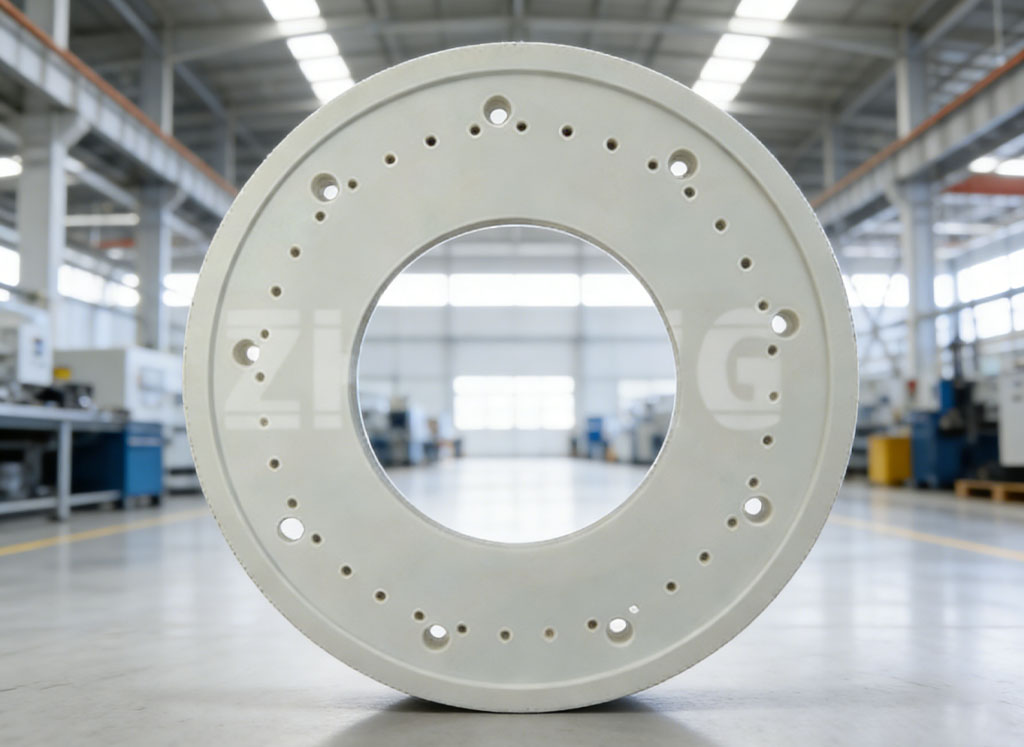
From a global perspective, the shift toward these materials represents a broader trend in the “Industrial 4.0″ landscape. European and American engineering firms are increasingly looking for partners who understand the nuance of pore size distribution and the microscopic topography of ceramic surfaces. It is no longer enough to simply provide a hard material; the goal is to provide a functional interface. Whether it is a porous ceramic vacuum chuck that holds a silicon wafer with uniform force or a dense ceramic guide rail that ensures sub-micron travel accuracy, the intersection of these technologies is where the next generation of hardware is being built.
As we look at the future of precision engineering, the synergy between air-floating technology and advanced material science will only deepen. The ability to move, hold, and process materials without physical degradation is the “holy grail” of high-tech manufacturing. By leveraging the specific advantages of porous structures for fluid distribution and the ruggedness of dense zirconia for structural integrity, companies are finding they can push their machines faster and more accurately than ever before. This is the new standard of excellence—a world where the air we breathe and the ceramics we engineer work in perfect harmony to create the most precise tools in human history.
Post time: Dec-24-2025