
In the highly competitive world of advanced display manufacturing, the difference between market leadership and obsolescence often comes down to one factor: precision. The fabrication and inspection of Low-Temperature Polycrystalline Silicon (LTPS) arrays—the foundation for high-resolution, high-performance OLED and LCD screens—demand tolerances that push the very boundaries of engineering. Achieving this ultra-high level of accuracy starts with the physical foundation of the machinery itself. This is why the selection of a granite machine base for LTPS Array equipment is not merely a design choice, but a fundamental requirement.
The processes involved in LTPS array fabrication, particularly the laser crystallization and subsequent photolithography and deposition steps, are incredibly sensitive to environmental noise, including subtle vibrations and thermal shifts. Even in the most meticulously controlled cleanroom environment, minute changes can critically impact the yield and uniformity of the array. The inspection phase—carried out by highly sophisticated equipment to ensure every transistor is perfectly formed—requires an even greater degree of structural integrity. This is the domain where the Granite machine base for Flat panel display low-temperature polysilicon array inspection equipment truly excels.
The Thermal and Dynamic Imperative of LTPS Inspection
LTPS technology allows for faster electron mobility, enabling smaller, more efficient transistors and leading to displays with breathtaking refresh rates and lower power consumption. However, the structures involved are microscopic, measured in microns. For the complex inspection equipment to accurately locate, measure, and analyze defects, its operational platform must be virtually motionless and dimensionally invariant.
Traditional materials like cast iron or steel, while robust, are inherently susceptible to thermal expansion. The coefficient of thermal expansion (CTE) for common steel is significantly higher than that of black granite. This means that a slight rise in ambient temperature, perhaps just a degree or two, will cause a steel machine structure to expand and contract more dramatically. In the context of array inspection, this thermal drift causes positional errors, misalignments in the optical path, and potentially inaccurate readings that could result in the rejection of good panels or the acceptance of defective ones.
Conversely, the use of a specialized granite machine bed for LTPS Array equipment provides a platform with an exceptionally low CTE. This thermal stability ensures that the machine’s critical geometry—the distance between the measurement sensor and the LTPS substrate—remains constant, allowing for the consistent, repeatable sub-micron measurements essential for quality control.
Unmatched Vibration Damping and Stiffness
Beyond thermal stability, the intrinsic material properties of granite offer a significant advantage in managing dynamic forces and vibrations. Advanced inspection systems utilize high-speed stages and sophisticated scanning mechanisms that generate minor mechanical movements and vibrations. These internal forces, coupled with external noise from air handlers or adjacent machinery, must be rapidly neutralized to prevent motion blur or reading instability.
Granite’s high internal damping capacity, a property that allows it to dissipate vibrational energy much faster than metals, is critical here. It acts as a passive shock absorber, ensuring that the machine quickly settles back into a state of perfect stillness after every motion. The stone’s high modulus of elasticity and density also contributes to an extremely stiff structure, minimizing static deflection under the weight of heavy gantry systems, optical assemblies, and vacuum chambers.
In essence, by choosing a precisely finished granite machine base for LTPS Array applications, engineers are establishing a foundation that is thermally stable, acoustically quiet, and structurally rigid. This triumvirate of properties is non-negotiable for achieving the throughput and yield goals required for modern LTPS display manufacturing.
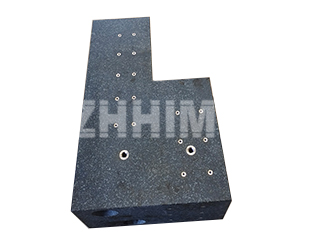
Engineering Perfection from Nature
The final product—the granite machine base—is far removed from rough quarry stone. It is a masterpiece of metrology, often finished to tolerances measured in the low-micron range or even sub-micron. Specialized techniques are employed to ensure the granite is stress-relieved and perfectly flat. This highly refined natural material provides the ultimate reference plane against which all subsequent mechanical and optical alignments are calibrated.
For manufacturers of LTPS array equipment, the integration of high-precision granite ensures that their machines can operate continuously at peak performance, translating directly into higher yields and better quality displays for the consumer market. It is a testament to the fact that when engineering demands absolute perfection, looking to the earth’s most stable natural material provides the most reliable solution.
Post time: Dec-03-2025