
In the world of high-end motion control and nanometer-scale positioning, the battle against friction is a constant struggle. For decades, mechanical bearings—whether ball, roller, or needle—have been the standard. However, as industries like semiconductor lithography, flat-panel display inspection, and high-precision metrology push into the realm of sub-micron accuracy, the physical limitations of metal-on-metal contact have become an insurmountable wall. This leads us to a fascinating question: is the combination of natural stone and pressurized air the ultimate solution for the future of motion?
At ZHHIMG, we have pioneered the development of high-performance motion foundations, and we’ve found that the most elegant solution to the friction problem is the Granite Air Floating Rail. By merging the absolute geometric stability of black granite with the frictionless properties of an Air Bearing, we are able to create motion systems that don’t just move—they glide with a level of silence and precision that was once thought impossible.
The Physics of the Perfect Glide
To understand why granite flotation guideways are replacing traditional mechanical rails, one must look at what happens at the microscopic level. In a mechanical system, no matter how well-lubricated, there is always “stiction”—the static friction that must be overcome to start movement. This creates a tiny “jump” or error in positioning. Furthermore, mechanical bearings suffer from recirculating vibrations as the balls or rollers move through their tracks.
An Air Bearing system eliminates this entirely. By introducing a thin, controlled film of clean, compressed air between the carriage and the granite surface, the components are separated by a gap typically measuring between 5 and 10 microns. This creates a state of near-zero friction. When this technology is applied to an airtrack configuration, the result is a motion profile that is perfectly linear and entirely devoid of the mechanical “noise” that plagues traditional CNC or inspection machines.
Why Granite is the Essential Partner for Air Flotation
The effectiveness of any air-floating system is entirely dependent on the surface it travels upon. If the surface is uneven, the air gap will fluctuate, leading to instability or “grounding.” This is why granite flotation instruments are almost exclusively built on high-density natural stone rather than metal. Granite can be lapped by hand to a degree of flatness that exceeds the capabilities of any milling machine.
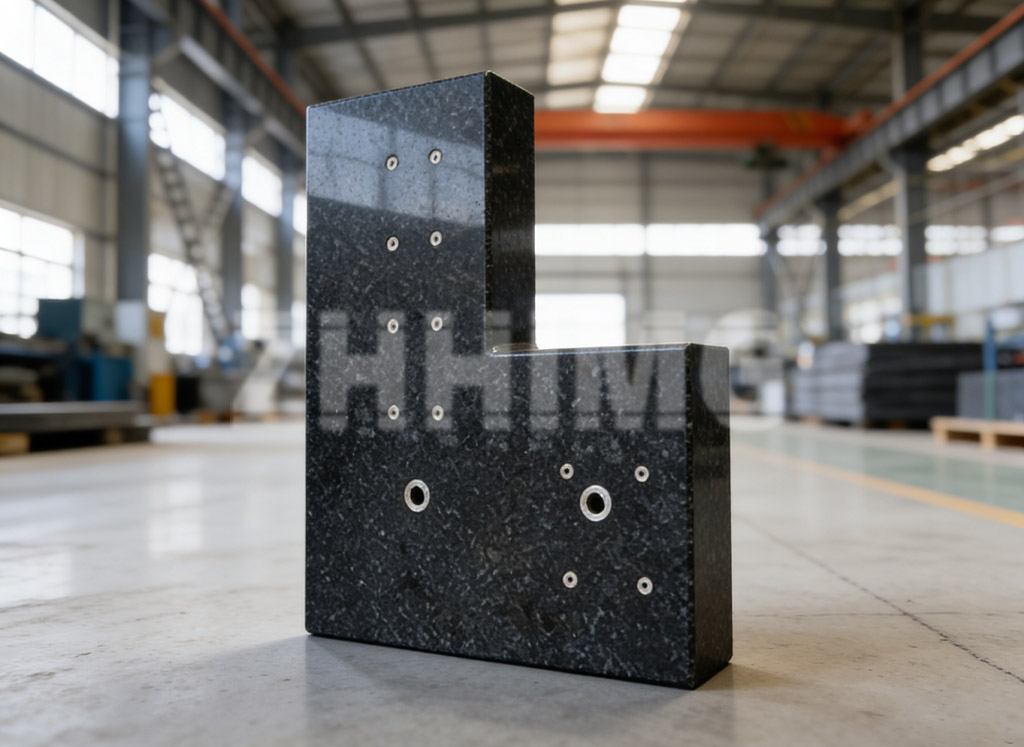
At ZHHIMG, our technicians work in temperature-controlled environments to refine a Granite Air Floating Rail until it achieves a flatness measured in fractions of a micron over several meters. Because granite is naturally porous at a microscopic level, it also helps in stabilizing the air film, preventing the “vortex” effects that can occur on non-porous surfaces like polished steel. This synergy between the stone’s surface integrity and the air film’s support is what allows our granite flotation guideways to maintain absolute parallelism over long travel distances.
Reliability Without Wear: The Maintenance Revolution
One of the most compelling arguments for adopting airtrack technology in a production environment is the total absence of wear. In a traditional precision machine, the rails eventually develop “dead spots” where the most frequent movements occur. Lubricants dry out, attract dust, and eventually turn into an abrasive paste that degrades accuracy.
With a Granite Air Floating Rail, there is no contact, which means there is no wear. As long as the air supply is kept clean and dry, the system will perform with the same precision on day 10,000 as it did on day one. This makes granite flotation instruments ideal for cleanroom environments, such as those found in medical device manufacturing or silicon wafer processing. There are no oils to outgas, no metal shavings to contaminate the environment, and no need for periodic rail replacements.
Custom Engineering and Integrated Solutions
At ZHHIMG, we believe that a motion system should be a seamless part of the machine’s architecture. We don’t just provide a slab of stone; we design integrated granite flotation guideways that incorporate vacuum pre-loading for increased stiffness. By using vacuum zones alongside the Air Bearing pads, we can “pull” the carriage toward the rail while the air “pushes” it away. This creates a highly rigid air film that can support significant loads while maintaining its frictionless characteristics.
This level of engineering has placed ZHHIMG among the top tier of global suppliers for precision foundations. We work with engineers who are building the next generation of laser interferometers and high-speed optical scanners—machines where even the vibration of a cooling fan can be too much. For these clients, the silent, vibration-damping nature of an airtrack built on a granite base is the only viable path forward.
Building the Foundation for Tomorrow’s Innovation
As we look toward the future, the demands for speed and accuracy will only increase. Whether it is in the rapid scanning of large-format displays or the precise positioning of a laser for micro-surgery, the foundation must be invisible—it must not interfere with the task at hand.
By investing in a Granite Air Floating Rail system, manufacturers are future-proofing their technology. They are moving away from the “grind and grease” of the 20th century toward the “float and glide” of the 21st. At ZHHIMG, we are proud to be the craftsmen behind these silent foundations, providing the world’s most advanced industries with the stability they need to innovate.
If you are currently struggling with mechanical wear, thermal expansion in your guideways, or positioning errors that you just can’t seem to shake, it might be time to stop fighting friction and start floating above it. Our team is ready to help you design a system that brings the unmatched stability of granite to your most ambitious projects.
Post time: Jan-04-2026