
Many metrology engineers face a common practical requirement when building height gauge measurement stations: drilling holes on granite bases to mount positioning pins, pressure plates, limit blocks, leveling feet and other fastening accessories. A lot of people worry that granite is brittle. Will drilling cause stone cracking or deformation of the reference surface, and thus impair the measurement accuracy of height gauges?
The answer is yes, holes can be made for fastening accessories. However, machining methods, hole locations and process treatment directly determine whether the finished base can serve precision measurement stably over the long term. ZHHIMG granite is not an unworkable raw stone. With rational planning and professional craftsmanship, threaded holes, counterbore holes and through holes can all be fabricated on granite bases to secure height gauge main units, positioning jigs and limit assemblies, adapting to assembly requirements of different inspection stations.
The drilling logic for granite differs greatly from metal parts. Metals feature good toughness and can generally be drilled and tapped at any position without cracking. Granite is a brittle mineral aggregate. The main risk of drilling does not lie in drilling itself, but in impact and local high heat generated during processing, as well as stress concentration when holes are too close to the reference surface. Rough drilling adopted by ordinary stone factories often leads to edge chipping and invisible internal microcracks. These microcracks will gradually expand in later service and eventually deform the reference plane, ruining the measurement reference of height gauges.
For drilling on precision granite bases, ZHHIMG follows a set of processing principles tailored for metrology equipment. Hole layout keeps away from the reference working surface with sufficient safety margins reserved to prevent stress concentration from affecting flatness. Special diamond drill bits and low-speed water cooling processes are applied to reduce impact and heat accumulation, avoiding hole-edge chipping and internal microfractures in the stone. After machining, hole walls are finely finished. Metal thread inserts can be embedded if necessary to solve insufficient thread strength when tapping granite directly. This allows repeated assembly and disassembly of fastening accessories without thread slipping or stripping.
It is necessary to distinguish ordinary marble from ZHHIMG high-density precision black granite. Marble has a loose texture. Hidden cracks easily develop along pores after drilling, making it unsuitable for assembling precision equipment. ZHHIMG high-density precision granite features uniform and compact texture. With standardized processing, the overall structural stability remains intact after drilling, and the flatness of the reference surface can still stay within high-precision ranges. Deformation will not occur merely because of pre-reserved mounting holes. 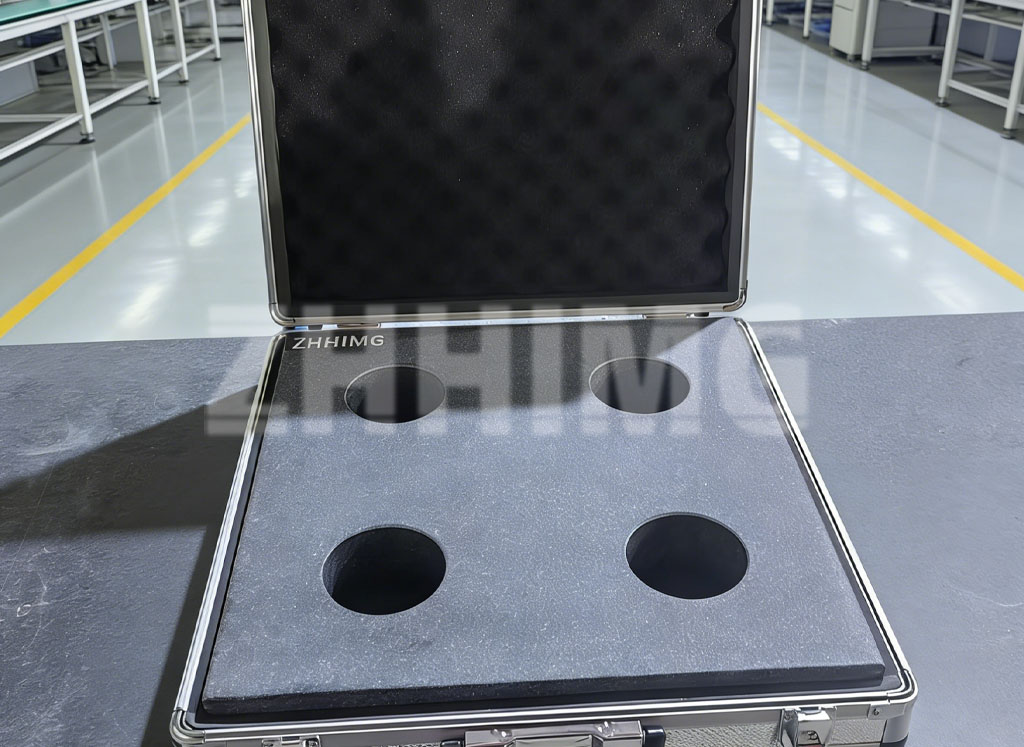
Many customers are concerned that drilling will change the vibration-damping performance of the base. In fact, a small number of properly arranged mounting holes barely affect the damping and vibration-absorbing properties of granite bases. They can still effectively buffer micro-vibrations in workshops and guarantee stable readings of height gauges. Nevertheless, excessive or densely arranged holes will break the continuous stone structure and weaken overall rigidity and vibration absorption. ZHHIMG engineers will plan the quantity and layout of holes in the design phase.
Some details need attention during assembly. When tightening fastening accessories, do not torque bolts heavily as you would on metal bases. Excessive clamping force creates local stress around holes and may even cause stone chipping. Apply moderate and uniform torque with elastic gaskets to disperse pressure. This firmly secures accessories without damaging the granite body.
Granite bases for height gauges can be drilled to install various fastening accessories, but simple drilling by ordinary stone manufacturers is not acceptable. Supported by ZHHIMG’s precision stone machining technology, holes are rationally laid out, and water-cooled diamond drilling plus embedded inserts are adopted to avoid chipping and microcracks. With standardized processes, drilled granite bases retain stable reference accuracy and flexibly meet assembly demands for height gauge jigs and positioning components.
Post time: Sep-16-2026