
In the modern era of photonic innovation, where laser paths are measured in nanometers and optical alignment requires absolute stillness, the foundation of the entire system has become a primary engineering challenge. As laboratory requirements in Europe and North America shift toward higher resolution and faster data acquisition, the limitations of traditional optical breadboards and metal structures have become apparent. This raises a fundamental question for optical physicists and system integrators: how can one ensure a stable environment that remains unaffected by thermal drift and micro-vibrations?
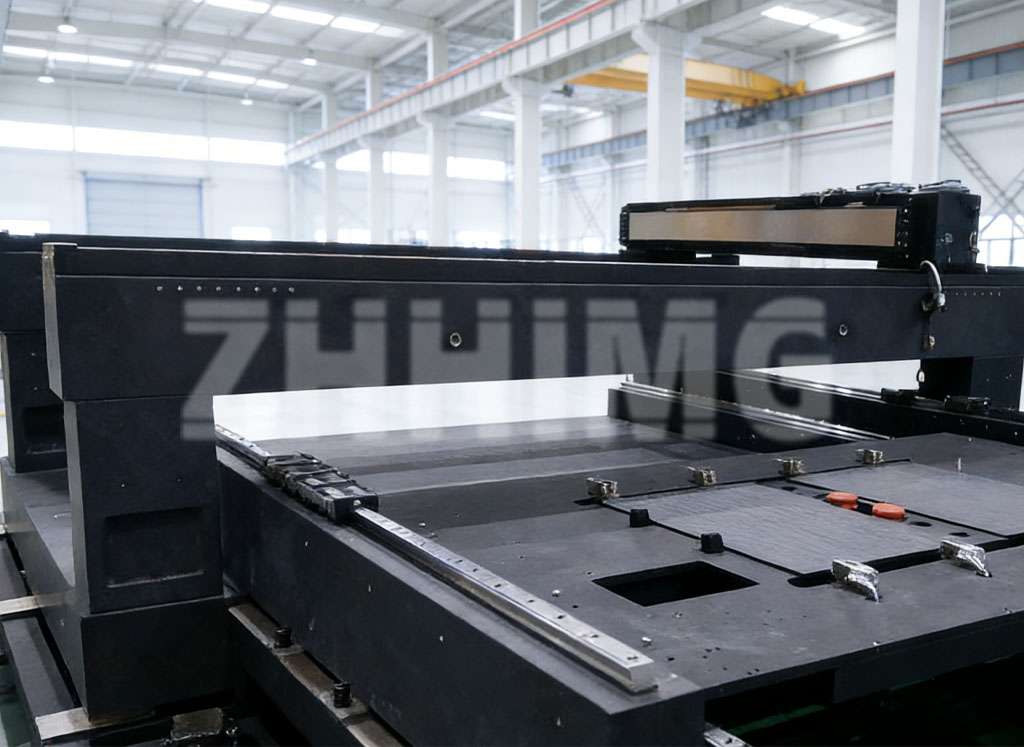
The industry is increasingly turning toward a Granite Platform for Laser & Optical Systems as the only viable solution for long-term dimensional integrity. At ZHHIMG, we have observed that the most successful optical projects are those that prioritize the physical substrate at the earliest design stage. A platform is not merely a table; it is the silent guarantor of optical path consistency.
The Physics of Thermal Passive Stability in Optical Engineering
One of the most persistent threats to laser alignment is thermal expansion. In high-power laser applications, even the minute heat generated by the source or the surrounding electronics can cause metallic platforms to expand unevenly, leading to beam wander or focus shift. Natural black granite possesses an incredibly low coefficient of thermal expansion, making it a “passive” thermal stabilizer.
Unlike aluminum or steel, which react rapidly to environmental fluctuations, the dense molecular structure of granite provides significant thermal mass. This allows Optical Granite Stages to maintain their geometry over extended periods, ensuring that sensitive interferometers and laser cutters remain calibrated from the first hour of operation to the last. For researchers and industrial engineers, this translates to less downtime for recalibration and a significant increase in data reliability.
Achieving the Impossible: The Meaning of λ/10 Flatness Guaranteed
In the world of precision optics, “flatness” is often measured against the wavelength of light itself. To state that a surface has a λ/10 Flatness Guaranteed is to enter the highest echelon of manufacturing. This specification means that the peak-to-valley deviation across the entire surface is less than one-tenth of the wavelength of a specific reference light (typically a HeNe laser at 632.8nm).
Achieving this level of precision on a large-scale granite platform requires more than just CNC machining; it requires the traditional art of hand-lapping combined with modern laser interferometric verification. At ZHHIMG, our technicians spend hundreds of hours refining the granite surface, checking and re-checking the progress against NIST-traceable standards. This rigorous process ensures that when an optical stage is integrated into a lithography machine or a high-resolution microscope, the base does not introduce even the slightest distortion into the optical wavefront.
Vibration Damping and the Future of Optical Stages
Modern laser systems often involve high-speed motion, where optical stages move with high acceleration to scan or process materials. These movements generate kinetic energy that can manifest as vibrations, potentially blurring images or causing errors in laser marking. Granite’s natural internal damping properties are far superior to those of metal alloys. The crystalline matrix of the stone absorbs high-frequency vibrations almost instantaneously, providing a “dead” surface that is essential for high-fidelity optical work.
Furthermore, the non-magnetic nature of granite is a critical advantage for systems that incorporate sensitive electron beams or magnetic sensors alongside lasers. By eliminating electromagnetic interference from the base itself, ZHHIMG provides an inert environment where the only variables are those intended by the experimenter.
A Global Partnership for Precision Innovation
As the semiconductor industry pushes toward smaller nodes and the aerospace sector demands more complex laser-based sensors, the need for customized, metrology-grade granite solutions will only grow. ZHHIMG is proud to stand at the intersection of geological stability and optical precision, offering tailored engineering support to OEM partners and research institutions worldwide.
We understand that for our clients in the Western markets, the “guarantee” of flatness is not just a marketing term—it is a contractual necessity that underpins their own product quality. By delivering granite platforms that meet and exceed these exacting standards, we are helping to build the foundation for the next generation of photonic breakthroughs. The pursuit of perfection in light requires a foundation of stone.
Post time: Feb-14-2026