
In advanced photonics manufacturing and laboratory research, optical fiber alignment has become one of the most tolerance-sensitive processes in the entire value chain. As coupling losses shrink toward fractions of a decibel and packaging density continues to increase, mechanical platform stability is no longer a background consideration—it is a primary determinant of yield and long-term reliability.
Across North America and Europe, engineers are increasingly specifying precision granite for optical fiber alignment applications, particularly in systems requiring sub-micron positioning and nanometer-scale repeatability. At the same time, demand is rising for granite tables with surface roughness Ra < 0.02μm, especially in cleanroom-grade photonics and semiconductor environments.
This shift reflects a deeper industry realization: ultra-precision optical performance depends directly on structural material science and surface engineering.
The Alignment Challenge in Modern Photonics
Optical fiber alignment—whether in passive alignment fixtures, active alignment stations, or automated packaging lines—requires deterministic mechanical reference geometry. Misalignment on the order of microns can dramatically affect insertion loss, back reflection, and long-term thermal stability.
Modern applications include:
High-power laser coupling
Silicon photonics packaging
Fiber array alignment for data centers
Medical laser modules
Aerospace optical sensing systems
In these environments, platform deflection, vibration transmission, and micro-surface irregularities introduce variables that directly compromise alignment consistency.
Conventional aluminum and steel structures provide machinability, but they exhibit higher coefficients of thermal expansion and lower damping capacity compared to dense natural granite. Residual stress and thermal cycling further amplify positioning error over time.
As a result, precision granite alignment bases are increasingly adopted for their inherent dimensional stability and natural vibration attenuation.
Why Surface Roughness Matters in Optical Platforms
When engineers specify a granite table with surface roughness Ra < 0.02μm, the requirement is not cosmetic—it is functional.
Ultra-low surface roughness improves:
Contact uniformity for vacuum fixtures
Adhesion stability in fiber bonding processes
Repeatable placement of kinematic mounts
Reduced micro-slip during alignment adjustments
Enhanced cleanliness control in ISO-classified environments
Surface finish at Ra < 0.02μm approaches optical-grade lapping standards. Achieving this level of smoothness requires controlled abrasive sequencing, stable environmental conditions, and precision metrology verification.
In fiber alignment systems where air-bearing stages or piezoelectric positioning modules are integrated directly onto the granite surface, micro-topography directly affects motion linearity and repeatability. Any deviation at the sub-micron level can translate into measurable optical loss.
Therefore, the granite platform becomes an active component in the precision chain rather than a passive support.
Structural Stability and Thermal Neutrality
Optical fiber alignment often occurs in temperature-controlled cleanrooms, yet even minimal thermal gradients can shift alignment reference points.
Granite offers distinct advantages:
Low thermal expansion coefficient
High compressive strength
Excellent internal damping
Long-term dimensional stability
Non-magnetic and corrosion resistant properties
Unlike fabricated steel frames, granite does not accumulate welding stress or internal strain from machining. It is naturally aged, reducing long-term geometric drift.
For automated fiber alignment stations operating continuously over extended production cycles, this stability reduces recalibration frequency and enhances process repeatability.
Search behavior across the United States, Germany, and the Netherlands shows growing interest in terms such as “precision granite base for fiber alignment,” “ultra-smooth granite table for photonics,” and “custom granite optical platform.” These trends indicate that R&D teams and procurement engineers are actively evaluating structural material upgrades.
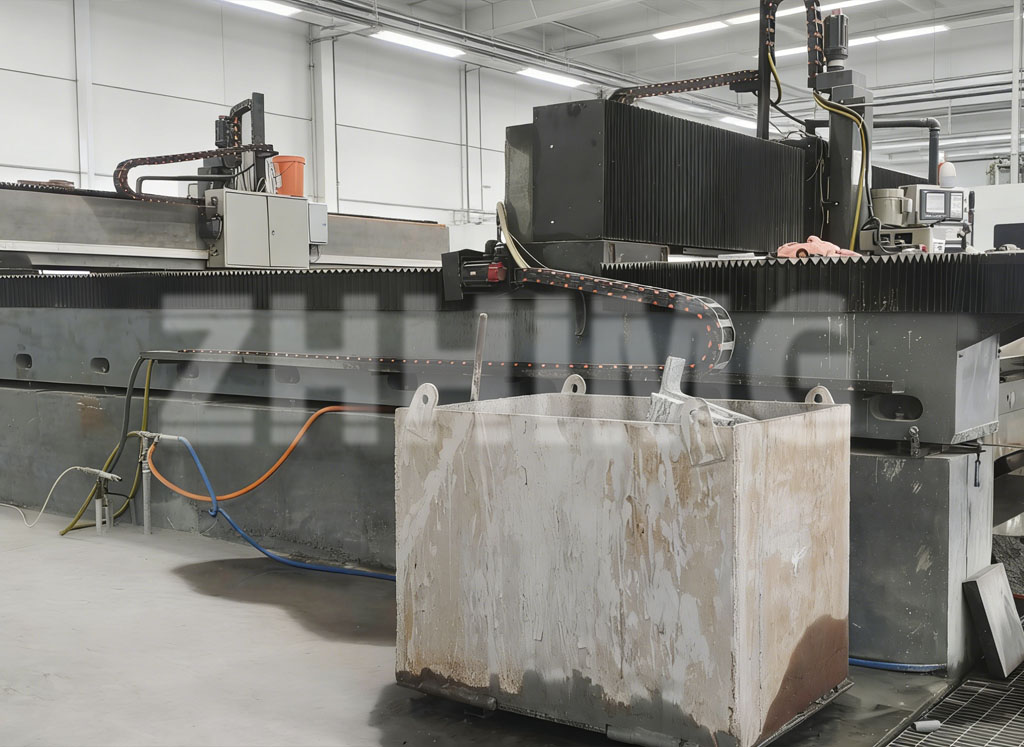
Customization for Optical Fiber Alignment Systems
No two alignment platforms share identical specifications. The geometry of fiber arrays, integration of motion stages, and environmental conditions all influence design requirements.
ZHHIMG engineers collaborate closely with photonics equipment manufacturers to define:
Granite thickness optimization for load distribution
Embedded threaded inserts or stainless steel bushings
Integrated vacuum channels
Air-bearing compatible reference surfaces
Parallelism and flatness grades
Cleanroom-level edge finishing
Our high-density black granite, processed in temperature-controlled manufacturing environments, enables both structural rigidity and ultra-fine lapping performance. Flatness can be produced to Grade 00 or higher according to international metrology standards, depending on application demands.
For projects requiring hybrid construction, granite bases can be combined with precision ceramic components, mineral casting substructures, or high-precision metal machining assemblies.
This integration capability is particularly relevant in semiconductor-adjacent photonics manufacturing, where mechanical and optical tolerances converge.
Case Insight: Upgrading an Automated Fiber Coupling Platform
A North American photonics equipment integrator recently transitioned from an anodized aluminum base to a custom precision granite platform for optical fiber alignment.
The objective was to reduce insertion loss variability in a high-volume fiber-to-chip packaging system.
After implementing a granite table with surface roughness Ra < 0.02μm and optimized structural thickness, the system demonstrated:
Reduced vibration transmission during active alignment
Improved repeatability after tool changeovers
Lower thermal drift during extended production cycles
Enhanced bonding stability for UV-cured adhesives
Most significantly, process yield improved due to tighter mechanical referencing and more consistent micro-positioning accuracy.
This example illustrates how material selection at the base structure level directly influences optical performance metrics.
Manufacturing Control and Verification
Producing ultra-smooth precision granite requires disciplined process management.
At ZHHIMG’s advanced production facilities, the workflow includes:
Environmental temperature stabilization during grinding and lapping
Sequential abrasive refinement to achieve sub-micron roughness
High-precision coordinate measurement inspection
Laser interferometric flatness verification
Surface roughness measurement using calibrated profilometry
Certification under ISO9001, ISO14001, and ISO45001 standards supports consistent quality assurance and traceability.
These measures are critical when supplying platforms for aerospace photonics, semiconductor inspection systems, and advanced research laboratories.
Industry Outlook: Integration of Granite into Photonics Manufacturing
As optical communication networks expand and silicon photonics scales toward mass production, fiber alignment tolerances will continue to narrow. Automation will increase, and mechanical reference stability will become even more decisive.
Structural vibration, thermal distortion, and surface irregularities—once manageable variables—are now limiting factors in high-performance systems.
Granite platforms, especially those engineered for ultra-low surface roughness and deterministic mounting integration, provide a foundation aligned with the next generation of photonics requirements.
The growing online search interest in “precision granite for optical fiber alignment” and “granite table Ra < 0.02μm” reflects this shift in engineering priorities across Western markets.
Building Mechanical Certainty for Optical Precision
In optical fiber alignment, precision is cumulative. Every micron of geometric stability and every nanometer of surface refinement contribute to system reliability.
By integrating precision granite for optical fiber alignment with ultra-smooth lapped surfaces and customized structural interfaces, laboratories and OEM manufacturers can significantly enhance alignment repeatability, thermal neutrality, and long-term operational stability.
As photonics technology continues advancing into quantum communication, high-density data transmission, and miniaturized sensing platforms, the mechanical base supporting these systems must evolve accordingly.
The future of optical performance does not depend solely on lasers, fibers, or photonic chips. It begins with the structural platform beneath them.
Post time: Mar-04-2026