
In recent years, the maker movement has collided with industrial ambition. Hobbyists are no longer satisfied with 3D printing trinkets—they’re building desktop CNC mills capable of machining aluminum, brass, and even hardened steel. But as cutting forces increase and precision demands grow, one question keeps resurfacing in forums, workshops, and YouTube comment sections: What’s the best material for a rigid, vibration-damping machine base that won’t break the bank?
Enter epoxy granite—a composite material once reserved for factory floors and metrology labs, now finding its way into garage-built machines through projects tagged “diy epoxy granite cnc.” At first glance, it seems almost too good to be true: mix crushed stone with resin, pour it into a mold, and voilà—you’ve got a base with 10x the damping of cast iron and near-zero thermal drift. But is it really that simple? And can a home-built epoxy granite cnc router truly rival commercial machines?
At ZHHIMG, we’ve been working with machinery artificial granite for over a decade—not just as manufacturers, but as educators, collaborators, and sometimes, skeptics. We admire the ingenuity behind the diy epoxy granite cnc community. But we also know that success hinges on details most tutorials overlook: aggregate grading, resin chemistry, curing protocols, and post-cure machining strategy. That’s why we’ve made it our mission to bridge the gap between hobbyist enthusiasm and industrial-grade performance.
First, let’s clarify terminology. What many call “granite epoxy cnc” or “epoxy granite cnc router” is technically polymer-bound mineral casting—a machinery artificial granite composed of 90–95% fine mineral aggregate (often recycled granite, basalt, or quartz) suspended in a high-strength epoxy matrix. Unlike natural granite slabs used in surface plates, this material is engineered from the ground up for structural integrity, internal damping, and design flexibility.
The appeal for DIYers is obvious. Cast iron requires foundry access, heavy machining, and rust protection. Steel frames flex under load. Wood absorbs moisture and vibrates like a drum. But a well-formulated epoxy granite base cures at room temperature, weighs less than iron, resists coolant corrosion, and—when done right—delivers exceptional stability for spindle mounts, linear rails, and lead screw supports.
Yet “when done right” is the operative phrase. We’ve seen countless diy epoxy granite cnc builds fail not because the concept is flawed, but because critical steps were skipped. Using coarse gravel instead of graded fines creates voids. Skipping vacuum degassing traps air bubbles that weaken the structure. Pouring in a humid garage causes amine blush on the surface, preventing proper adhesion of threaded inserts. And perhaps most critically—trying to drill or tap cured epoxy granite without the right tools leads to chipping, delamination, or ruined alignment.
That’s where machining epoxy granite becomes its own discipline.
Unlike metal, epoxy granite is abrasive. Standard HSS drills dull in seconds. Even carbide bits wear rapidly if feed rates and coolant aren’t optimized. At ZHHIMG, we use diamond-coated end mills and low-RPM, high-torque spindles when machining epoxy granite for precision datums or rail mounting surfaces. For DIYers, we recommend solid carbide drills with reduced rake angles, plenty of lubrication (even if dry-cutting metal), and peck drilling to evacuate chips.
But here’s a better idea: design your mold so that critical features are cast in place. Embed stainless steel threaded inserts, linear rail blocks, or cable glands during the pour. Use 3D-printed sacrificial cores to form internal coolant channels or wiring tunnels. This minimizes post-cure machining—and maximizes long-term alignment.
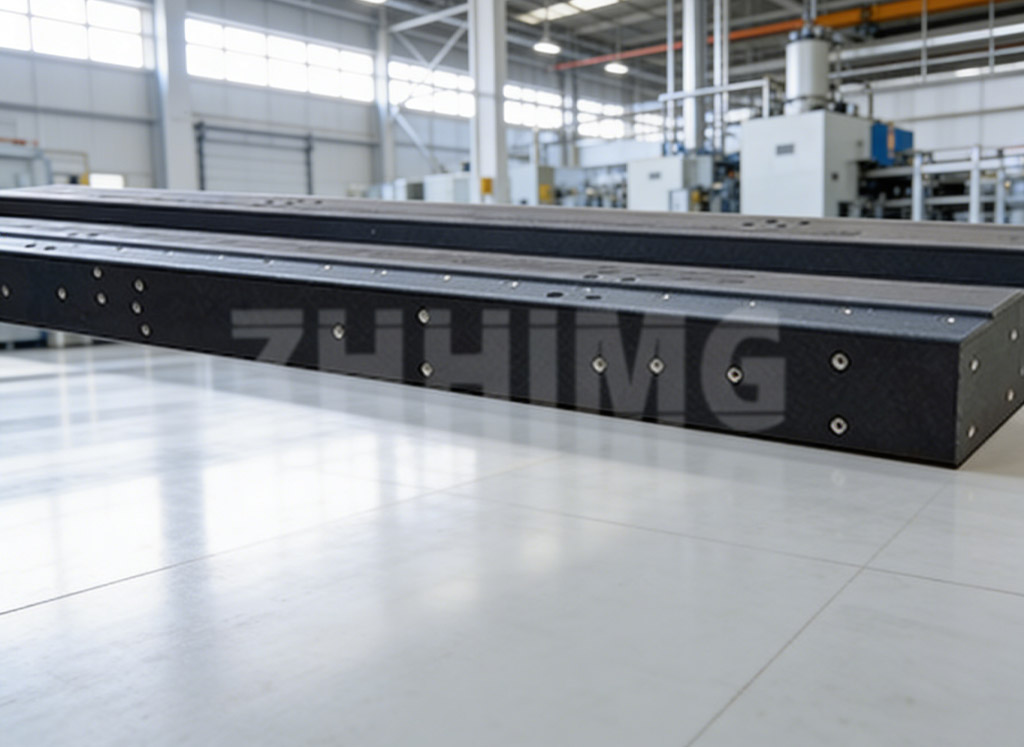
We’ve worked with several advanced makers who took this approach. One engineer in Germany built a granite epoxy cnc mill with embedded THK rail mounts and a central cavity for a brushless spindle—all cast in a single pour. After light surface skimming on a friend’s Bridgeport, his machine achieved ±0.01 mm repeatability on aluminum parts. “It’s quieter than my old steel frame,” he told us. “And it doesn’t ‘sing’ when I cut full-depth slots.”
Recognizing the growing interest, ZHHIMG now offers two resources specifically for the DIY and small-shop community. First, our Epoxy Granite Starter Kit includes pre-sieved mineral blend, calibrated epoxy resin, mixing instructions, and a guide to mold design—formulated for room-temperature cure and easy machining. Second, our technical team provides free consultation on geometry, reinforcement, and insert placement for anyone planning a epoxy granite cnc router build.
We don’t sell complete machines. But we do believe that access to industrial-grade materials shouldn’t be limited to corporations with six-figure budgets. In fact, some of the most innovative applications of machinery artificial granite have come from passionate individuals pushing boundaries in their home workshops.
Of course, there are limits. A DIY epoxy granite base won’t match the dimensional accuracy of a professionally machining epoxy granite platform validated by laser tracker. Thermal stability depends heavily on resin selection—cheap hardware-store epoxy may expand significantly with temperature. And large pours require careful thermal management to avoid exothermic cracking.
But for sub-$2,000 CNC routers aiming for professional results, epoxy granite remains one of the smartest choices available. It’s why companies like Tormach and Haas have quietly explored mineral casting for entry-level models—and why the diy epoxy granite cnc movement continues to grow.
So as you sketch your next machine design, ask yourself: Am I building a frame—or a foundation?
If you want your spindle to stay aligned, your cuts to remain clean, and your machine to run whisper-quiet for years, the answer may lie not in more metal, but in smarter composites. At ZHHIMG, we’re proud to support both industrial clients and independent builders in advancing what’s possible with granite epoxy cnc technology.
Post time: Dec-31-2025