
The evolution of manufacturing has pushed dimensional tolerances to the absolute limits of measurement, making the metrology environment more critical than ever before. At the heart of this environment lies the granite metrology table, the single most important reference surface for any advanced inspection or assembly task. It is the unyielding “zero point” that validates the accuracy of multi-million dollar machinery, from Coordinate Measuring Machines (CMMs) to semiconductor handling stages.
However, the question facing every precision engineer is whether their current granite metrology table is truly capable of supporting the verification needs of the nanometer age. The answer depends entirely on the intrinsic material quality, the engineering rigor applied during manufacturing, and the total system stability.
The Material Science of Absolute Stability
The choice of material for a granite metrology table is non-negotiable in the ultra-precision domain. Lesser materials, such as common granites or marble, fail primarily due to thermal instability and insufficient rigidity. True metrology-grade surfaces demand high-density, black gabbro granite.
Our specialized ZHHIMG® Black Granite is selected precisely for its superior physical characteristics:
-
Exceptional Density: With a density approaching 3100 kg/m³, the material possesses the high Young’s modulus required to resist deflection under extreme loads. This rigidity is fundamental to maintaining flatness, especially for large tables that support massive equipment.
-
Thermal Inertia: The granite exhibits extremely low thermal expansion. This superior thermal inertia means the table’s dimensions remain nearly constant despite minor temperature fluctuations in the lab, eliminating a primary source of measurement error in sensitive applications.
-
Vibration Damping: The dense mineral structure provides exceptional passive damping against environmental and machine vibrations, effectively isolating the sensitive inspection process from external noise.
This material undergoes meticulous natural and controlled aging to eliminate internal stresses, ensuring the table’s dimensional integrity is maintained over decades of service—a characteristic impossible to achieve with typical engineered materials.
Engineering Perfection: From Quarry to Calibration
Manufacturing a high-end granite metrology table capable of achieving Grade 00 or Grade 000 flatness tolerances is an exacting process that merges colossal machining capability with micro-level finishing. It is far more than simple polishing.
The process demands an ultra-stable environment. Our facilities include massive, climate-controlled cleanrooms built upon thick, vibration-dampened concrete foundations, often surrounded by anti-vibration trenches. This environment is essential because the final stages of lapping and measurement are highly susceptible to environmental interference.
Large, specialized grinding machines are used for initial shaping, but the final, critical accuracy is achieved through expert hand-lapping. This is where the human element is irreplaceable. Our master craftsmen, relying on decades of experience and ultra-sensitive tools, perform final corrections, bringing the table’s flatness, parallelism, and squareness into adherence with global standards like ASME B89.3.7 or DIN 876. Their ability to precisely control material removal at the sub-micron level is the final determinant of the table’s absolute quality.
Traceability and Certification: The Metrology Mandate
A granite metrology table is only as reliable as its certification. Every table must be accompanied by comprehensive traceability documentation, verifying its geometric integrity using the most advanced instruments available, including laser interferometers, electronic levels, and high-resolution probes.
Our adherence to simultaneous certification standards (ISO 9001, 45001, 14001, CE) means that every aspect of the table’s creation, from raw material sourcing to final calibration, is governed by a globally recognized quality management system. This level of quality assurance is why our tables are trusted by world-leading institutions and multinational corporations.
Versatile Integration: More Than Just a Flat Surface
Modern granite metrology tables are increasingly integrated into complex machine systems. They are designed not only as reference surfaces but also as structural bases for dynamic equipment:
-
Integrated Components: The tables can be custom-machined with precision features such as T-slots, threaded inserts (e.g., Mahr, M6, M8), and air-bearing grooves. These features allow for the direct, high-accuracy mounting of machine components like linear guides, optical columns, and dynamic XY stages, transforming the passive table into an active machine base.
-
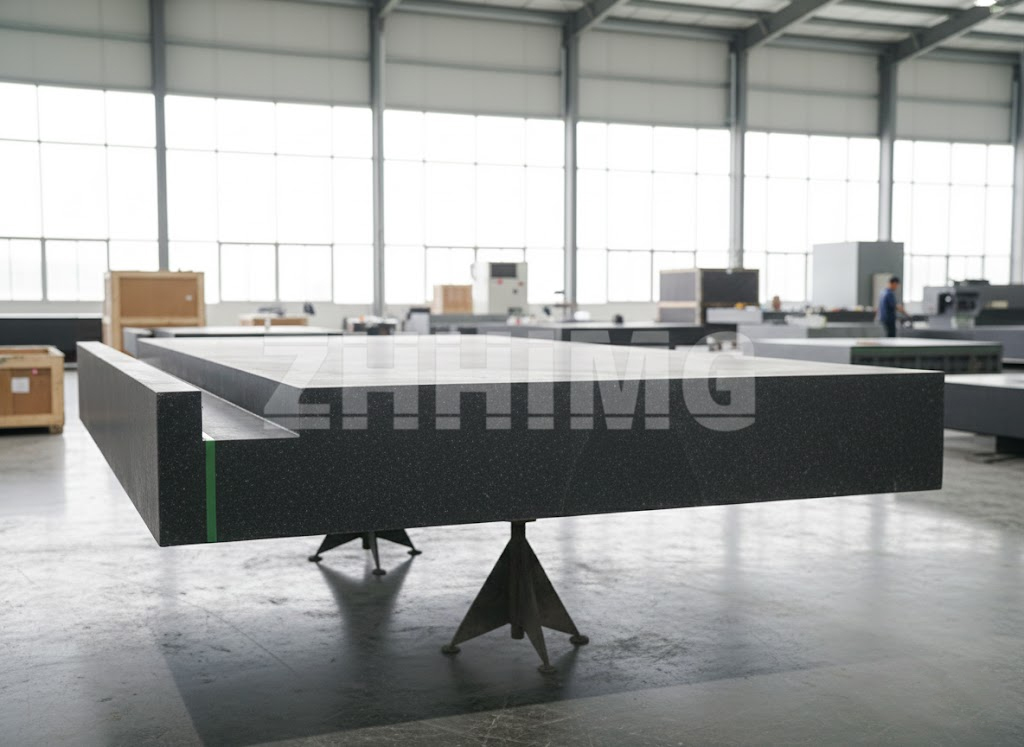
System Stability: When a granite table is mounted onto an engineered stand—often featuring vibration isolation pads or leveling feet—the entire assembly forms a single, highly stable metrology system, essential for maintaining the alignment of multi-axis CMMs and complex laser measuring devices.
In an era where manufacturing precision dictates competitive advantage, the granite metrology table remains the foundational investment in quality assurance. It ensures that every measurement taken, every component assembled, and every quality report generated, is based on a verifiable, unshakeable reference point, protecting the integrity of your entire production process.
Post time: Dec-10-2025