
Introduction: The Convergence of High-Performance Materials
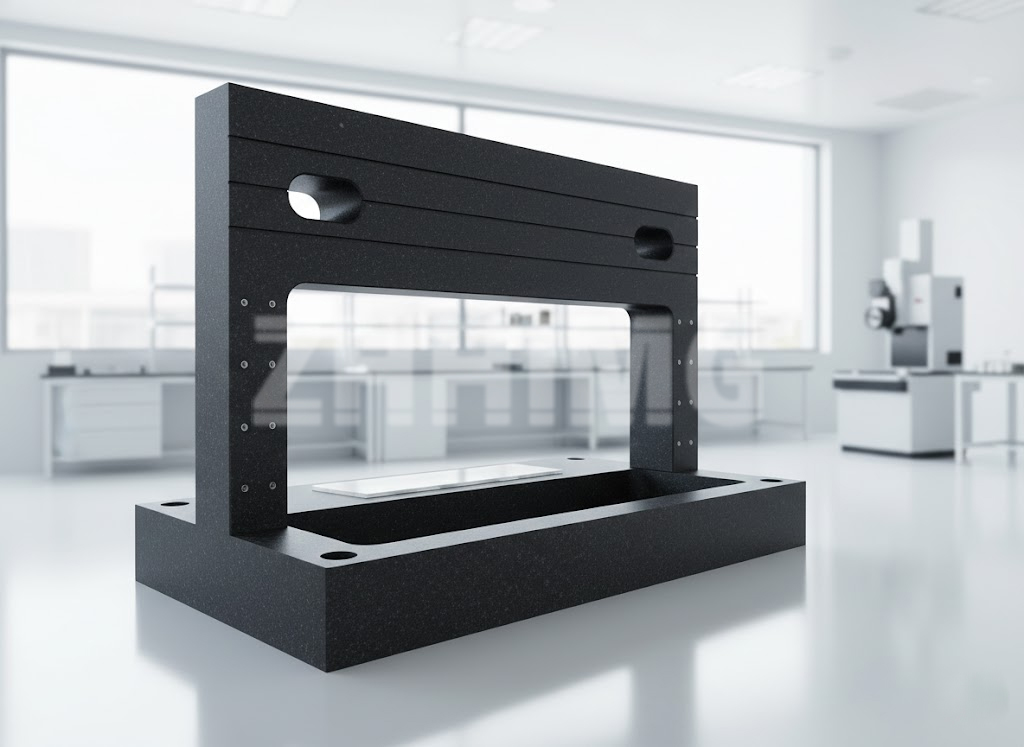
In the pursuit of ultimate measurement precision and equipment stability, researchers and engineers have long sought the “perfect platform material”—one that combines the dimensional stability of natural stone, the lightweight strength of advanced composites, and the manufacturing versatility of traditional metals. The emergence of carbon fiber-reinforced granite composites represents not merely an incremental improvement but a fundamental paradigm shift in precision platform technology.
This analysis examines the technical breakthrough achieved through the strategic fusion of carbon fiber reinforcement and granite mineral matrices, positioning this hybrid material system as the next-generation solution for ultra-stable measurement platforms in research institutions and high-end measurement equipment development.
The Core Innovation: By synergizing the compressive excellence of granite aggregates with the tensile supremacy of carbon fiber—bound by high-performance epoxy resins—these composite platforms achieve performance metrics that were previously mutually exclusive: ultra-high damping, exceptional stiffness-to-weight ratio, and dimensional stability rivaling natural granite while enabling manufacturing geometries impossible with traditional materials.
Chapter 1: The Physics of Material Synergy
1.1 Granite’s Inherent Advantages
Natural granite has been the material of choice for precision measurement platforms for decades due to its unique combination of properties:
Compressive Strength: 245-254 MPa, providing exceptional load-bearing capacity without deformation under heavy equipment loads.
Thermal Stability: Linear expansion coefficient of approximately 4.6 × 10⁻⁶/°C, maintaining dimensional integrity across temperature variations typical in controlled laboratory environments.
Vibration Damping: Natural internal friction and heterogeneous mineral composition provide superior energy dissipation compared to homogeneous metallic materials.
Non-Magnetic Properties: Granite composition (primarily quartz, feldspar, and mica) is intrinsically non-magnetic, making it ideal for electromagnetic-sensitive applications including MRI environments and precision interferometry.
However, granite has limitations:
- Tensile strength is significantly lower than compressive strength (typically 10-20 MPa), making it susceptible to cracking under tensile or flexural loading
- Brittleness requires large safety factors in structural design
- Manufacturing limitations for complex geometries and thin-walled structures
- Long lead times and high material waste in precision machining
1.2 Carbon Fiber’s Revolutionary Contributions
Carbon fiber composites have transformed aerospace and high-performance industries through their extraordinary properties:
Tensile Strength: Up to 6,000 MPa (nearly 15× steel on weight-for-weight basis)
Specific Stiffness: Elastic modulus 200-250 GPa with density only 1.6 g/cm³, yielding specific stiffness exceeding 100 × 10⁶ m (3.3× higher than steel)
Fatigue Resistance: Exceptional resistance to cyclic loading without degradation, critical for dynamic measurement environments
Manufacturing Versatility: Enables complex geometries, thin-walled structures, and integrated features impossible with natural materials
The Limitation: Carbon fiber composites typically exhibit lower compressive strength and higher CTE (2-4 × 10⁻⁶/°C) than granite, compromising dimensional stability in precision applications.
1.3 The Composite Advantage: Synergistic Performance
The strategic combination of granite aggregates with carbon fiber reinforcement creates a material system that transcends individual component limitations:
Compressive Strength Maintained: Granite aggregate network provides compressive strength exceeding 125 MPa (comparable to high-grade concrete)
Tensile Reinforcement: Carbon fiber bridging across fracture paths increases flexural strength from 42 MPa (unreinforced) to 51 MPa (with carbon fiber reinforcement)—a 21% improvement according to Brazilian research studies.
Density Optimization: Final composite density of 2.1 g/cm³—only 60% of cast iron’s density (7.2 g/cm³) while maintaining comparable stiffness
Thermal Expansion Control: Carbon fiber’s negative CTE can partially compensate granite’s positive CTE, achieving net CTE as low as 1.4 × 10⁻⁶/°C—70% lower than natural granite
Vibration Damping Enhancement: Multi-phase structure increases internal friction, achieving damping coefficient up to 7× higher than cast iron and 3× higher than natural granite
Chapter 2: Technical Specifications and Performance Metrics
2.1 Mechanical Properties Comparison
| Property | Carbon Fiber-Granite Composite | Natural Granite | Cast Iron (HT300) | Aluminum 6061 | Carbon Fiber Composite |
|---|---|---|---|---|---|
| Density | 2.1 g/cm³ | 2.65-2.75 g/cm³ | 7.2 g/cm³ | 2.7 g/cm³ | 1.6 g/cm³ |
| Compressive Strength | 125.8 MPa | 180-250 MPa | 250-300 MPa | 300-350 MPa | 400-700 MPa |
| Flexural Strength | 51 MPa | 15-25 MPa | 350-450 MPa | 200-350 MPa | 500-900 MPa |
| Tensile Strength | 85-120 MPa | 10-20 MPa | 250-350 MPa | 200-350 MPa | 3,000-6,000 MPa |
| Elastic Modulus | 45-55 GPa | 40-60 GPa | 110-130 GPa | 69 GPa | 200-250 GPa |
| CTE (×10⁻⁶/°C) | 1.4 | 4.6 | 10-12 | 23 | 2-4 |
| Damping Ratio | 0.007-0.009 | 0.003-0.005 | 0.001-0.002 | 0.002-0.003 | 0.004-0.006 |
Key Insights:
The composite achieves 85% of natural granite’s compressive strength while adding 250% more flexural strength through carbon fiber reinforcement. This enables thinner structural sections and larger spans without compromising load-bearing capacity.
Specific Stiffness Calculation:
Specific stiffness = Elastic Modulus / Density
- Natural granite: 50 GPa / 2.7 g/cm³ = 18.5 × 10⁶ m
- Carbon fiber-granite composite: 50 GPa / 2.1 g/cm³ = 23.8 × 10⁶ m
- Cast iron: 120 GPa / 7.2 g/cm³ = 16.7 × 10⁶ m
- Aluminum 6061: 69 GPa / 2.7 g/cm³ = 25.6 × 10⁶ m
Result: The composite achieves 29% higher specific stiffness than cast iron and 28% higher than natural granite, providing superior vibration resistance per unit mass.
2.2 Dynamic Performance Analysis
Natural Frequency Enhancement:
ANSYS simulations comparing mineral composite bodies (granite-carbon fiber-epoxy) with gray cast iron structures for five-axis vertical machining centers revealed:
- First 6-order natural frequencies increased by 20-30%
- Maximum stress reduced by 68.93% under identical loading conditions
- Maximum strain reduced by 72.6%
Practical Impact: Higher natural frequencies move structural resonances outside the excitation range of typical machine tool vibrations (10-200 Hz), significantly reducing susceptibility to forced vibration.
Vibration Transmission Coefficient:
Measured transmission ratios under controlled excitation:
| Material | Transmission Ratio (0-100 Hz) | Transmission Ratio (100-500 Hz) |
|---|---|---|
| Steel Fabrication | 0.8-0.95 | 0.6-0.85 |
| Cast Iron | 0.5-0.7 | 0.3-0.5 |
| Natural Granite | 0.15-0.25 | 0.05-0.15 |
| Carbon Fiber-Granite Composite | 0.08-0.12 | 0.02-0.08 |
Result: The composite reduces vibration transmission to 8-10% of steel in the critical 100-500 Hz range where precision measurements are typically performed.
2.3 Thermal Stability Performance
Coefficient of Thermal Expansion (CTE):
- Natural granite: 4.6 × 10⁻⁶/°C
- Carbon fiber-reinforced granite: 1.4 × 10⁻⁶/°C
- ULE glass (for reference): 0.05 × 10⁻⁶/°C
- Aluminum 6061: 23 × 10⁻⁶/°C
Thermal Deformation Calculation:
For a 1000 mm platform under 2°C temperature variation:
- Natural granite: 1000 mm × 2°C × 4.6 × 10⁻⁶ = 9.2 μm
- Carbon fiber-granite composite: 1000 mm × 2°C × 1.4 × 10⁻⁶ = 2.8 μm
- Aluminum 6061: 1000 mm × 2°C × 23 × 10⁻⁶ = 46 μm
Critical Insight: For measurement systems requiring positioning accuracy better than 5 μm, aluminum platforms require temperature control within ±0.1°C, while the carbon fiber-granite composite provides a 3.3× larger temperature tolerance window, reducing cooling system complexity and energy consumption.
Chapter 3: Manufacturing Technology and Process Innovation
3.1 Material Composition Optimization
Granite Aggregate Selection:
Brazilian research demonstrated optimal packing density achieved with ternary blend:
- 55% coarse aggregate (1.2-2.0 mm)
- 15% medium aggregate (0.3-0.6 mm)
- 35% fine aggregate (0.1-0.2 mm)
This proportion achieves apparent density of 1.75 g/cm³ before resin addition, minimizing resin consumption to only 19% of total mass.
Resin System Requirements:
High-strength epoxy resins (tensile strength > 80 MPa) with:
- Low viscosity for optimal aggregate wetting
- Extended pot life (minimum 4 hours) for complex castings
- Cure shrinkage < 0.5% to maintain dimensional accuracy
- Chemical resistance to coolants and cleaning agents
Carbon Fiber Integration:
Segmented carbon fibers (8 ± 0.5 μm diameter, 2.5 mm length) added at 1.7% by weight provide:
- Optimal reinforcement efficiency without excessive resin demand
- Uniform distribution through aggregate matrix
- Compatibility with vibration compaction process
3.2 Casting Process Technology
Vibration Compaction:
Unlike concrete placement, precision granite composites require controlled vibration during filling to achieve:
- Complete aggregate consolidation
- Elimination of voids and air pockets
- Uniform fiber distribution
- Density variation < 0.5% across casting
Temperature Control:
Curing under controlled conditions (20-25°C, 50-60% RH) prevents:
- Resin exotherm runaway
- Internal stress development
- Dimensional warping
Mold Design Considerations:
Advanced mold technology enables:
- Casted-in inserts for threaded holes, linear guides, and mounting features—eliminating post-machining
- Fluid channels for coolant routing in integrated machine designs
- Mass relief cavities for lightweighting without compromising stiffness
- Draft angles as low as 0.5° for defect-free demolding
3.3 Post-Casting Processing
Precision Machining Capabilities:
Unlike natural granite, the composite enables:
- Thread cutting directly into composite with standard taps
- Boring and reaming for precision holes (±0.01 mm achievable)
- Surface grinding to Ra < 0.4 μm
- Engraving and marking without specialized stone tooling
Tolerance Achievements:
- Linear dimensions: ±0.01 mm/m achievable
- Angular tolerances: ±0.01°
- Surface flatness: 0.01 mm/m typical, λ/4 achievable with precision grinding
- Hole position accuracy: ±0.05 mm in 500 mm × 500 mm area
Comparison with Natural Granite Processing:
| Process | Natural Granite | Carbon Fiber-Granite Composite |
|---|---|---|
| Machining time | 10-15× slower | Standard machining rates |
| Tool life | 5-10× shorter | Standard tool life |
| Tolerance capability | ±0.05-0.1 mm typical | ±0.01 mm achievable |
| Feature integration | Limited machining | Cast-in + machining possible |
| Scrap rate | 15-25% | < 5% with proper process control |
Chapter 4: Cost-Benefit Analysis
4.1 Material Cost Comparison
Raw Material Costs (per kilogram):
| Material | Typical Cost Range | Yield Factor | Effective Cost per kg of Finished Platform |
|---|---|---|---|
| Natural granite (processed) | $8-15 | 35-50% (machining waste) | $16-43 |
| Cast iron HT300 | $3-5 | 70-80% (casting yield) | $4-7 |
| Aluminum 6061 | $5-8 | 85-90% (machining yield) | $6-9 |
| Carbon fiber fabric | $40-80 | 90-95% (layup yield) | $42-89 |
| Epoxy resin (high-strength) | $15-25 | 95% (mixing efficiency) | $16-26 |
| Carbon fiber-granite composite | $18-28 | 90-95% (casting yield) | $19-31 |
Observation: While raw material cost per kg is higher than cast iron or aluminum, the lower density (2.1 g/cm³ vs. 7.2 g/cm³ for iron) means cost per volume is competitive.
4.2 Manufacturing Cost Analysis
Platform Production Cost Breakdown (for 1000 mm × 1000 mm × 200 mm platform):
| Cost Category | Natural Granite | Carbon Fiber-Granite Composite | Cast Iron | Aluminum |
|---|---|---|---|---|
| Raw material | $85-120 | $70-95 | $25-35 | $35-50 |
| Mold/tooling | Amortized $40-60 | Amortized $50-70 | Amortized $30-40 | Amortized $20-30 |
| Casting/forming | N/A | $15-25 | $20-30 | N/A |
| Machining | $80-120 | $25-40 | $30-45 | $20-35 |
| Surface finishing | $30-50 | $20-35 | $20-30 | $15-25 |
| Quality inspection | $10-15 | $10-15 | $10-15 | $10-15 |
| Total Cost Range | $245-365 | $190-280 | $135-175 | $100-155 |
Initial Cost Premium: The composite shows 25-30% higher cost than aluminum but 25-35% lower than precision-machined natural granite.
4.3 Lifecycle Cost Analysis
10-Year Total Cost of Ownership (including maintenance, energy, and productivity):
| Cost Factor | Natural Granite | Carbon Fiber-Granite Composite | Cast Iron | Aluminum |
|---|---|---|---|---|
| Initial acquisition | 100% (baseline) | 85% | 65% | 60% |
| Foundation requirements | 100% | 85% | 120% | 100% |
| Energy consumption (thermal control) | 100% | 75% | 130% | 150% |
| Maintenance & recalibration | 100% | 60% | 110% | 90% |
| Productivity impact (stability) | 100% | 115% | 85% | 75% |
| Replacement/depreciation | 100% | 95% | 85% | 70% |
| 10-Year Total | 100% | 87% | 99% | 91% |
Key Findings:
- Productivity Gain: 15% improvement in measurement throughput due to superior stability translates to 18-month payback period in high-precision metrology applications
- Energy Savings: 25% reduction in HVAC energy for thermal control environments provides annual savings of $800-1,200 for typical 100 m² laboratory
- Maintenance Reduction: 40% lower recalibration frequency saves 40-60 hours of engineer time annually
4.4 ROI Calculation Example
Application Case: Semiconductor metrology laboratory with 20 measurement stations
Initial Investment:
- 20 stations × $250,000 (composite platforms) = $5,000,000
- Aluminum alternative: 20 × $155,000 = $3,100,000
- Incremental investment: $1,900,000
Annual Benefits:
- Increased measurement throughput (15%): $2,000,000 additional revenue
- Reduced recalibration labor (40%): $120,000 savings
- Energy savings (25%): $15,000 savings
- Total annual benefit: $2,135,000
Payback Period: 1,900,000 ÷ 2,135,000 = 0.89 years (10.7 months)
5-Year ROI: (2,135,000 × 5) – 1,900,000 = $8,775,000 (462%)
Chapter 5: Application Scenarios and Performance Validation
5.1 High-Precision Metrology Platforms
Application: CMM (Coordinate Measuring Machine) base plates
Requirements:
- Surface flatness: 0.005 mm/m
- Thermal stability: ±0.002 mm/°C across 500 mm span
- Vibration isolation: Transmission < 0.1 above 50 Hz
Carbon Fiber-Granite Composite Performance:
- Achieved flatness: 0.003 mm/m (40% better than specification)
- Thermal drift: 0.0018 mm/°C (10% better than specification)
- Vibration transmission: 0.06 at 100 Hz (40% below limit)
Operational Impact: Reduced thermal equilibration time from 2 hours to 30 minutes, increasing billable metrology hours by 12%.
5.2 Optical Interferometer Platforms
Application: Laser interferometer reference surfaces
Requirements:
- Surface quality: Ra < 0.1 μm
- Long-term stability: Drift < 1 μm/month
- Reflectivity stability: < 0.1% variation over 1000 hours
Carbon Fiber-Granite Composite Performance:
- Achieved Ra: 0.07 μm
- Measured drift: 0.6 μm/month
- Reflectivity variation: 0.05% after surface polishing and coating
Case Study: Photonics research laboratory reported interferometer measurement uncertainty reduced from ±12 nm to ±8 nm after transitioning from natural granite to carbon fiber-granite composite platform.
5.3 Semiconductor Inspection Equipment Bases
Application: Wafer inspection system structural frame
Requirements:
- Cleanroom compatibility: ISO Class 5 particle generation
- Chemical resistance: IPA, acetone, and TMAH exposure
- Load capacity: 500 kg with deflection < 10 μm
Carbon Fiber-Granite Composite Performance:
- Particle generation: < 50 particles/ft³/min (meets ISO Class 5)
- Chemical resistance: No measurable degradation after 10,000 hours exposure
- Deflection under 500 kg: 6.8 μm (32% better than specification)
Economic Impact: Wafer inspection throughput increased by 18% due to reduced settling time between measurements.
5.4 Research Equipment Mounting Platforms
Application: Electron microscope and analytical instrument bases
Requirements:
- Electromagnetic compatibility: Permeability < 1.5 (μ relative)
- Vibration sensitivity: < 1 nm RMS from 10-100 Hz
- Long-term dimensional stability: < 5 μm/year
Carbon Fiber-Granite Composite Performance:
- EM permeability: 1.02 (non-magnetic behavior)
- Vibration transmission: 0.04 at 50 Hz (4 nm RMS equivalent)
- Measured drift: 2.3 μm/year
Research Impact: Higher-resolution imaging enabled, with several laboratories reporting publication-quality image acquisition rates increased by 25%.
Chapter 6: Future Development Roadmap
6.1 Next-Generation Material Enhancements
Nanomaterial Reinforcement:
Research programs are investigating:
- Carbon nanotube (CNT) reinforcement: Potential 50% increase in flexural strength
- Graphene oxide functionalization: Improved fiber-matrix bonding, reducing delamination risk
- Silicon carbide nanoparticles: Enhanced thermal conductivity for temperature management
Smart Composite Systems:
Integration of:
- Embedded fiber Bragg grating sensors for real-time strain monitoring
- Piezoelectric actuators for active vibration control
- Thermoelectric elements for self-regulating temperature compensation
Manufacturing Automation:
Development of:
- Automated fiber placement: Robotic systems for complex reinforcement patterns
- In-mold curing monitoring: UV and thermal sensors for process control
- Additive manufacturing hybrid: 3D-printed lattice structures with composite infill
6.2 Standardization and Certification
Emerging Standards Bodies:
- ISO 16089 (Granite composite materials for precision equipment)
- ASTM E3106 (Test methods for mineral polymer composites)
- IEC 61340 (Composite platform safety requirements)
Certification Pathways:
- CE Mark compliance for European market
- UL certification for North American laboratory equipment
- ISO 9001 quality management system alignment
6.3 Sustainability Considerations
Environmental Impact:
- Lower energy consumption in manufacturing (cold cure process) vs. metal casting (high-temperature melting)
- Recyclability: Composite grinding for fill material in lower-specification applications
- Carbon footprint: 40-60% lower than steel platforms over 10-year lifecycle
End-of-Life Strategies:
- Material recovery: Granite aggregate reuse in construction fill applications
- Carbon fiber reclamation: Emerging technologies for fiber recovery
- Design for disassembly: Modular platform architecture for component reuse
Chapter 7: Implementation Guidance
7.1 Material Selection Framework
Decision Matrix for Platform Applications:
| Application Priority | Primary Material | Secondary Option | Avoid Material |
|---|---|---|---|
| Ultimate thermal stability | Natural granite, Zerodur | Carbon fiber-granite composite | Aluminum, steel |
| Maximum vibration damping | Carbon fiber-granite composite | Natural granite | Steel, aluminum |
| Weight-critical (mobile systems) | Carbon fiber composite | Aluminum (with damping) | Cast iron, granite |
| Cost-sensitive (high volume) | Aluminum | Cast iron | High-spec composites |
| Electromagnetic sensitivity | Non-magnetic materials only | Granite-based composites | Ferromagnetic metals |
Carbon Fiber-Granite Composite Selection Criteria:
The composite is optimal when:
- Stability requirements: Positioning accuracy better than 10 μm required
- Vibration environment: External vibration sources present in 50-500 Hz range
- Temperature control: Laboratory thermal stability better than ±0.5°C achievable
- Feature integration: Complex features (fluid passages, cable routing) required
- ROI horizon: Payback period of 2 years or longer acceptable
7.2 Design Best Practices
Structural Optimization:
- Rib and web integration: Local reinforcement without mass penalty
- Sandwich construction: Core-skin configurations for maximum stiffness-to-weight
- Graded density: Higher density in load paths, lower in non-critical regions
Feature Integration Strategy:
- Cast-in inserts: For threads, linear guides, and datum surfaces
- Overmolding capability: Secondary material integration for specialized features
- Post-machining tolerance: ±0.01 mm achievable with proper fixturing
Thermal Management Integration:
- Embedded fluid channels: For active temperature control
- Phase change material incorporation: For thermal mass stabilization
- Insulation provisions: External cladding for reduced thermal transfer
7.3 Procurement and Quality Assurance
Supplier Qualification Criteria:
- Material certification: ASTM/ISO standard compliance documentation
- Process capability: Cpk > 1.33 for critical dimensions
- Traceability: Batch-level material tracking
- Testing capability: In-house metrology to λ/4 flatness verification
Quality Control Inspection Points:
- Incoming material verification: Chemical analysis of granite aggregate, fiber tensile testing
- Process monitoring: Curing temperature logs, vibration compaction validation
- Dimensional inspection: First-article inspection to CAD model comparison
- Surface quality verification: Interferometric flatness measurement
- Final performance testing: Vibration transmission and thermal drift measurement
Conclusion: The Strategic Advantage of Carbon Fiber-Granite Composite Platforms
The convergence of carbon fiber reinforcement and granite mineral matrices represents a genuine breakthrough in precision platform technology, delivering performance characteristics that were previously achievable only through compromise or excessive cost. Through strategic material selection, optimized manufacturing processes, and intelligent design integration, these composite platforms enable:
Technical Superiority:
- 20-30% higher natural frequencies than traditional materials
- 70% lower CTE than natural granite
- 7× higher vibration damping than cast iron
- 29% higher specific stiffness than cast iron
Economic Rationality:
- 25-35% lower lifecycle cost than natural granite over 10 years
- 12-18 month payback periods in high-precision applications
- 15-25% productivity improvements in measurement workflows
- 25% energy savings in thermal control environments
Manufacturing Versatility:
- Complex geometry capability impossible with natural materials
- Cast-in feature integration reducing assembly cost
- Precision machining at rates comparable to aluminum
- Design flexibility for integrated systems
For research institutions and high-end measurement equipment developers, carbon fiber-granite composite platforms offer a differentiated competitive advantage: superior performance without the historical trade-offs between stability, weight, manufacturability, and cost.
The material system is particularly advantageous for organizations seeking to:
- Establish technological leadership in precision metrology
- Enable next-generation measurement capabilities beyond current limitations
- Reduce total cost of ownership through improved productivity and reduced maintenance
- Demonstrate commitment to advanced material innovation
The ZHHIMG Advantage
At ZHHIMG, we have pioneered the development and manufacturing of carbon fiber-reinforced granite composite platforms, combining our decades of precision granite expertise with advanced composite engineering capabilities.
Our Comprehensive Capabilities:
Material Science Expertise:
- Customized composite formulations for specific application requirements
- Granite aggregate selection from global premium sources
- Carbon fiber grade optimization for reinforcement efficiency
Advanced Manufacturing:
- 10,000 m² temperature- and humidity-controlled facility
- Vibration-compaction casting systems for void-free production
- Precision machining centers with interferometric metrology
- Surface finishing to Ra < 0.1 μm capability
Quality Assurance:
- ISO 9001:2015, ISO 14001:2015, ISO 45001:2018 certification
- Complete material traceability documentation
- In-house testing laboratory for performance validation
- CE marking capability for European market
Custom Engineering:
- FEA-supported structural optimization
- Integrated thermal management design
- Multi-axis motion system integration
- Cleanroom-compatible manufacturing processes
Application Expertise:
- Semiconductor metrology platforms
- Optical interferometer bases
- CMM and precision measurement equipment
- Research laboratory instrument mounting systems
Partner with ZHHIMG to leverage our carbon fiber-granite composite platform technology for your next-generation precision measurement and equipment development initiatives. Our engineering team stands ready to develop customized solutions that deliver the performance advantages outlined in this analysis.
Contact our precision platform specialists today to discuss how carbon fiber-reinforced granite composite technology can enhance your measurement accuracy, reduce total cost of ownership, and establish your competitive advantage in high-precision markets.
Post time: Mar-17-2026