
In advanced industries such as aerospace, automotive engineering, and semiconductor equipment manufacturing, the demand for lighter yet highly accurate components continues to grow. Engineers are under constant pressure to reduce system weight while maintaining—or even improving—dimensional stability and performance. This challenge has accelerated the adoption of carbon fiber reinforced polymer (CFRP) in precision manufacturing.
Carbon fiber stands out due to its exceptional combination of low density, high strength, and near-zero thermal expansion. With a density of approximately 1.5–1.6 g/cm³, it is about 40% lighter than aluminum and nearly five times lighter than steel. At the same time, its tensile strength can reach up to 5000 MPa in unidirectional configurations, making it suitable for demanding structural applications. Even more critical for precision engineering is its thermal behavior: carbon fiber composites can achieve near-zero or even negative coefficients of thermal expansion, ensuring outstanding dimensional stability in environments with temperature fluctuations.
From a manufacturing perspective, producing high-quality carbon fiber precision parts requires specialized processes and strict control. Precision CNC machining with diamond-coated tools allows tolerances as tight as ±0.025 mm while minimizing fiber damage and ensuring clean edges. For more complex geometries, compression molding provides consistent structural integrity and repeatability, especially in medium to high production volumes. In applications involving tubular or beam-like structures, filament winding enables optimal fiber alignment, maximizing strength while keeping weight to a minimum. These combined capabilities allow manufacturers to deliver components that meet both structural and precision requirements.
However, designing with carbon fiber is fundamentally different from working with metals. As an anisotropic material, its mechanical properties depend heavily on fiber orientation and layer stacking. Engineers must carefully define fiber directions to match load paths and ensure rigidity where needed. In addition, metal inserts are often integrated to provide reliable threaded connections and load transfer interfaces. Surface finishing options—such as clear coating, industrial painting, or precision-machined finishes—can be selected depending on functional and aesthetic requirements.
The practical benefits of carbon fiber precision components are already well demonstrated across multiple industries. In aerospace applications, satellite brackets made from CFRP can reduce weight by up to 60% compared to aluminum, directly lowering launch costs while maintaining structural performance. In automotive manufacturing, lightweight robotic arms benefit from reduced inertia, enabling faster cycle times—often improving efficiency by around 15%—while enhancing positioning accuracy. In semiconductor equipment, carbon fiber structures are increasingly used in vibration-sensitive systems, where their combination of stiffness and thermal stability helps maintain alignment and process consistency.
Despite these advantages, cost remains a key consideration. Carbon fiber components typically cost three to five times more than conventional aluminum or steel parts. However, for many high-end applications, the overall system-level benefits—such as energy savings, improved dynamics, and enhanced precision—justify the investment. This is particularly true in industries where weight reduction directly translates into operational cost savings or performance gains.
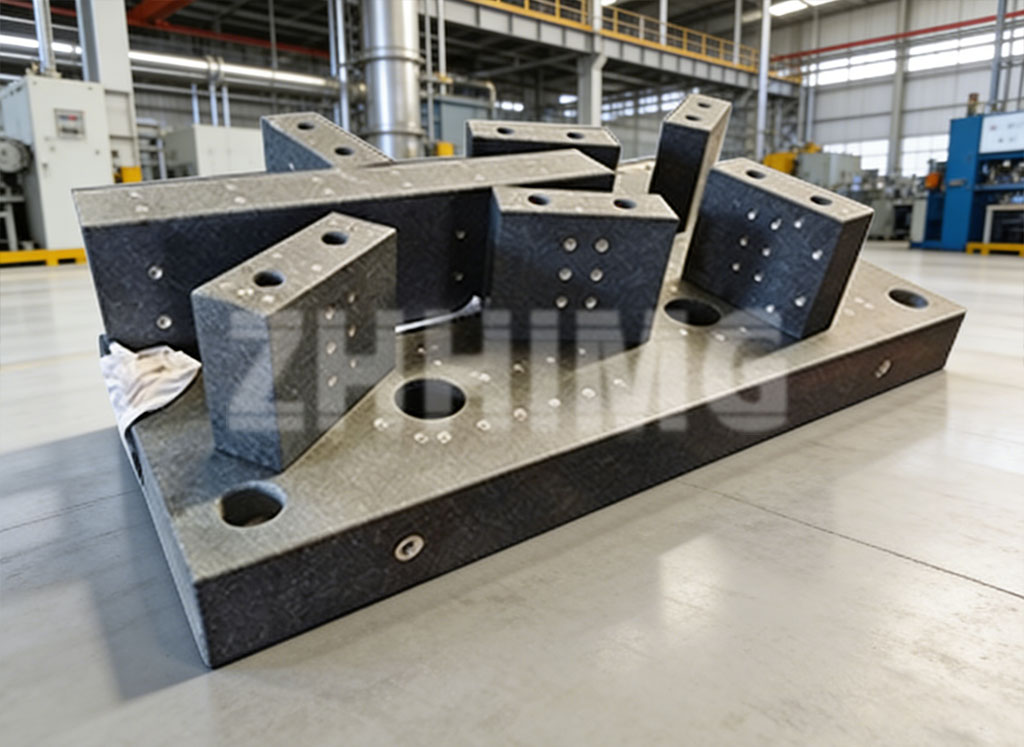
ZHHIMG has developed strong capabilities in the manufacturing of carbon fiber precision components, combining advanced machining technologies with deep material expertise. By integrating carbon fiber structures with metal elements and maintaining strict dimensional control throughout production, ZHHIMG delivers solutions tailored to high-performance applications in aerospace, automotive, and semiconductor sectors.
As engineering requirements continue to evolve, carbon fiber is no longer just an alternative material—it is becoming a strategic choice for achieving lightweight design without sacrificing accuracy. For companies seeking to push the limits of performance and precision, carbon fiber precision components offer a clear and measurable advantage.
Post time: Apr-08-2026