
In the design of modern high-speed automated systems—such as SMT pick-and-place machines, laser cutters, and high-precision gantry platforms—the “moving beam” is the heart of the machine’s dynamic performance. Engineers are constantly balancing the trade-off between mass and rigidity.
Choosing between a Carbon Fiber Precision Beam and a Granite Beam depends entirely on your specific motion requirements. At ZHHIMG®, we specialize in both materials to help you optimize your structural design.
Here is how these two high-performance materials compare in high-speed environments.
The Dynamic Challenge: Mass vs. Precision
For equipment moving at high accelerations (often exceeding 2G or 3G), the primary enemy is inertia. However, reducing weight cannot come at the expense of structural stiffness, or the system will suffer from vibration and “settling time” delays.
1. Carbon Fiber: The King of Dynamic Response
Carbon fiber precision beams are the ultimate lightweight, high-rigidity materials. With a density significantly lower than aluminum or steel, carbon fiber allows for:
-
Extreme Acceleration: Lower mass means the motor can drive the beam faster with less energy.
-
Reduced Vibration: Carbon fiber has excellent internal damping properties, absorbing high-frequency micro-vibrations during high-speed stops.
-
High Specific Stiffness: It provides a strength-to-weight ratio that is unmatched by any metal or mineral.
2. Granite: The Anchor of Static Stability
Granite beams remain the gold standard for applications where the priority is absolute geometric accuracy and thermal mass.
-
Zero Internal Stress: Unlike welded or machined metals, granite is naturally aged for millions of years. It will not warp over time.
-
Thermal Inertia: Granite reacts very slowly to environmental temperature changes, maintaining micron-level flatness across long spans.
-
Damping Capacity: While heavier than carbon fiber, its sheer mass provides a “low-pass filter” effect against low-frequency floor vibrations.
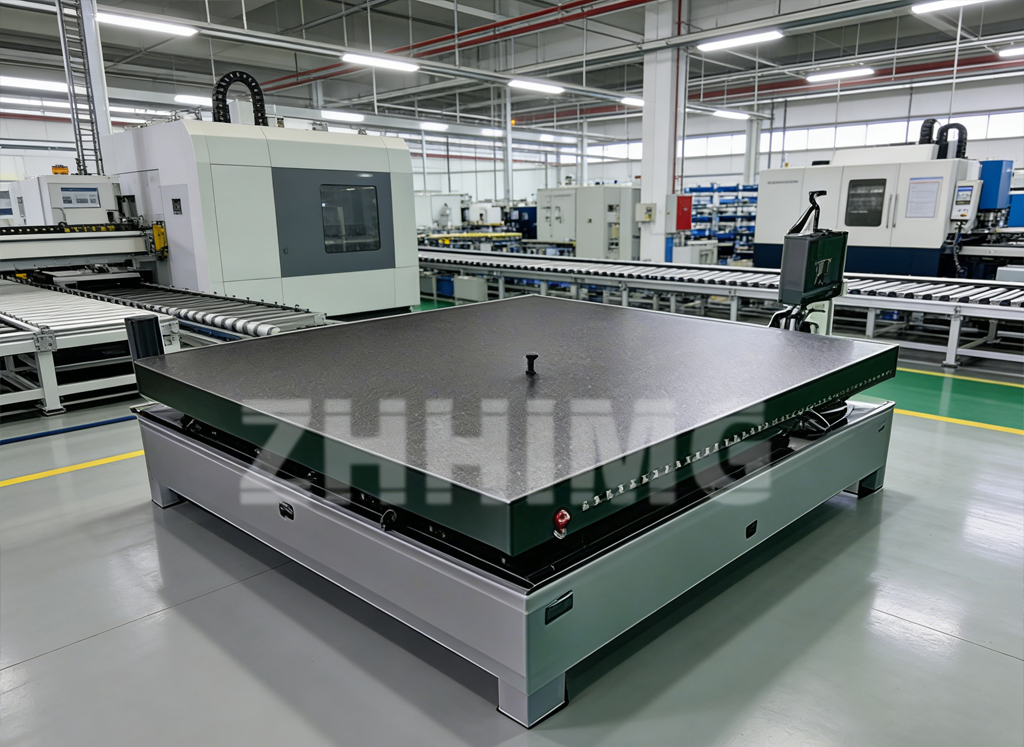
Performance Comparison: Side-by-Side
| Feature | Carbon Fiber (CFRP) | High-Density Granite |
| Density ($g/cm^3$) | ~1.6 – 1.8 (Ultralight) | ~3.0 – 3.1 (Heavy) |
| Dynamic Response | Superior (High acceleration) | Moderate (High inertia) |
| Thermal Expansion | Low to Zero (Tunable) | Very Low ($5 \times 10^{-6}/K$) |
| Stiffness-to-Weight | Highest | Moderate |
| Vibration Damping | Excellent (Active/High-freq) | Excellent (Passive/Mass-based) |
| Best Use Case | High-speed SMT & AOI | CMMs & Precision Grinding |
Which Should You Choose?
Choose Carbon Fiber if:
-
Your application involves constant, rapid reciprocating motion (start-stop cycles).
-
You need to reduce the load on your linear motors to extend their lifespan.
-
You are building high-speed motion structural components for equipment like semiconductor bonders or lightweight gantries.
Choose Granite if:
-
Your equipment moves at a steady, slower pace where accuracy is more important than speed.
-
The environment has significant temperature fluctuations.
-
You are designing a heavy-duty gantry where the base and the beam must act as a single, thermally synchronized unit.
Structural Optimization with ZHHIMG®
At ZHHIMG®, we don’t just supply materials; we provide solutions. Whether you need the ultra-low inertia of a carbon fiber precision beam for a 30,000 CPH pick-and-place machine, or the rock-solid reliability of a black granite beam for a large-format CMM, our engineering team is here to assist.
Post time: Mar-18-2026