
In precision manufacturing, accuracy is rarely limited by machine capability alone. More often, it is influenced by factors that are less visible but equally critical—one of the most important being vibration. Whether it comes from nearby equipment, floor transmission, or internal machine dynamics, vibration can quietly undermine measurement results and machining quality.
As industries push toward tighter tolerances and higher throughput, the choice of base material—particularly between cast iron platforms and granite bases—has become a topic of renewed attention. Both materials have long histories in engineering, and both continue to play essential roles in modern precision machining applications. Yet when it comes to vibration damping, their differences are more nuanced than they first appear.
This article explores those differences from a practical, application-focused perspective, helping engineers and buyers better understand how material behavior affects real-world performance.
Why Vibration Damping Matters More Than Ever
In traditional machining environments, small vibrations could often be tolerated without significant impact. Today, however, the margin for error has narrowed considerably. High-speed machining, ultra-precision inspection, and automated production lines all demand a level of stability that leaves little room for disturbance.
Vibration does not always manifest as visible movement. In many cases, it exists as micro-level oscillations that influence surface finish, tool life, and measurement repeatability. Over time, these subtle effects accumulate, leading to inconsistencies that are difficult to trace back to a single cause.
This is why vibration damping platforms are no longer considered optional components. They are integral to maintaining accuracy, particularly in environments where precision is measured in microns—or even nanometers.
Cast Iron: A Tradition of Strength and Integration
Cast iron has been a cornerstone of machine tool construction for generations. Its widespread use is not accidental. The material offers a combination of strength, machinability, and cost-effectiveness that has made it a default choice for structural components.
One of the defining characteristics of cast iron is its internal graphite structure. This microstructure contributes to its ability to absorb and dissipate vibrational energy, giving it a natural damping capacity that is well-suited for many industrial applications.
In practice, cast iron platforms are often integrated directly into machine frames. This integration allows for compact designs and efficient load distribution. For applications involving heavy cutting forces or dynamic loads, cast iron provides the rigidity needed to maintain structural integrity.
However, its performance is not without limitations. Cast iron is sensitive to environmental factors such as temperature changes and humidity. Over time, these influences can lead to dimensional shifts, particularly if the material has not been properly aged or stress-relieved. In high-precision contexts, even minor changes can affect alignment and calibration.
Granite: Stability Through Natural Structure
Granite, by contrast, offers a fundamentally different approach to vibration control. Formed over millions of years, this natural stone exhibits a dense, uniform structure with excellent dimensional stability.
One of the key advantages of granite bases is their ability to damp high-frequency vibrations. Unlike metals, which can transmit certain frequencies more readily, granite tends to absorb and dissipate energy across a broader spectrum. This makes it particularly effective in applications where environmental vibration is a concern.
Another important factor is thermal behavior. Granite has a low coefficient of thermal expansion, meaning it is less affected by temperature fluctuations. In controlled environments such as metrology labs or semiconductor facilities, this stability is a major advantage.
The concept of granite bases stability is closely tied to this property. Measurements taken on granite surfaces are less likely to drift due to thermal variation, contributing to more reliable results over time.
That said, granite is not typically used as a structural component in the same way as cast iron. It is more commonly applied as a base or reference surface, often supporting machines or measurement systems rather than forming part of their internal structure.
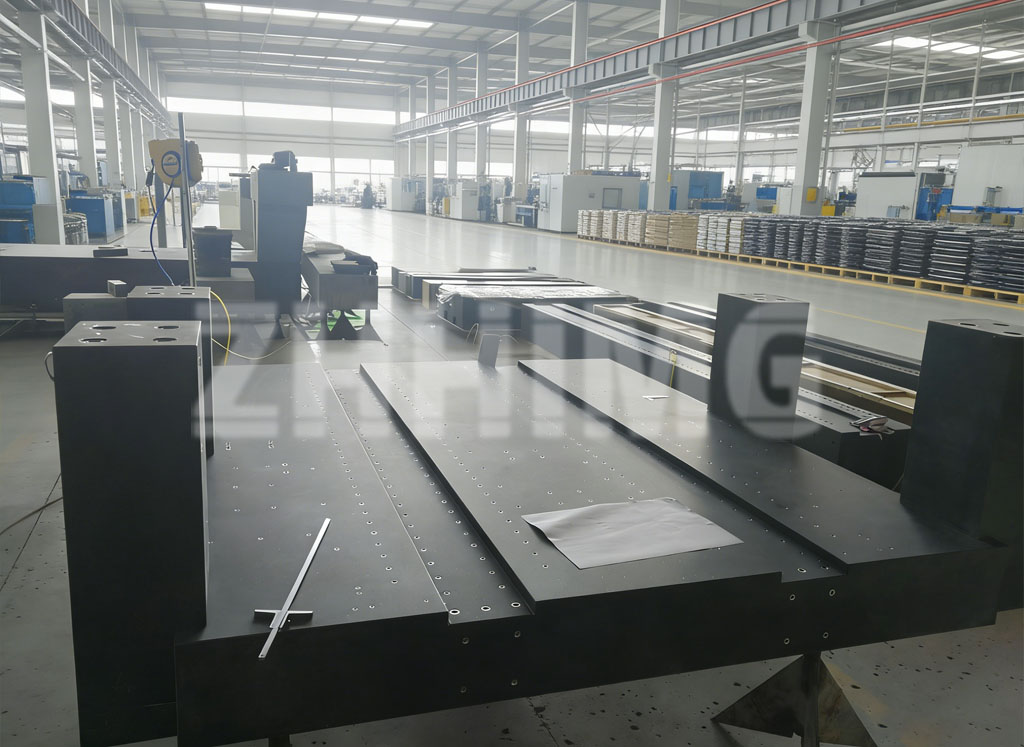
Comparing Vibration Behavior in Real Applications
When evaluating cast iron vs granite vibration performance, it is important to move beyond theoretical properties and consider how each material behaves in actual working conditions.
Cast iron tends to perform well in scenarios where vibrations originate from within the machine itself. Its structural integration allows it to absorb energy generated by motors, cutting tools, and moving components. For heavy-duty machining, this internal damping is a significant advantage.
Granite, on the other hand, excels in isolating external vibrations. In facilities where multiple machines operate simultaneously, or where building vibrations are present, granite bases can act as a barrier, reducing the transmission of unwanted energy to sensitive equipment.
This distinction highlights an important point: vibration damping is not a single characteristic, but a combination of responses to different types of excitation. Choosing the right material depends on identifying the dominant source of vibration in a given application.
Material Properties and Their Impact on Accuracy
The relationship between material properties accuracy is often underestimated. Engineers may focus on machine specifications while overlooking how base materials influence overall system performance.
For cast iron, factors such as residual stress, casting quality, and aging processes play a significant role. Poorly managed materials can introduce internal तनाव that affects long-term stability.
Granite, while more stable in many respects, requires precise processing to achieve flatness and parallelism. The quality of grinding and lapping directly affects its suitability for high-precision tasks.
In both cases, the material itself is only part of the equation. Manufacturing processes, quality control, and installation practices all contribute to the final outcome.
Choosing the Right Solution for Your Application
There is no universal answer to whether cast iron or granite is “better.” The decision depends on the specific requirements of the application.
For machining centers dealing with high loads and dynamic forces, cast iron platforms often provide the necessary strength and integration. Their ability to handle internal vibration makes them a practical choice for production environments.
For inspection systems, optical equipment, and ultra-precision measurement setups, granite bases are frequently preferred. Their stability, resistance to environmental influence, and superior performance in damping external vibrations make them ideal for these contexts.
In many modern facilities, a hybrid approach is also emerging. Machines may use cast iron structures mounted on granite bases, combining the strengths of both materials. This reflects a broader trend toward system-level optimization rather than reliance on a single material solution.
Looking Ahead: Evolving Requirements in Precision Engineering
As manufacturing technologies continue to advance, the demands placed on base materials are becoming more complex. Automation, high-speed machining, and digital measurement systems all require a higher level of consistency and reliability.
At the same time, global competition is pushing manufacturers to reduce variability and improve efficiency. In this environment, understanding the role of materials in vibration control is becoming a strategic advantage.
The discussion around vibration damping platforms is likely to evolve further, incorporating new materials, composite structures, and advanced design techniques. Yet the fundamental principles—stability, damping, and accuracy—will remain central.
Conclusion
The choice between cast iron platforms and granite bases is not simply a matter of preference. It is a decision that directly affects vibration behavior, measurement accuracy, and overall system performance.
Cast iron offers strength and integration, making it well-suited for handling internal machine dynamics. Granite provides stability and environmental isolation, supporting high-precision measurement and sensitive applications.
By understanding how these materials respond to different types of vibration, engineers and buyers can make more informed decisions—ensuring that their equipment performs not just to specification, but to expectation.
In a field where even the smallest disturbance can have measurable consequences, the foundation you choose matters more than ever.
Post time: Apr-10-2026