
As precision requirements across industries push toward sub-micron and even nanometer-scale tolerances, the materials we use for measurement are evolving beyond traditional steel and granite. Ceramic measuring tools—including ceramic straight edges, ceramic squares, and ceramic gauge blocks—are emerging as the superior choice for high-precision metrology applications where stability, wear resistance, and thermal neutrality are non-negotiable.
The quiet revolution in precision measurement isn’t happening at the software or sensor level alone—it’s happening at the material level. Advanced technical ceramics, engineered through decades of materials science innovation, offer distinct advantages that address the fundamental limitations of traditional measurement tools. For quality control laboratories, calibration centers, and manufacturing environments where measurement uncertainty must be minimized, ceramic measuring instruments deliver performance characteristics that steel and granite simply cannot match.
The Limitations of Traditional Measurement Materials
Steel Gauges: Thermal Expansion and Wear Concerns
For decades, steel measuring tools served as the industry standard for dimensional metrology. Their affordability and availability made them ubiquitous in workshops and calibration laboratories worldwide. However, as measurement tolerances tighten, steel’s inherent limitations have become increasingly problematic.
Thermal Expansion Susceptibility
Steel exhibits a coefficient of thermal expansion of approximately 10-12 × 10⁻⁶/°C, meaning that even modest temperature fluctuations cause dimensional changes. In a shop environment where temperature can vary by 10°C or more, a 100 mm steel gauge block can expand or contract by 10-12 microns—equivalent to or exceeding the tolerance of many precision measurements. For sub-micron applications, this thermal drift makes steel unsuitable without严environmental conditions.
Wear and Deformation
While steel gauges are durable, repeated contact with workpieces and calibration standards inevitably causes wear. The material’s hardness, typically 60-65 HRC, provides limited wear resistance compared to ceramics. Over time, the measuring surfaces gradually degrade, necessitating more frequent recalibration and eventual replacement. Additionally, steel is susceptible to corrosion in humid environments or when exposed to cutting fluids, acids, and other industrial chemicals common in manufacturing settings.
Magnetic Interference
Steel’s magnetic properties create problems in environments where magnetic fields could affect measurement accuracy. When calibrating sensitive electronic instruments or measuring magnetic workpieces, steel tools can introduce measurement errors through magnetic attraction or interference. This limitation has become increasingly critical as industries adopt more advanced measurement technologies.
Granite Tools: Porosity and Micro-Damage Issues
Granite surface plates, squares, and straight edges have served as the backbone of precision metrology for over a century. Their natural damping characteristics, reasonable thermal stability, and excellent flatness made them the material of choice for calibration laboratories and inspection rooms. However, even granite has limitations that become apparent at the highest precision levels.
Material Heterogeneity and Porosity
Natural granite, despite its reputation for stability, is not perfectly homogeneous. Microscopic variations in crystal structure and distribution create subtle inconsistencies in thermal expansion behavior throughout the material. More critically, granite exhibits some degree of porosity—microscopic voids that can absorb moisture, oils, and other contaminants. This absorption can cause dimensional changes over time and compromise surface quality.
Micro-Chipping and Surface Damage
When granite measuring tools experience impact or repeated contact, they tend to chip rather than simply wear smoothly. These micro-chips create burrs and surface irregularities that affect measurement accuracy. Unlike steel, where wear occurs relatively uniformly across the surface, granite damage tends to be localized and more difficult to predict or control.
Limited Wear Resistance
While harder than many metals, granite’s wear resistance falls short of that achieved by engineered ceramics. In high-use applications where measuring tools contact workpieces thousands of times per day, granite surfaces gradually degrade, requiring more frequent resurfacing and recalibration. The material’s porosity also makes it more susceptible to infiltration by cutting fluids and lubricants, accelerating wear.
Engineered Ceramics: The Material Science Revolution
Understanding Technical Ceramics
The term “ceramic” in metrology applications refers not to everyday pottery, but to highly engineered technical materials produced through advanced sintering processes under extreme heat and pressure. Two ceramic families dominate precision measurement applications: alumina-based ceramics and silicon carbide-based ceramics. Each offers specific advantages suited to different metrology requirements.
Alumina Ceramics (Al₂O₃)
Alumina ceramics, particularly high-purity grades (99.5%+), offer an exceptional balance of properties for precision measurement. With a Vickers hardness of 1500-1800 HV, alumina provides outstanding wear resistance—significantly harder than both steel and granite. The material’s coefficient of thermal expansion of 7-8 × 10⁻⁶/°C is approximately half that of steel, dramatically reducing thermal drift.
Alumina’s non-porous structure eliminates moisture absorption and makes it chemically inert—immune to corrosion from acids, alkalis, and industrial chemicals. The material exhibits excellent dimensional stability over time, with negligible creep or stress relaxation even under heavy loads. At 3.6-3.9 g/cm³ density, alumina is lighter than steel while maintaining superior stiffness due to its high elastic modulus (350-400 GPa).
Silicon Carbide Ceramics (SiC)
For applications requiring ultimate stiffness and thermal conductivity, silicon carbide ceramics offer exceptional performance. With a Young’s modulus exceeding 400 GPa—more than three times that of steel—SiC provides extraordinary rigidity that minimizes deflection under load. The material’s thermal conductivity, rivaling that of aluminum, enables rapid thermal equalization and exceptional stability in varying temperature environments.
Silicon carbide’s coefficient of thermal expansion can be engineered to match that of optical glasses or silicon wafers, enabling near-zero differential expansion in hybrid assemblies. This characteristic makes SiC ceramics invaluable in semiconductor manufacturing, aerospace optics, and other high-precision applications where thermal mismatch must be eliminated.
Zirconia-Toughened Ceramics (ZTA)
Zirconia-toughened alumina combines the best properties of both materials, offering enhanced fracture toughness while maintaining excellent hardness and wear resistance. The material’s transformation-toughening mechanism provides exceptional resistance to chipping and impact damage, addressing one of the traditional concerns about ceramic brittleness. ZTA ceramics are particularly valuable in applications where the measuring tool may experience occasional impacts or rough handling.
Key Advantages of Ceramic Measuring Tools
1. Superior Thermal Stability
The most significant advantage of ceramic measuring tools lies in their exceptional thermal stability compared to steel and traditional materials. This stability manifests in multiple ways that directly impact measurement accuracy and repeatability.
Low Coefficient of Thermal Expansion
Alumina ceramic’s coefficient of thermal expansion (7-8 × 10⁻⁶/°C) is approximately half that of steel, meaning it experiences half the dimensional change for the same temperature variation. In practical terms, a 500 mm alumina ceramic straight edge will expand or contract by approximately 4 microns when the temperature changes by 10°C, compared to 60-80 microns for a comparable steel tool. This difference represents an order of magnitude improvement in thermal stability.
For high-precision applications where tolerances are measured in microns or sub-microns, this thermal stability is not merely advantageous—it’s essential. Semiconductor lithography, precision optics manufacturing, and aerospace component inspection all require measurement references that remain stable across normal environmental temperature variations. Ceramic measuring tools deliver this stability without the need for extreme environmental controls.
Thermal Equilibration Rate
Beyond the coefficient of thermal expansion, ceramic materials exhibit favorable thermal conductivity characteristics that enable rapid thermal equilibration. Alumina ceramics conduct heat more uniformly than steel, reducing thermal gradients within the measuring tool when ambient temperatures change. Silicon carbide, with thermal conductivity comparable to aluminum, equilibrates almost instantly, ensuring that the entire tool reaches thermal equilibrium quickly after environmental changes.
This rapid equilibration reduces measurement uncertainty caused by thermal lag—the delay between environmental temperature changes and the tool’s dimensional response. In busy laboratories or manufacturing floors where temperatures fluctuate throughout the day, ceramic tools reach stable dimensions faster and maintain them more consistently than steel alternatives.
Reduced Calibration Frequency
The combination of low thermal expansion and rapid equilibration means ceramic measuring tools require less frequent recalibration compared to steel equivalents. In quality systems that define calibration intervals based on measurement uncertainty analysis, ceramic tools can often justify extended calibration cycles—reducing downtime, maintenance costs, and the risk of using tools that have drifted out of specification between calibration cycles.
2. Exceptional Wear Resistance
The second major advantage of ceramic measuring tools is their outstanding wear resistance, which directly impacts service life and measurement accuracy retention over time.
Hardness Characteristics
Alumina ceramics achieve Vickers hardness values of 1500-1800 HV, while silicon carbide reaches 2500-3000 HV. For comparison, hardened tool steel typically achieves 800-900 HV, and granite measures approximately 600-700 HV. This hardness advantage translates directly to wear resistance—ceramic tools can withstand significantly more contact cycles before dimensional accuracy degrades.
In practical use, a ceramic straight edge or square can experience thousands of measurement contacts per day for years without noticeable wear. Steel tools, by contrast, gradually lose accuracy due to surface wear, requiring more frequent inspection and recalibration. The difference becomes particularly apparent in high-volume production environments where measuring tools are in constant use.
Wear Pattern Uniformity
Unlike granite, which tends to chip when damaged, ceramics wear uniformly under normal use. This uniform wear pattern means that dimensional changes occur predictably and gradually rather than through catastrophic localized damage. When wear eventually occurs, it typically affects the entire measuring surface equally, preserving the tool’s geometric accuracy longer than if damage were concentrated in specific areas.
Extended Service Life
The combination of high hardness and uniform wear patterns gives ceramic measuring tools exceptional service life—often 5-10 times longer than steel equivalents in similar applications. Quality managers who calculate total cost of ownership frequently find that despite higher initial purchase prices, ceramic tools deliver lower lifetime costs due to extended service intervals, reduced recalibration frequency, and eliminated replacement costs.
A ceramic gauge block used daily for calibration may maintain accuracy for 15-20 years, while a comparable steel block might require replacement every 3-5 years. Over the lifetime of a high-use calibration laboratory, this difference represents substantial cost savings and reduced administrative overhead for calibration management.
3. Dimensional Stability and Long-Term Accuracy
Dimensional stability—the ability to maintain precise dimensions over time under various environmental and usage conditions—represents perhaps the most critical characteristic of precision measuring tools. Ceramic materials excel in this regard through multiple mechanisms.
Absence of Material Creep
Unlike metals, which can experience gradual plastic deformation under sustained loads (creep), ceramic materials exhibit virtually no creep deformation at normal operating temperatures and loads. A ceramic surface plate or square maintains its flatness and parallelism indefinitely, even when supporting heavy workpieces for extended periods.
This absence of creep is particularly valuable for master reference tools used in calibration laboratories. A ceramic master square used to calibrate coordinate measuring machines (CMMs) will maintain its perpendicularity specification for decades, eliminating the uncertainty introduced by gradual dimensional drift that can affect metal or even some granite references.
Resistance to Stress Relaxation
Ceramic materials do not experience stress relaxation—the gradual relief of internal stresses over time that can cause dimensional changes in manufactured parts. Once precision-machined and stress-relieved during sintering, ceramic measuring tools maintain their geometry indefinitely. This contrasts with metals, which can gradually distort as internal stresses relax over months or years.
For critical metrology applications where measurement uncertainty must be minimized, this long-term dimensional stability is invaluable. Calibration laboratories can establish traceability chains with confidence that their reference standards will not drift between certification cycles.
Moisture and Chemical Resistance
Ceramic materials are completely non-porous and chemically inert, eliminating concerns about moisture absorption or chemical degradation. Steel tools require protective oils and coatings to prevent rust in humid environments, and even with protection, gradual corrosion can affect dimensional accuracy. Granite, though less porous than many materials, can still absorb cutting fluids, oils, and other contaminants over time.
Ceramic tools require no protective coatings or special environmental considerations. They can be used in cleanrooms, chemical processing environments, and outdoor applications without compromising measurement accuracy. This versatility reduces environmental control requirements and maintenance procedures.
4. Non-Magnetic and Non-Conductive Properties
For modern measurement applications, ceramic’s electrical and magnetic properties offer significant advantages over traditional materials.
Magnetic Interference Elimination
Steel’s magnetic properties create problems in environments where electromagnetic fields could affect measurement accuracy. When calibrating sensitive electronic instruments, measuring magnetic workpieces, or operating near electromagnetic interference sources, steel tools can introduce measurement errors through magnetic attraction or field distortion.
Ceramic tools are completely non-magnetic, eliminating these interference concerns entirely. This characteristic is becoming increasingly important as industries adopt more electronic and optically-based measurement technologies that can be affected by magnetic fields. Medical device manufacturing, semiconductor equipment calibration, and precision electronics inspection all benefit from ceramic’s non-magnetic nature.
Electrical Insulation
Ceramic materials are excellent electrical insulators, with dielectric strengths exceeding 10 kV/mm for alumina ceramics. This property is valuable in applications where electrical conductivity could cause measurement errors or safety hazards. In environments where static charge accumulation is a concern, ceramic tools help prevent discharge events that could damage sensitive electronic components.
Cleanroom Compatibility
The non-porous, non-shedding nature of ceramic surfaces makes them ideal for cleanroom applications. Steel tools can generate microscopic metal particles through wear, while granite tools may shed crystalline particles. Ceramic tools generate minimal particulate contamination, making them suitable for semiconductor fabrication facilities, aerospace cleanrooms, and other controlled environments where particle generation must be minimized.
5. Weight and Ergonomic Advantages
Beyond their metrological advantages, ceramic measuring tools offer practical benefits related to weight and usability.
Reduced Weight
Ceramic materials typically weigh approximately half as much as steel and one-third as much as granite for equivalent dimensions. A 1000 mm ceramic straight edge weighs approximately 40 kg, compared to 80 kg for steel and 120 kg for granite. This weight reduction makes large-format measuring tools significantly easier to handle, transport, and position.
In busy laboratories or manufacturing floors, reduced weight translates to improved ergonomics and reduced risk of operator injury. Single-person handling becomes possible for larger tools, reducing the need for lifting equipment or multiple operators. The weight advantage also facilitates setup changes and tool repositioning during measurement processes.
Stiffness-to-Weight Ratio
Despite their lighter weight, ceramic materials offer exceptional stiffness due to their high elastic modulus. Ceramic measuring tools provide the stiffness-to-weight ratio that surpasses both steel and granite, meaning they deflect less under their own weight while still being easier to handle. This characteristic is particularly valuable for long straight edges and large squares where self-weight deflection can compromise measurement accuracy.
6. Vibration Damping Characteristics
Ceramic materials exhibit excellent vibration damping properties, absorbing vibrations that could otherwise affect measurement accuracy. This characteristic is valuable in manufacturing environments where external vibrations from machinery, foot traffic, or other sources are present.
Internal Damping
The crystalline structure of ceramic materials provides internal damping that dissipates vibrational energy. Unlike steel, which can ring and transmit vibrations, ceramic tools absorb and damp vibrations, maintaining measurement stability even in noisy environments.
Stability in Dynamic Environments
For applications involving moving workpieces or dynamic measurement processes, ceramic tools provide a stable reference that resists vibration-induced errors. Coordinate measuring machine bases, precision alignment fixtures, and dynamic inspection setups all benefit from ceramic’s vibration damping characteristics.
Ceramic Measuring Tool Applications
Ceramic Straight Edges: The Ultimate Reference for Straightness Measurement
Ceramic straight edges represent one of the most valuable applications of advanced ceramics in precision metrology. These tools provide exceptional straightness references for machine tool calibration, surface inspection, and precision alignment tasks.
Precision Capabilities
High-quality ceramic straight edges achieve straightness tolerances better than 0.8 µm over 500 mm lengths, with some specialized tools reaching 0.5 µm over 1000 mm. By comparison, equivalent steel or granite straight edges typically achieve 2-3 µm over similar lengths. This precision advantage makes ceramic straight edges indispensable for calibrating coordinate measuring machines, inspecting machine tool guideways, and verifying surface plate flatness.
Length Capabilities
Ceramic materials enable the production of extraordinarily long straight edges that would be impractical in steel or granite due to weight and handling concerns. Ceramic straight edges up to 4000 mm in length are commercially available, with custom lengths possible. These long references maintain exceptional straightness while weighing significantly less than alternative materials, enabling practical use in large-scale measurement applications.
Specialized Variants
Beyond standard straight edges, ceramic technology enables specialized variants such as air-floating ceramic rulers. These tools incorporate precision air-bearing surfaces that allow the ruler to float a few microns above the workpiece, eliminating contact wear and enabling true non-contact measurement. Air-floating ceramic rulers are particularly valuable for inspecting delicate optical components, semiconductor wafers, and other sensitive parts where contact could cause damage.
Application Examples
- Machine Tool Calibration: Verifying straightness of CNC machine tool guideways and work tables
- Surface Plate Inspection: Checking flatness of granite or ceramic surface plates using the straight edge as a reference
- CMM Verification: Calibrating coordinate measuring machine straightness and squareness accuracy
- Precision Alignment: Aligning linear stages, optical components, and precision assemblies
- Automotive Component Inspection: Measuring straightness and flatness of engine blocks, transmission housings, and other critical components
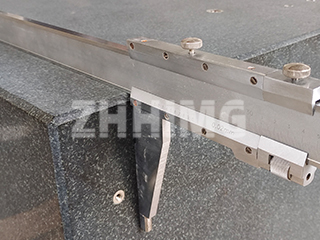
Ceramic Squares: Perpendicularity Redefined
Ceramic squares—also called ceramic angle plates or ceramic master squares—provide exceptional perpendicularity references for calibration and inspection tasks requiring precise angle verification.
Angle Accuracy
High-precision ceramic squares achieve perpendicularity tolerances within 1-2 arc-seconds (equivalent to 5-10 µm deviation at 300 mm). This accuracy level exceeds that of comparable steel or granite squares, which typically achieve 3-5 arc-seconds. For applications requiring verification of right angles within tight tolerances, ceramic squares provide the most reliable reference.
Multi-Planar Accuracy
Ceramic squares are available with two, three, four, or even six precision faces, enabling verification of multiple orthogonal relationships simultaneously. A six-face ceramic square provides reference planes for X, Y, and Z axes, making it invaluable for CMM calibration, machine tool squareness verification, and comprehensive inspection tasks.
Thermal Stability Benefits
The low thermal expansion of ceramic materials makes squares particularly valuable for perpendicularity measurements. Unlike steel squares, which can change their angle significantly with temperature variations, ceramic squares maintain precise right angles across normal environmental temperature ranges. This stability eliminates the need for temperature-controlled environments for many applications.
Application Examples
- CMM Calibration: Establishing perpendicularity reference for coordinate measuring machine axes
- Machine Tool Squareness: Verifying squareness between machine tool axes (X-Y, Y-Z, Z-X)
- Precision Assembly: Aligning orthogonal components in aerospace, optical, and precision machinery assembly
- Calibration Laboratory: Serving as master angle references for calibrating other angle measurement devices
- Quality Control: Inspecting perpendicularity of machined components, welded assemblies, and manufactured parts
Ceramic Gauge Blocks: The Ultimate Length Standard
Ceramic gauge blocks represent the pinnacle of length standard technology, offering superior stability and wear resistance compared to traditional steel gauge blocks.
Wringing Performance
Ceramic gauge blocks exhibit excellent wringing characteristics—the ability to adhere to other blocks or reference surfaces through molecular attraction forces. High-purity ceramic surfaces, when properly cleaned and lapped, wring together as effectively as steel blocks, enabling the assembly of precise dimension combinations.
Calibration Grade Performance
Ceramic gauge blocks are available in the highest calibration grades (K, 0, and AS-1), with length tolerances as tight as ±0.05 µm for 10 mm blocks in Grade K. The material’s stability ensures that these tight tolerances are maintained between calibration cycles, with minimal dimensional drift.
Environmental Robustness
Unlike steel gauge blocks, which require protective coatings and careful environmental control to prevent corrosion, ceramic gauge blocks operate without special protection. They can be used in humid environments, cleanrooms, and outdoor applications without compromising accuracy. This robustness reduces maintenance requirements and enables use in diverse environments.
Long-Term Stability Studies
Long-term stability studies conducted by national metrology institutes have demonstrated that ceramic gauge blocks maintain their calibration accuracy for significantly longer periods than steel equivalents. While steel blocks may require annual recalibration for critical applications, ceramic blocks can often justify 2-3 year calibration intervals while maintaining required uncertainty levels.
Application Examples
- Length Standard Calibration: Serving as master length standards for calibrating micrometers, calipers, height gauges, and other length measuring instruments
- CMM Probe Calibration: Providing precise length references for calibrating coordinate measuring machine probes and stylus lengths
- Precision Manufacturing: Setting precise dimensions in precision machining, grinding, and assembly operations
- Laboratory Standards: Serving as primary length standards in calibration laboratories and quality control departments
Surface Plates and Reference Surfaces
While granite has traditionally dominated the surface plate market, ceramic materials are increasingly used for high-precision applications requiring exceptional stability and cleanliness.
Cleanroom Surface Plates
Ceramic surface plates are ideal for cleanroom applications where particle generation must be minimized. Unlike granite, which can shed crystalline particles, ceramic surfaces are non-porous and generate minimal particulate contamination. This characteristic makes ceramic plates valuable in semiconductor manufacturing, aerospace cleanrooms, and pharmaceutical production environments.
Thermal Stability Applications
For applications requiring exceptional thermal stability, ceramic surface plates outperform both granite and steel options. Ceramic’s low coefficient of thermal expansion and high thermal conductivity enable the plate to maintain flatness across wider temperature ranges. Applications in environments with limited climate control benefit from this enhanced stability.
Specialized Configurations
Ceramic materials enable specialized surface plate configurations not practical in granite. Lightweight honeycomb structures reduce weight while maintaining stiffness. Integrated leveling systems and vibration isolation can be incorporated during manufacturing. Custom shapes and embedded features are more feasible in ceramics, enabling application-specific solutions.
Cost Considerations and Return on Investment
Initial Investment Premium
Ceramic measuring tools typically command higher initial purchase prices than equivalent steel tools—often 30-50% more for gauge blocks and 50-100% more for straight edges and squares. This premium reflects several factors:
- Material Costs: High-purity ceramic powders and advanced sintering processes are more expensive than steel production
- Manufacturing Complexity: Precision machining of ceramics requires diamond tooling and specialized grinding equipment
- Quality Control: Additional inspection and certification processes are required to achieve tight tolerances
However, this initial premium must be evaluated in the context of total cost of ownership rather than purchase price alone.
Total Cost of Ownership Analysis
When evaluating ceramic measuring tools across their service life, the total cost analysis often favors ceramics despite higher initial prices.
Extended Service Life
Ceramic tools typically last 5-10 times longer than steel equivalents in similar applications. A ceramic straight edge that maintains calibration accuracy for 15-20 years provides significantly lower annualized cost than a steel tool requiring replacement every 3-5 years.
Reduced Calibration Frequency
The superior dimensional stability of ceramics enables extended calibration intervals. While steel tools may require annual recalibration, ceramic tools can often justify 2-3 year intervals for critical applications. This reduction in calibration frequency saves both direct calibration costs and the indirect costs of tool downtime and logistics.
Lower Maintenance Costs
Ceramic tools require no protective coatings, oiling, or special storage procedures. They are immune to corrosion and resistant to chemical damage. This eliminates ongoing maintenance costs associated with protecting steel tools from environmental degradation.
Quality and Reliability Benefits
The reliability and accuracy of ceramic tools translate directly into improved measurement quality. Reduced measurement uncertainty means fewer rejected parts, less rework, and higher first-pass yield. For high-precision manufacturers, these quality improvements can represent substantial cost savings that far exceed tool price differences.
Break-Even Analysis
In many high-use applications, ceramic measuring tools achieve break-even compared to steel alternatives within 3-5 years. Beyond this point, the cumulative savings from extended service intervals, reduced calibration frequency, and eliminated replacement costs generate ongoing economic benefits.
For calibration laboratories serving external customers, ceramic tools can also enable new business opportunities. The superior performance of ceramic references may justify premium calibration services for customers requiring the highest measurement accuracy and uncertainty.
Implementation Considerations
Transitioning from Traditional Materials
For laboratories and manufacturers considering the transition to ceramic measuring tools, several implementation considerations should be addressed.
Training Requirements
Operators accustomed to steel or granite tools may require training on ceramic handling and maintenance procedures. While ceramics are more wear-resistant, they can be brittle if mishandled. Proper handling techniques, storage procedures, and inspection methods should be established to maximize tool life and maintain accuracy.
Storage and Handling
Ceramic tools require appropriate storage solutions to prevent damage. While more resistant to environmental degradation than steel, ceramics should be stored in protective cases to prevent chipping from impact. Wooden or lined cases provide appropriate protection. Large tools like straight edges require proper support during storage to prevent bending or stress.
Calibration Integration
Existing calibration processes may need adaptation to accommodate ceramic tools. Calibration equipment capable of achieving the tighter tolerances of ceramic references may be required. Calibration intervals should be reevaluated based on ceramic stability characteristics, potentially extending intervals compared to steel tools.
Documentation and Traceability
Ceramic tools should be integrated into existing quality management systems with appropriate documentation. Material certificates, calibration reports, and traceability chains should be maintained. The superior stability of ceramics often justifies more rigorous initial certification to fully leverage their capabilities.
Quality System Integration
Ceramic measuring tools integrate seamlessly with international quality standards and measurement systems.
ISO 9001 and ISO 17025
Ceramic tools are fully compatible with ISO 9001 quality management requirements and ISO 17025 calibration laboratory accreditation. Their stability and accuracy characteristics facilitate compliance with measurement uncertainty requirements and calibration traceability obligations.
Industry-Specific Standards
In industries with specific metrology requirements—such as aerospace (AS9100), automotive (IATF 16949), or medical devices (ISO 13485)—ceramic tools help meet stringent measurement accuracy and traceability requirements. The enhanced stability and reduced uncertainty of ceramic references support compliance with industry-specific quality standards.
The Future of Ceramic Metrology
Material Science Advances
Ongoing research in materials science continues to advance ceramic capabilities for metrology applications. New ceramic formulations with enhanced properties are under development:
Zirconia Toughened Alumina (ZTA) Variants
Improved ZTA formulations are enhancing fracture toughness while maintaining hardness and wear resistance. These materials address traditional concerns about ceramic brittleness while preserving the metrological advantages of ceramics.
Ultra-Low Expansion Ceramics
Research into ceramic materials with near-zero thermal expansion coefficients could revolutionize precision measurement. Materials with CTE values below 1 × 10⁻⁶/°C would virtually eliminate thermal drift, enabling unprecedented measurement stability.
Hybrid Ceramic-Metal Composites
Composite materials combining ceramic surfaces with metal structural elements could provide optimal combinations of stiffness, thermal conductivity, and manufacturability. These hybrid approaches may expand ceramic applications into new measurement domains.
Manufacturing Technology Advances
Advances in ceramic manufacturing are improving the quality and availability of precision ceramic measuring tools.
Ultra-Precision Grinding
Sub-micron grinding capabilities enable tighter tolerances and better surface finishes on ceramic components. Advances in diamond grinding wheel technology and CNC grinding platforms are pushing ceramic precision to new levels.
Laser Interferometric Measurement
In-process laser interferometry enables real-time verification of ceramic tool dimensions during manufacturing, ensuring that final products meet tight specifications with minimal scrap.
Additive Manufacturing
Emerging ceramic additive manufacturing techniques may enable new geometries and configurations not possible with traditional forming methods. Complex internal structures for lightweight designs and integrated functional features could become feasible.
Market Trends and Adoption
The market for ceramic measuring tools continues to grow as industries recognize their advantages.
Semiconductor Industry Adoption
Semiconductor manufacturers increasingly specify ceramic measuring tools for critical metrology tasks. The industry’s push toward smaller feature sizes and tighter tolerances demands the stability and accuracy that only ceramics can provide.
Aerospace and Defense
Aerospace applications, with their extreme precision requirements and harsh operating environments, represent strong growth markets for ceramic metrology tools. Satellite manufacturing, rocket propulsion system inspection, and aircraft component measurement all benefit from ceramic advantages.
Medical Device Manufacturing
Medical device manufacturers, particularly those producing implants and precision surgical instruments, are adopting ceramic measuring tools to meet regulatory requirements for measurement accuracy and traceability.
Conclusion: The Ceramic Advantage
Ceramic measuring tools represent the future of precision metrology. Their combination of thermal stability, wear resistance, dimensional stability, and environmental robustness addresses fundamental limitations of traditional steel and granite measurement tools.
For quality control laboratories, calibration centers, and precision manufacturers facing ever-tightening tolerance requirements, ceramic tools offer distinct advantages:
- Reduced measurement uncertainty through superior thermal stability
- Extended service life reducing total cost of ownership
- Lower calibration frequency decreasing downtime and maintenance costs
- Improved quality enabling higher first-pass yields and reduced scrap
- Environmental versatility enabling use in diverse applications
While the initial investment in ceramic measuring tools is higher than traditional alternatives, the total cost of ownership analysis frequently favors ceramics over their service life. The extended calibration intervals, reduced maintenance requirements, and eliminated replacement costs generate economic benefits that compound over time.
As industries continue pushing toward atomic-scale precision and sub-micron tolerances, the limitations of traditional materials become increasingly apparent. Ceramic measuring tools, with their exceptional metrological characteristics, are not merely an option for high-precision applications—they are becoming a necessity.
For organizations committed to maintaining measurement excellence and supporting continuous improvement in precision manufacturing, ceramic measuring tools represent a strategic investment in measurement infrastructure. The question is not whether ceramic tools will become the standard for high-precision metrology—the question is how quickly organizations will transition to realize the competitive advantages they provide.
At ZHHIMG, we specialize in delivering ceramic measuring tools engineered to the highest precision standards. Our ceramic straight edges, squares, and gauge blocks are manufactured using advanced materials and precision machining processes to deliver exceptional performance for the most demanding metrology applications.
Post time: Mar-13-2026