
In high-precision industries such as aerospace component manufacturing and precision mold fabrication, square masters are fundamental reference tools used for verifying perpendicularity, straightness, and geometric integrity. As tolerances tighten and measurement environments diversify, the choice of material—ceramic or granite—has become a critical engineering decision.
While granite has long been the traditional standard, advanced alumina ceramic metrology tools are rapidly gaining adoption due to their unique combination of lightweight structure, extreme hardness, and thermal stability.
The Evolving Requirements of Precision Measurement
Modern applications increasingly demand:
- High verticality accuracy over large dimensions
- Portability for on-site or in-process inspection
- Resistance to wear and environmental influence
- Long-term dimensional stability
For aerospace and mold manufacturers, these requirements often extend beyond what conventional granite tools can efficiently deliver—especially in mobile or large-scale inspection scenarios.
Ceramic vs. Granite: Material Property Comparison
1. Density & Weight (Lightweight Advantage)
| Material | Density (g/cm³) |
|---|---|
| Granite | 2.7 – 3.0 |
| Alumina Ceramic | 3.6 – 3.9 |
At first glance, ceramic appears denser. However, in real-world applications:
- Ceramic square masters can be engineered with thinner cross-sections
- Structural optimization reduces overall mass
- Final tools are often 20–40% lighter than equivalent granite designs
Engineering Impact:
- Easier handling and repositioning
- Reduced operator fatigue
- Ideal for large vertical inspection setups
2. Hardness & Wear Resistance
| Material | Mohs Hardness |
|---|---|
| Granite | 6 – 7 |
| Alumina Ceramic | 8 – 9 |
Key Insight:
Alumina ceramic exhibits significantly higher hardness, resulting in:
- Superior scratch resistance
- Minimal surface wear over prolonged use
- Maintained accuracy even in high-frequency inspection environments
For precision mold manufacturers, this ensures consistent measurement reliability across extended production cycles.
3. Thermal Stability (CTE Performance)
| Material | CTE (×10⁻⁶ /°C) |
|---|---|
| Granite | 5.5 – 7.0 |
| Alumina Ceramic | 6.5 – 8.0 |
Both materials offer excellent thermal stability. However:
- Granite has slightly lower CTE → advantageous in controlled lab environments
- Ceramic provides more uniform thermal behavior and faster equilibrium
Application Insight:
- Granite → optimal for static, temperature-controlled metrology rooms
- Ceramic → better suited for dynamic or shop-floor conditions
4. Structural Design Flexibility
Ceramic materials allow advanced manufacturing techniques such as:
- Precision sintering
- CNC machining of complex geometries
- Integration of lightweight internal structures
This enables:
- Slimmer profiles without compromising rigidity
- Custom-designed square masters for large-scale aerospace parts
- Easier integration into automated inspection systems
Granite, by contrast, is limited by its natural structure and machining constraints.
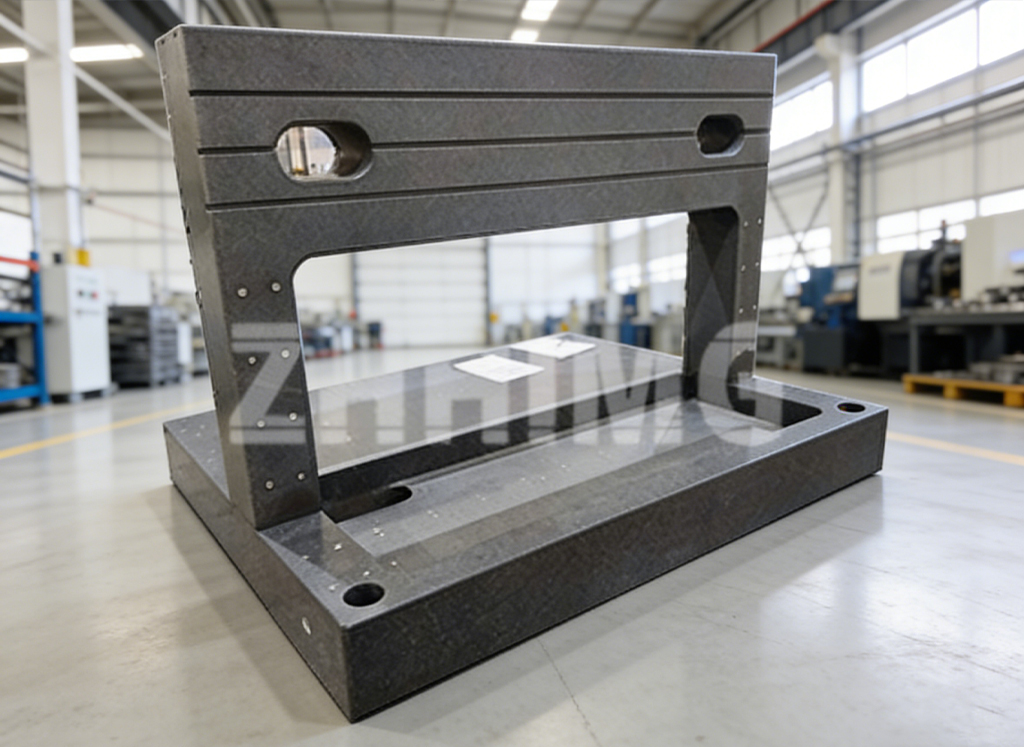
5. Vibration & Stability Characteristics
Granite remains superior in natural vibration damping, making it ideal for:
- Ultra-stable laboratory environments
- High-end metrology reference systems
Ceramic, while slightly less damped, compensates with:
- Higher stiffness-to-weight ratio
- Better suitability for portable precision tools
Application-Based Material Selection
Choose Ceramic Square Masters when:
- Portability is critical
- Large components require frequent repositioning
- High wear resistance is needed
- Inspection occurs on the shop floor
Typical users:
- Aerospace structural component manufacturers
- Large mold and die makers
- On-site quality inspection teams
Choose Granite Square Masters when:
- Maximum vibration damping is required
- Measurement is conducted in controlled environments
- Tool weight is not a limitation
- Long-term static calibration is the priority
ZHHIMG® Alumina Ceramic Metrology Solutions
ZHHIMG offers high-performance alumina ceramic square masters engineered for next-generation precision measurement:
Key features:
- High-purity alumina for exceptional hardness and stability
- Lightweight optimized structures for ergonomic handling
- Precision lapped surfaces for micron-level perpendicularity
- Custom sizes for large aerospace and mold applications
These tools are increasingly adopted in:
- Aircraft structural inspection
- Precision tooling validation
- Large-format verticality measurement
The Bottom Line
The debate between ceramic vs. granite is not about which material is universally better—it is about application alignment.
- Granite remains the benchmark for stability and damping
- Ceramic represents the future of lightweight precision tools
For manufacturers facing challenges in mobility, handling, and wear resistance, ceramic square masters offer a decisive advantage.
Conclusion
As precision manufacturing evolves toward greater scale, flexibility, and efficiency, metrology tools must evolve accordingly.
For aerospace and mold industries seeking high-performance, lightweight, and durable inspection solutions, ZHHIMG® alumina ceramic metrology tools provide a powerful alternative to traditional granite.
Post time: Apr-08-2026