
In the nanometer world of semiconductor lithography, the slightest structural tremor or a microscopic thermal expansion can render a multi-million dollar silicon wafer useless. As the industry moves toward 2nm nodes and beyond, the materials used for machine bases are no longer just “supports”—they are active participants in the pursuit of precision.
At ZHHIMG, we are increasingly asked by global OEMs: Should we stick with the proven stability of precision granite, or is it time to transition to advanced technical ceramics? The answer lies in the specific physics of your application.
The Physics of Stability: Granite vs. Ceramic
When comparing precision granite components and ceramic members, we must look at the “holy trinity” of precision engineering: Damping, Thermal Stability, and Stiffness.
1. Vibration Damping: The Advantage of Natural Microstructure
Vibration is the enemy of throughput. Granite, a natural igneous rock, possesses a complex polycrystalline structure that acts as a natural shock absorber. This internal friction allows granite to dissipate mechanical energy far more effectively than most synthetic materials.
In contrast, advanced ceramics like Silicon Carbide (SiC) or Alumina are incredibly stiff. While this stiffness is beneficial for high-frequency response, ceramics offer significantly less internal damping. In a lithography environment, where stages move with extreme acceleration, a granite base from ZHHIMG provides the “quiet” environment necessary for the optics to remain perfectly aligned.
2. Thermal Dynamics: Managing the Micron
Thermal expansion is often the bottleneck in long-term accuracy. Natural granite has a remarkably low coefficient of thermal expansion (CTE), typically around 5 × 10^{-6}/K to 6 × 10^{-6}/K.
Advanced ceramics can achieve even lower nominal CTE values, but they often have lower thermal inertia. This means that while they expand less in total, they react much faster to ambient temperature fluctuations. Granite’s massive thermal mass acts as a “buffer,” making it the preferred choice for large-scale lithography machine bases where the environment must remain steady over hours of continuous operation.
Materials for the Lithography Frontier
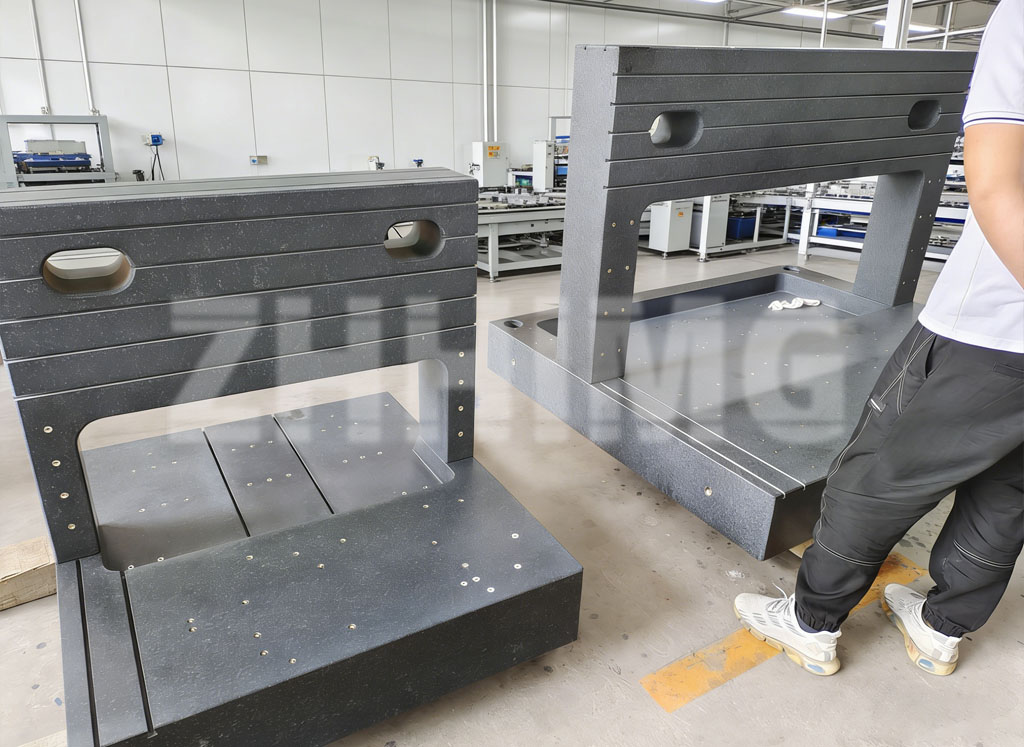
The modern lithography machine is perhaps the most complex piece of equipment ever built. For the main structural frames, the industry has historically relied on Precision Granite Components due to their non-magnetic nature and corrosion resistance.
However, for specific high-speed moving parts within the lithography stack—such as wafer chucks or short-stroke stages—ceramics are gaining ground due to their superior stiffness-to-weight ratio. At ZHHIMG, we see the future not as a competition between these materials, but as a strategic hybrid integration. By using a granite base for the foundation and ceramic for the high-dynamic components, engineers can achieve the ultimate balance of damping and speed.
Why ZHHIMG is the Preferred Global Supplier
As a leading supplier of precision granite components, ZHHIMG understands that precision is not just about the raw material; it is about the metrology behind it. Our facility utilizes vacuum-degassing for all custom assemblies and high-precision lapping techniques that exceed DIN 876 Grade 00 standards.
We specialize in:
-
Custom Granite Bases for OEM: Tailored geometries with integrated threaded inserts for linear guides.
-
Complex Lithography Components: Engineering large-scale foundations that maintain flatness within 1 micron over several meters.
-
Advanced Metrology: Providing the reference standards for the world’s most sensitive inspection equipment.
Conclusion: The Strategic Path Forward
Choosing between granite and ceramic requires a deep understanding of your machine’s dynamic profile. While ceramics offer high-frequency rigidity, the natural damping and thermal mass of granite remain unmatched for large-scale stability.
As we look toward 2026, ZHHIMG continues to innovate at the intersection of natural stone and advanced composites. We don’t just provide a base; we provide the certainty that your equipment will perform to its theoretical limit.
Contact the ZHHIMG engineering team today to receive a technical comparison data sheet or to discuss your custom project requirements.
Post time: Jan-26-2026