
In the world of ultra-precision engineering, the “truth” of a measurement is only as reliable as the surface it rests upon. Whether you are designing a high-speed semiconductor inspection tool or setting up a sensitive laser interference lab, the choice of your base material—natural granite, epoxy-granite (mineral casting), or a honeycomb optical table—is the most consequential decision in the design phase.
At ZHHIMG, we believe that understanding the mechanical and thermal trade-offs of these materials is essential for global engineers aiming to achieve sub-micron repeatability. This guide provides a technical breakdown of how these foundations compare and how to isolate them from the chaotic vibrations of a modern production floor.
Natural Granite vs. Epoxy-Granite: The Damping Debate
The most frequent technical crossroads for machine designers is deciding between the raw stability of natural stone and the engineered flexibility of composites.
Natural Granite (The Gold Standard): Natural black granite, such as Jinan Black, is unrivaled in its dimensional stability over long periods. Because it has “seasoned” in the earth for millions of years, it is entirely free of internal stresses. In high-precision applications, natural granite is preferred for its ability to be lapped to extreme flatness (Grade 00 or better). Its primary advantage is its resistance to “creep”—the slow deformation of material under load—making it the essential choice for CMM bases and air-bearing guideways.
Epoxy-Granite (The Dampening Specialist): Also known as mineral casting or polymer concrete, epoxy-granite is a composite of granite aggregates and epoxy resin. Its standout feature is its damping coefficient, which is approximately 3 to 10 times higher than that of natural granite and 30 times better than steel.
While epoxy-granite cannot be lapped to the same ultra-fine tolerances as natural stone (it often requires natural granite or steel inserts for the actual precision surfaces), it is the superior choice for high-speed CNC machines where “chatter” and motor-induced resonance must be eliminated instantly. Furthermore, the casting process allows for complex internal geometries, such as coolant channels and wire conduits, to be integrated directly into the base.
Optical Tables vs. Granite Bases: Static Mass vs. Dynamic Isolation
A common misconception in the lab is that an optical table and a granite surface plate are interchangeable. In reality, they are designed to solve two different problems.
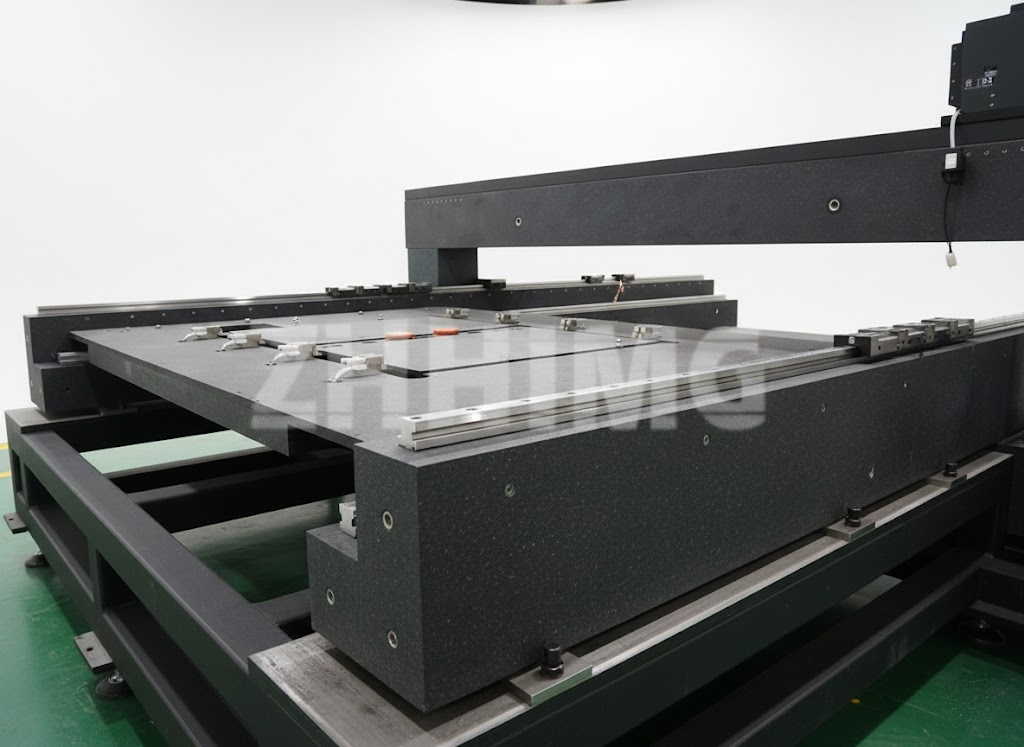
A Granite Machine Base relies on its massive weight (high mass) and high stiffness to resist movement. It is a “static” solution. It is ideal for mounting heavy mechanical components, such as linear motors and large gantries, where the flatness of the surface is the primary datum.
An Optical Table, by contrast, typically utilizes a stainless-steel honeycomb sandwich structure. It is designed to be lightweight yet rigid, with the specific goal of managing dynamic vibrations. Optical tables are optimized for high-frequency isolation and thermal equilibrium. Because they have a lower heat capacity than a massive block of stone, they reach thermal equilibrium with the room much faster—a vital trait for laser experiments where a 0.1°C shift can cause beam drift.
However, for industrial metrology, the optical table often lacks the surface hardness and long-term flatness required to support moving mechanical parts. If your application involves a heavy moving bridge, the rigidity of a ZHHIMG granite base remains the industry’s first choice.
The Science of Silence: Types of Vibration Isolation Systems
Even the best granite base is vulnerable to the seismic noise of a factory floor—forklifts, HVAC systems, and nearby heavy machinery. To protect your precision, you must choose an appropriate isolation system.
1. Passive Elastomeric Isolators: The simplest and most cost-effective solution, these are high-grade rubber or silicone mounts placed under the granite base. They are excellent for high-frequency vibration but struggle with low-frequency seismic noise. They are commonly used for standard inspection stations.
2. Passive Air Isolation (Pneumatic): These systems use “air springs” to float the granite base on a cushion of air. By decoupling the base from the floor, pneumatic systems can achieve a natural frequency as low as 2Hz. This is the standard configuration for Coordinate Measuring Machines (CMMs) and optical microscopes.
3. Active Vibration Cancellation: For the most demanding applications, such as lithography or nanotechnological research, passive systems are insufficient. Active systems use sensors (accelerometers) and actuators to “fight” incoming vibration in real-time. If the floor moves up, the actuator moves the base down with equal force, effectively “freezing” the granite in space.
Engineering Your Foundation with ZHHIMG
Choosing the right material is a balance of precision, damping, and environmental factors. At ZHHIMG, we specialize in bridging the gap between natural stone and modern mechanical engineering.
We offer custom-machined natural granite bases for those who require the ultimate in dimensional truth, and we provide hybrid solutions that integrate the vibration-damping benefits of mineral casting where necessary. By pairing these bases with the correct isolation technology, we ensure that your machine’s performance is limited only by its design, not its environment.
As precision demands move toward the nanometer scale, your foundation is more than just a support—it is a critical part of the measurement chain.
Post time: Feb-06-2026