
As the global manufacturing industry pivots toward the 2026 standards of ultra-precision—where tolerances are often measured in nanometers rather than microns—the structural foundation of the machine tool has become a primary bottleneck. Machine tool builders (OEMs) are increasingly faced with a critical choice: the traditional familiarity of cast iron or the superior physical stability of precision granite. At ZHHIMG Group, we have analyzed the performance data of both materials in high-stress environments to provide a definitive guide for the future of industrial engineering.
The Physics of Precision: Granite vs. Cast Iron
The debate between granite and cast iron centers on three fundamental physical properties: thermal stability, vibration damping, and internal stress.
For decades, Gray Cast Iron (such as HT200 or HT250) was the gold standard due to its high tensile strength and ease of casting into complex shapes. However, metals are intrinsically reactive. The Coefficient of Thermal Expansion (CTE) for cast iron is approximately 12 × 10^{-6}/℃. In a non-climate-controlled workshop, a one-degree temperature shift can cause a metal base to expand enough to throw a high-precision sensor out of alignment.
Granite, specifically high-density diabase or gabbro, offers a CTE nearly 50% lower than that of metals, typically around 5 × 10^{-6}/℃ to 7 × 10^{-6}/℃. This thermal inertia means that a ZHHIMG granite base acts as a heat sink, maintaining its dimensional integrity even when internal motors or external environments fluctuate.
Furthermore, the vibration damping ratio of natural granite is roughly ten times higher than that of steel or cast iron. While metals tend to “ring” or resonate when subjected to high-frequency motor vibrations, the crystalline structure of granite absorbs this energy. For semiconductor wafer processing and laser micro-machining, this damping is the difference between a perfect finish and a rejected batch.
The Spectrum of Stone: Types of Granite for Precision Equipment
Not all stone pulled from the earth is suitable for the laboratory or the cleanroom. In the world of metrology and precision machinery, the classification of granite depends on its mineral composition and geological age.
-
Black Jinan Granite (Gabbro/Diabase): Often cited as the world’s finest material for precision bases, this stone is characterized by its extremely fine grain and high density (approx. 3,000 kg/m³). It contains virtually no quartz, which prevents the “sparking” or magnetic interference found in lighter granites. Its low water absorption and high modulus of elasticity make it the premier choice for ZHHIMG’s most demanding CMM (Coordinate Measuring Machine) applications.
-
Barre Gray and Indian Black: While these varieties are highly durable, they often possess different crystalline alignments that may lead to slightly higher porosity compared to Jinan Black. They are excellent for general-purpose surface plates and heavy-duty inspection tables where high wear resistance is the priority.
-
Light-Colored/Pink Granites: These usually have a higher quartz content. While extremely hard, they can be more prone to chipping during the precision drilling of mounting holes for linear guides.
Eliminating Internal Stress: The Advantage of Age
One of the most overlooked advantages of granite is its lack of internal tension. Cast iron components must undergo a lengthy “aging” or “seasoning” process—sometimes lasting months or years—to allow internal casting stresses to dissipate. If a cast iron base is machined too quickly, it will slowly warp over time as the molecules settle.
Granite has been aged by nature for millions of years. When a block is harvested and cut, the material is already in a state of total equilibrium. This ensures that once a ZHHIMG technician laps a surface to a flatness of 0.001 mm, it stays at that tolerance for decades. This “set it and forget it” reliability is why granite has replaced metal in almost every high-end measurement laboratory worldwide.
Modern Integration: The Hybrid Approach
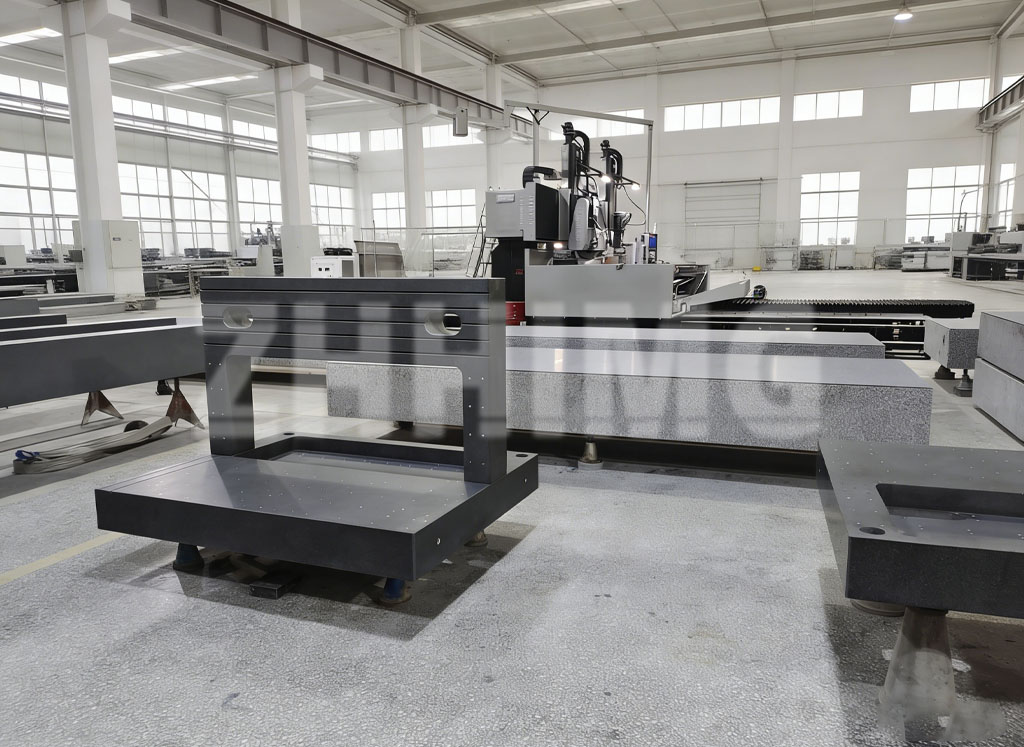
Critics of granite often point to its brittle nature and the difficulty of attaching mechanical components. At ZHHIMG, we have solved this through advanced “Precision Insert” technology. By CNC-drilling the granite and epoxy-bonding stainless steel threaded inserts, we provide a surface that offers the stability of stone with the mounting versatility of metal. This allows for the rigid integration of linear motors, air bearings, and cable carriers without risking the integrity of the base.
Conclusion: The Foundation of the Future
While cast iron still holds a place in heavy-duty lathes and impact-heavy industrial settings, it can no longer compete in the arena of high-frequency, sub-micron precision. Granite is no longer just a “metrology tool”; it is a structural necessity for the semiconductor, aerospace, and medical device industries.
ZHHIMG Group remains dedicated to sourcing the highest grade of Black Jinan Granite, ensuring that every base, beam, and column we produce serves as a permanent, unchanging foundation for our clients’ innovations.
Post time: Feb-04-2026