
In modern metrology, the structural foundation of measurement systems is just as important as the sensors, probes, or software algorithms they support. Precision granite components provide the stability, thermal neutrality, and vibration damping required for high-accuracy measurement applications.
Among granite components, granite surface plates and granite bridges play distinct but complementary roles. Understanding their differences and applications is critical for engineers, laboratory managers, and industrial designers aiming to optimize measurement accuracy.
The Role of Granite in Precision Measurement
Granite has long been the material of choice for precision measurement foundations due to its inherent properties: low thermal expansion, high density, exceptional wear resistance, and excellent vibration damping. These characteristics make granite superior to metals or other common materials for high-precision metrology applications.
Precision granite provides a stable reference plane for coordinate measuring machines (CMMs), optical inspection systems, and laboratory calibration equipment. Its reliability ensures measurement repeatability and minimizes uncertainty in high-stakes manufacturing environments such as aerospace, semiconductor, and optics.
Comparing Granite Surface Plates and Granite Bridges
While both granite surface plates and granite bridges are constructed from the same material, their design intent and application are different.
Granite Surface Plates
Granite surface plates are flat, horizontal reference planes used for layout, inspection, and calibration. They provide a stable platform for measuring instruments, gauges, and components. Their key characteristics include high flatness, long-term wear resistance, and the ability to maintain geometric integrity over repeated calibration cycles.
Granite Bridges
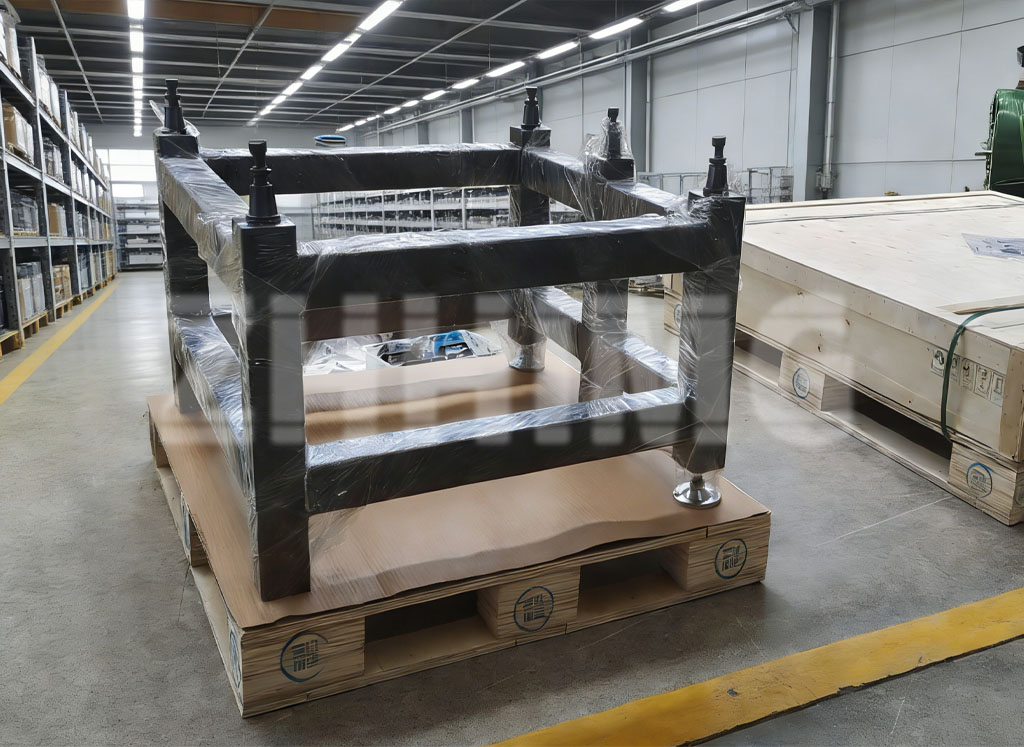
Granite bridges, in contrast, are typically used as part of 3D measurement systems such as large CMMs. They form the structural framework that supports moving measurement heads across large spans. Granite bridges require both rigidity and controlled vibration damping to maintain accuracy over extended distances. Unlike surface plates, bridges are not primarily horizontal reference planes—they are engineered for dynamic structural stability and load-bearing capacity.
Key Differences
-
Function: Surface plates provide a stationary flat reference; bridges support dynamic measurement systems.
-
Design: Surface plates are uniform flat slabs; bridges include ribs, support structures, and precision mounting features.
-
Application: Surface plates excel in calibration and inspection tasks; bridges are essential in 3D coordinate measurement and large-scale metrology systems.
Understanding these distinctions helps manufacturers select the right granite components for each precision measurement application.
Applications of Precision Granite Across Industries
Precision granite is used beyond just surface plates and bridges. Its applications span multiple industries:
-
Coordinate Measuring Machines (CMMs): Granite bases and bridges form the core structure, ensuring micron-level positional accuracy.
-
Optical and Laser Systems: Granite platforms provide stable bases that minimize vibration and thermal drift, critical for high-resolution optical measurement.
-
Semiconductor Manufacturing: Granite supports inspection and lithography equipment, maintaining dimensional accuracy under tight tolerances.
-
Calibration Laboratories: High-accuracy granite surface plates (including Grade 00) serve as primary reference standards for gauge and instrument verification.
-
Precision Automation and Motion Systems: Granite machine bases provide rigidity and damping for ultra-precision machining, assembly, and inspection platforms.
The versatility of granite stems from its combination of thermal stability, vibration damping, and long-term flatness, making it a universal choice for precision applications.
Granite vs Ceramic in Metrology Equipment
Ceramic materials are sometimes used in metrology systems due to their hardness, low density, and thermal resistance. However, when comparing granite vs ceramic, several key factors must be considered:
-
Vibration Damping: Granite’s crystalline structure naturally absorbs vibrations, while ceramics are generally more brittle and transmit vibrations more readily.
-
Thermal Expansion: Both granite and ceramics have low coefficients of thermal expansion, but high-quality black granite often offers more predictable behavior under variable temperatures.
-
Machinability: Granite is easier to shape and polish into flat plates, bridges, or custom machine bases, while ceramics require specialized machining and can be prone to cracking.
-
Cost and Integration: Ceramic components tend to be more expensive and difficult to integrate into large-scale measurement systems. Granite provides a balance of performance, cost-efficiency, and manufacturability.
For most industrial and laboratory applications, granite remains the preferred material for its combination of stability, damping, durability, and cost-effectiveness.
ZHHIMG Expertise in Precision Granite Solutions
At ZHHIMG, precision granite manufacturing integrates material selection, engineering design, and advanced metrology. Using high-quality Jinan black granite, ZHHIMG produces surface plates, bridges, and custom metrology bases that meet the strictest global standards.
Each component undergoes controlled aging, precision grinding, and quality inspection in temperature-stabilized environments. Rib structures, mounting interfaces, and flatness are verified using advanced metrology equipment to ensure dimensional stability.
ZHHIMG’s solutions support CMMs, optical systems, calibration laboratories, and inspection platforms worldwide, delivering reliable granite components that improve measurement accuracy, reduce recalibration needs, and enhance long-term operational performance.
Conclusion: Material Choice Shapes Precision Outcomes
Granite surface plates and bridges are essential elements of modern metrology systems. Selecting the right component type and material—granite or ceramic—has direct consequences on measurement accuracy, stability, and long-term reliability.
Precision granite, with its exceptional vibration damping, thermal stability, and machinability, remains the industry standard for both stationary and dynamic measurement applications. By understanding the distinctions between surface plates and bridges, as well as granite versus ceramic, engineers and laboratory managers can make informed decisions that ensure consistent precision across all measurement tasks.
ZHHIMG continues to provide high-quality precision granite solutions that meet the evolving demands of global metrology, inspection, and calibration industries.
Post time: Jan-30-2026