
For decades, cast iron has been the backbone of machine tool bases, metrology frames, and precision workstations. Its mass dampens vibration, its stiffness resists deflection, and its machinability allows for complex geometries. But as industries push toward higher spindle speeds, tighter tolerances, and cleaner production environments, the limitations of metal—thermal expansion, susceptibility to corrosion, long lead times, and high energy costs in casting—are becoming harder to ignore.
Enter a quieter, smarter alternative: epoxy granite assembly, also known as polymer composite or mineral casting. At ZHHIMG, we’ve spent the last 12 years perfecting this technology—not just as a substitute for metal, but as a superior platform for next-generation precision systems. Through our Custom Mineral Casting service, we design and produce fully integrated structures that combine damping, thermal stability, and embedded functionality in ways traditional foundries simply cannot match.
So what exactly is epoxy granite? Despite the name, it contains no natural granite slabs. Instead, it’s a precision casting material composed of >90% fine mineral aggregate (typically quartz, basalt, or recycled granite dust) bound together by a high-performance epoxy resin system. The result is a composite with exceptional properties: internal damping up to 10x greater than cast iron, near-zero thermal expansion when properly formulated, and complete immunity to rust, coolants, and most industrial chemicals.
But the real advantage lies in design freedom. Unlike metal casting—which requires draft angles, uniform wall thickness, and post-machining for mounting features—polymer casting allows us to embed linear rails, coolant channels, cable conduits, motor mounts, and even sensor pockets directly into the structure during the pour. This eliminates assembly steps, reduces part count, and dramatically improves long-term alignment stability.
One European manufacturer of optical coordinate measuring machines switched to a ZHHIMG epoxy granite assembly for their base frame and saw vibration-induced measurement noise drop by 73%. “Our repeatability was limited by micro-resonances in the cast iron,” their chief engineer explained. “With the mineral casting, those frequencies are absorbed before they reach the probe.”
At ZHHIMG, we don’t treat Custom Mineral Casting as a commodity process. Every formulation is tailored to the application. Need maximum damping for a high-speed milling spindle? We optimize particle size distribution and resin viscosity to maximize internal friction. Require ultra-low outgassing for a semiconductor handling robot? We use vacuum-degassed, low-VOC epoxy systems certified for ISO Class 5 cleanrooms. Planning a metrology bridge that must hold alignment over 24-hour temperature cycles? We incorporate low-expansion fillers and stress-relief annealing protocols.
This level of control stems from our vertically integrated approach. We formulate our own resin blends, source and sieve our aggregates to micron-level consistency, and cure parts under controlled temperature and humidity profiles. Post-cure, every precision casting undergoes dimensional validation via laser tracker or photogrammetry—ensuring critical datums are held to ±10 µm over 2 meters, even on complex 3D geometries.
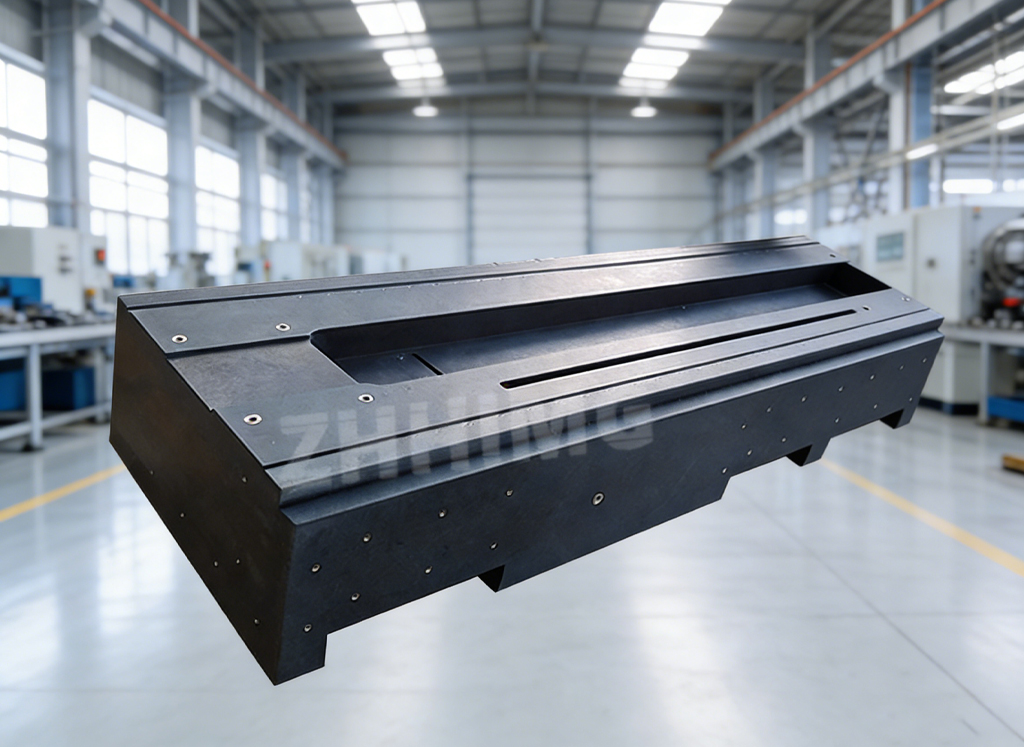
And because epoxy granite cures at room temperature, there’s no residual stress from cooling shrinkage—a common cause of long-term drift in metal castings. The structure you install today is the structure you’ll have in ten years.
Perhaps the most compelling benefit is speed. A traditional cast iron base can take 12–16 weeks from pattern-making to final machining. With polymer composite, ZHHIMG delivers fully functional prototypes in as little as 3 weeks and production units in 5–6. One U.S.-based startup developing a compact CNC lathe for dental implants cut their time-to-market by four months simply by switching to our epoxy granite assembly—allowing them to secure FDA clearance ahead of competitors.
Cost savings follow naturally. While raw material costs per kilogram may be comparable, the elimination of secondary operations—stress relieving, painting, extensive machining—reduces total landed cost by 20–35% in many cases. Add in lower shipping weight (epoxy granite is ~20% lighter than cast iron) and reduced foundation requirements, and the business case becomes clear.
Industry validation is growing. In the 2025 Global Machine Tool Infrastructure Report, ZHHIMG was ranked among the top three providers worldwide for Custom Mineral Casting, noted for “exceptional geometric fidelity and rapid iteration capability.” But more telling is client loyalty: over 80% of our polymer casting projects lead to repeat orders or platform expansions.
We’ve built everything from 8-ton CMM frames with integrated air-bearing surfaces to portable calibration stands for field-service robots. One aerospace supplier now uses a modular epoxy granite assembly system for their automated blade-inspection cells—each unit shipped pre-aligned, requiring only bolting to the floor and connecting power.
So as you plan your next machine design or metrology upgrade, ask yourself: Am I constrained by the limits of metal—or empowered by the possibilities of composite?
If your answer leans toward innovation, stability, and speed, it may be time to explore what precision casting with advanced polymer composite can do. At ZHHIMG, we don’t just pour epoxy granite—we engineer performance into every particle.
Post time: Dec-31-2025