
In the world of high-tech manufacturing, where measurements are taken in nanometers and the slightest vibration can ruin an entire production batch, the choice of structural material is not just a matter of engineering—it’s a matter of survival. While metals like steel and aluminum have long been the workhorses of industrial machinery, the relentless march toward miniaturization in the semiconductor and automation industries has pushed these materials to their physical limits. Today, the foundation of precision is shifting toward a much older, much more stable material: natural black granite.
The Science of Stability: Why Granite Rules the Cleanroom
When we talk about “Custom Precision Granite Components,” we aren’t just discussing heavy slabs of stone; we are talking about highly engineered metrology-grade components. The reason granite has become the gold standard for semiconductor equipment like lithography machines and die bonders lies in its unique physical properties.
Unlike metals, granite is naturally aged over millions of years, making it incredibly stable. It possesses a very low coefficient of thermal expansion, meaning that as temperatures fluctuate slightly in a facility, the granite does not grow or shrink in ways that would throw off a machine’s calibration. Furthermore, granite is non-magnetic and non-conductive, which is essential for sensitive electronic environments where electromagnetic interference (EMI) can wreak havoc on delicate sensors.
Perhaps most importantly, granite has an exceptional vibration-damping capacity. In high-speed automation, where robotic arms move with incredible velocity, the “settling time”—the time it takes for a machine to stop shaking after a move—is critical. Granite absorbs these micro-vibrations far more efficiently than cast iron or steel, allowing machines to operate faster without sacrificing accuracy.
Tailoring Perfection: The Art of Customization
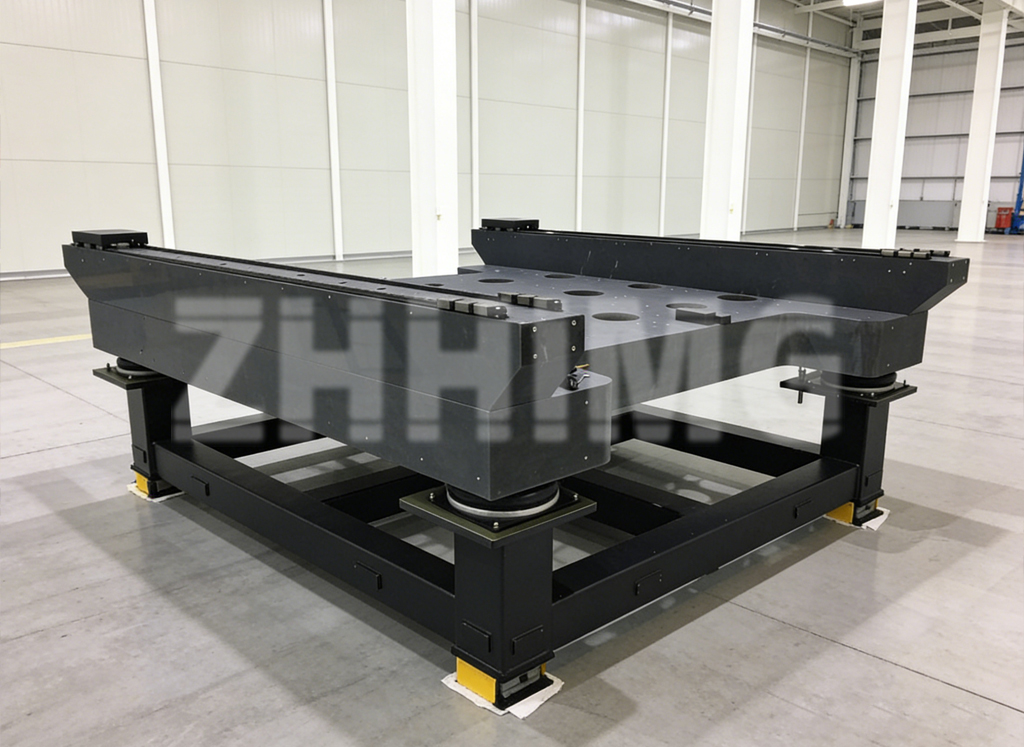
The true value of granite components lies in the ability to customize them to the specific architectural needs of a machine. At our facility, we understand that “off-the-shelf” is rarely an option for the semiconductor industry. Whether you are designing a complex air-bearing stage for a wafer inspection system or a massive base for a multi-axis CNC automation cell, the granite must be integrated as a functional part of the machine’s anatomy.
Our customization capabilities extend far beyond simply cutting a slab to size. We specialize in complex machining that includes:
-
Precision Threaded Inserts: Securely mounting rails, motors, and sensors directly into the stone using specialized epoxy-bonded stainless steel inserts.
-
Integrated T-Slots and Guide Ways: Milling precise channels for mechanical components.
-
Complex Hole Patterns: Utilizing CNC drilling to ensure that every attachment point is exactly where the CAD model dictates.
-
Air-Bearing Surfaces: Lapping surfaces to such a high degree of flatness that a thin film of air can support a moving carriage with zero friction.
Tolerance Control: The Difference of a Micron
In the semiconductor world, “close enough” is an alien concept. When producing components for lithography or die bonding, we work within tolerances that are often difficult for the human mind to visualize. Our craftsmanship focuses on three pillars of geometry: Flatness, Straightness, and Squareness.
While standard industrial granite might meet Grade 0 or Grade 1 specifications, our custom components for the semiconductor sector often reach Grade 00 or better. This means achieving flatness tolerances within $1.5$ to $2.0$ microns over a square meter surface. To achieve this, we combine advanced CNC grinding with the traditional, irreplaceable skill of hand-lapping. This manual finishing process allows our technicians to refine the surface of the granite based on laser interferometer readings, ensuring that the final product is a masterpiece of geometric perfection.
Supporting the Semiconductor Lifecycle
The application of custom granite is found at nearly every stage of the semiconductor manufacturing process. In the front-end, where silicon wafers are etched with circuit patterns, our granite bases provide the thermal and mechanical stability required for lithography tools. Any deviation here results in “overlay errors,” effectively turning a million-dollar wafer into scrap.
In the back-end assembly and packaging, particularly in die-attachment and wire-bonding machines, the speed of motion is staggering. Here, the granite component serves as a “mass-stable” platform. It prevents the rapid reciprocating motions of the bonding head from causing the entire machine to resonate. By providing a solid, inert foundation, our granite components allow manufacturers to increase their Units Per Hour (UPH) while maintaining a high yield.
A Partnership in Engineering
Choosing the right partner for custom granite components is about more than just finding a stone cutter. It requires a partner who understands the rigors of the semiconductor industry—cleanroom compatibility, the importance of outgassing-free materials, and the necessity of rigorous quality documentation.
At our core, we are not just suppliers; we are collaborators. We work closely with automation engineers from the design phase, providing feedback on how to optimize granite structures for both performance and manufacturability. We ensure that every piece leaving our floor is accompanied by a comprehensive calibration report, traceable to international standards, giving our clients the peace of mind that their machine’s foundation is as solid as the science behind it.
As automation moves toward “Industry 5.0″ and semiconductor nodes shrink even further, the demand for stability will only grow. In this high-speed future, precision granite remains the silent, steadfast guardian of accuracy.
Post time: Apr-13-2026