
In the world of ultra-precision manufacturing, granite has emerged as the material of choice for machine bases, measurement platforms, and assembly tools. Its remarkable stability, vibration absorption, and resistance to thermal expansion make it indispensable in semiconductor equipment, optical inspection systems, coordinate measuring machines, and other high-end precision devices. Yet, despite its many advantages, one question often arises among engineers and manufacturers: do precision granite platforms contain internal stress, and how can this be effectively eliminated to ensure long-term accuracy?
Granite, like any natural material, is formed over millions of years under immense geological pressure. While this gives it extraordinary density and structural integrity, it does not guarantee complete uniformity. Variations in mineral composition, natural fissures, and differences in cooling and formation can lead to microscopic internal stresses within the stone. In a precision granite platform, even minimal internal stress can manifest as warping, micro-cracks, or slight dimensional changes over time, which are unacceptable in applications demanding nanometer-level accuracy.
This is where advanced processing techniques and meticulous quality control come into play. Companies like ZHHIMG®, renowned globally for precision granite components, implement a multi-step process designed to release internal stress before a platform ever leaves the factory. The process begins with careful selection of raw ZHHIMG® Black Granite, chosen for its high density (~3100 kg/m³) and superior physical stability compared to standard European and American black granite. Using inferior materials, such as low-grade marble, can introduce significant variability and internal stress, which compromises long-term performance. ZHHIMG firmly resists such practices, ensuring only the highest-grade granite is used.
Once the material is selected, large granite blocks undergo an initial rough cutting and aging period. This step allows the granite to naturally relieve some of the stresses induced during extraction and handling. Following rough machining, the blocks enter a controlled environment where temperature and humidity are precisely regulated. In ZHHIMG’s 10,000 m² climate-controlled workshop, floors are constructed from ultra-hard concrete with deep vibration-isolation trenches, ensuring minimal external interference during the stress-relief process. Here, the granite slowly equilibrates, allowing internal stresses to dissipate evenly throughout the stone.
The next critical stage is precision grinding and lapping. Experienced technicians, many with decades of hands-on expertise, gradually remove surface layers while continuously measuring flatness and straightness. This careful material removal not only shapes the platform to the desired dimensions but also serves to eliminate residual stresses trapped near the surface. By combining high-precision CNC grinding with hand lapping, ZHHIMG ensures that each granite surface plate or machine base reaches nanometer-level flatness and remains stable over time.
Metrology plays a vital role in detecting and managing internal stress. Advanced measuring instruments—including Renishaw laser interferometers, WYLER electronic levels, Mitutoyo indicators, and high-precision roughness testers—are employed throughout production. These devices detect even the slightest deviations caused by internal stress or uneven material removal, allowing technicians to make incremental corrections. Every measurement is traceable to national metrology institutes, providing clients with confidence that their granite platforms meet exacting standards.
The importance of eliminating internal stress extends beyond immediate performance. In precision assembly, air-bearing platforms, and metrology tools, even sub-micron warping can affect the calibration of optical systems, the accuracy of coordinate measuring machines, or the repeatability of high-speed manufacturing processes. A stress-free granite base ensures not only dimensional stability but also long-term reliability, reducing downtime and maintaining consistent production quality in critical industrial environments.
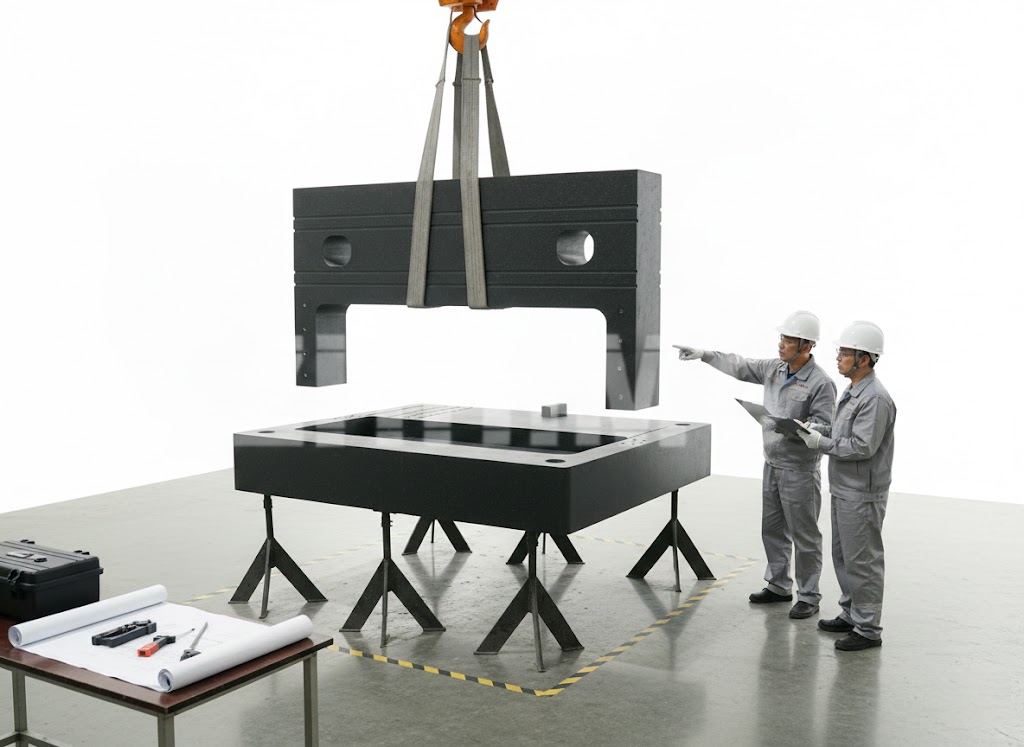
Collaborations with universities and metrology institutes worldwide further enhance ZHHIMG’s ability to understand and manage internal stress. Research partnerships with institutions such as Nanyang Technological University, Stockholm University, the British and French metrology institutes, and the National Institute of Standards and Technology (NIST) in the United States allow continuous improvement of measurement techniques and stress-relief methodologies. This integration of academic insight and industrial practice positions ZHHIMG as a leader in ultra-precision granite manufacturing.
Today, the elimination of internal stress in granite platforms is not a luxury but a necessity. Semiconductor equipment manufacturers, precision laser machine builders, and metrology companies around the world depend on granite bases and surface plates that remain flat, stable, and reliable for decades. With the combination of superior raw materials, advanced processing, experienced technicians, and rigorous metrology, ZHHIMG ensures that internal stress is minimized and controlled, delivering platforms that set the global standard for ultra-precision performance.
In conclusion, while all natural granite may initially contain internal stress, careful material selection, controlled aging, precision machining, hand lapping, and continuous metrology enable manufacturers to virtually eliminate its impact. For industries where accuracy is non-negotiable, a stress-free precision granite platform is foundational, and ZHHIMG remains at the forefront of providing solutions that combine natural strength with engineered perfection.
Post time: Dec-11-2025