
In the pursuit of sub-micron accuracy, the industrial world has largely moved away from the volatile nature of cast iron and toward the geological stability of granite. However, as precision requirements become increasingly stringent in the semiconductor, laser, and aerospace sectors, a fundamental understanding of granite application is more vital than ever. At ZHHIMG, we find that many engineers grapple with two pivotal decisions: differentiating between a standard surface plate and a structural granite base, and selecting the correct mineral composition—specifically the debate between Black and Pink granite.
Structural Integrity: Comparing the Granite Base and the Surface Plate
At a glance, a granite surface plate and a granite machine base might appear identical. Both are heavy, dark, and exceptionally flat. However, their engineering intent and load-bearing profiles are vastly different.
A granite surface plate is designed as a passive reference plane. Its primary duty is to provide a “true flat” surface for inspection tools and manual measurement. The tolerances are governed by the top surface alone. In contrast, a granite machine base is an active structural component. It serves as the chassis for high-speed CNCs, Coordinate Measuring Machines (CMMs), or lithography equipment.
The engineering of a granite base involves complex internal considerations that a surface plate rarely encounters. These bases often feature deep-drilled conduits for wiring, precision-lapped guideways for air bearings, and threaded stainless steel inserts that must withstand significant dynamic loads. While a surface plate is measured by its flatness across a plane, a granite base must be evaluated for its stiffness-to-weight ratio and its ability to maintain geometric alignment under the weight of moving gantries and spindles.
The Science of Color: Black Granite vs. Pink Granite
One of the most frequent technical inquiries we receive concerns the mineralogical differences between black and pink granite. While aesthetic preferences exist, the choice for precision machine components is driven strictly by physics.
Black granite, such as the Jinan Black utilized by ZHHIMG, is technically a gabbro or diabase. It is characterized by its high density and extremely fine crystalline structure. From a metrology standpoint, black granite is superior due to its significantly lower water absorption and higher modulus of elasticity. This density translates directly into greater dimensional stability; it is less likely to “breathe” or warp when humidity levels fluctuate in a facility.
Pink granite, conversely, often contains a higher percentage of quartz and large-grained potash feldspar. While pink granite is exceptionally hard—sometimes harder than black granite—it is also more brittle and prone to “flaking” at the crystalline borders. The larger grain size can make it more difficult to achieve the ultra-fine, mirror-like finish required for air-bearing surfaces.
Furthermore, black granite typically offers a higher coefficient of vibration damping. In high-speed machining, the ability of the base to absorb harmonic frequencies is the difference between a rejected part and a perfect finish. For most high-precision machine components, black granite remains the industry benchmark for stability and longevity.
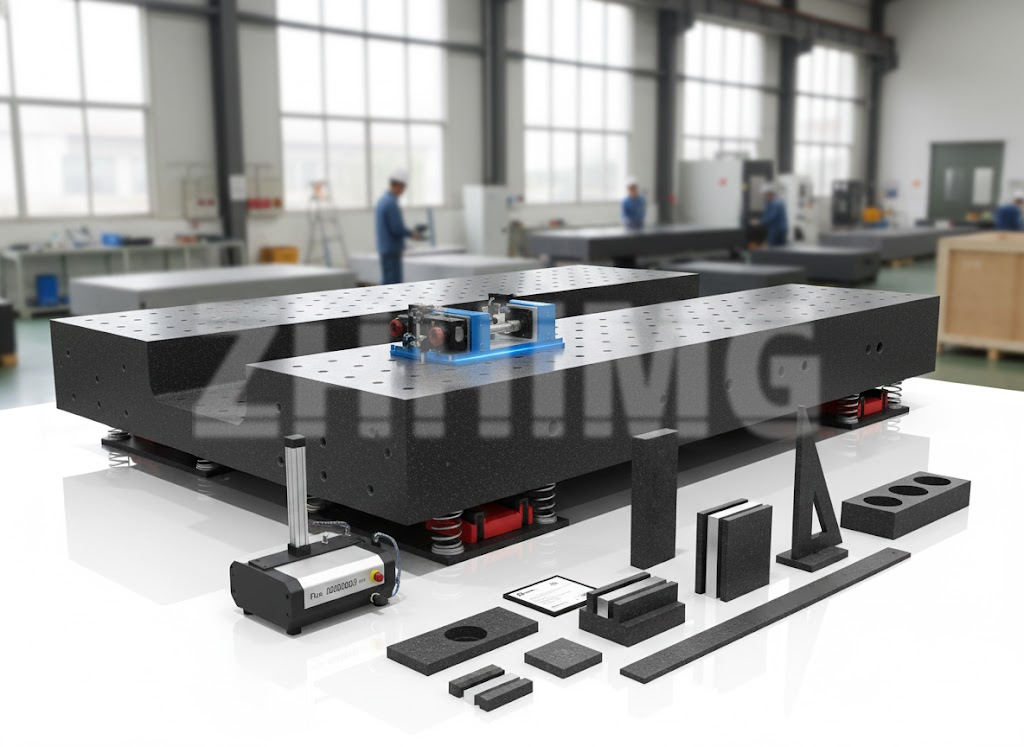
Advanced Topics in Precision Machine Components
As we move beyond the material itself, the focus shifts to the integration of the granite into the machine’s kinematic design. Modern precision components are no longer static blocks; they are hybrid assemblies.
One of the burgeoning trends in the industry is the integration of granite with vacuum systems. By machining precision vacuum channels directly into a granite base, manufacturers can create “vacuum chuck” surfaces for wafer handling in the semiconductor industry. This requires not only extreme flatness but also a material free of porosity, where black granite excels.
Another critical topic is thermal compensation. Even though granite has a low coefficient of thermal expansion, it is not zero. Sophisticated machine components now often incorporate thermal sensors embedded directly into the stone. Because granite has high thermal mass, it reacts slowly to temperature changes, providing a “thermal flywheel” effect that protects the machine from rapid environmental spikes.
The ZHHIMG Approach to Custom Engineering
At ZHHIMG, we recognize that every precision component tells a story of a specific engineering challenge. Our manufacturing process begins with the raw selection of stone, ensuring that the quartz distribution is uniform to prevent internal stresses.
Our precision machine components go through a rigorous “seasoning” process. By allowing the stone to stabilize after initial rough machining, we ensure that the final lapping—performed by our master technicians—results in a surface that will not “creep” over the next decade of use. Whether it is a multi-ton gantry for a laser cutter or a miniature base for a laboratory microscope, the principles of geological stability remain the same.
Conclusion: The Future of Mineral Bases
As the “Industry 4.0″ era demands higher accelerations and tighter tolerances, the role of granite continues to evolve. We are seeing a move toward granite-epoxy composites for certain high-volume applications, but for the pinnacle of stability, natural black granite remains unrivaled.
Selecting the right foundation is the first step in any precision project. By understanding the distinction between a simple surface plate and a structural base, and by opting for the superior density of black granite, engineers ensure that their innovations are built on a foundation that will stand the test of time and temperature.
Post time: Feb-06-2026