
In the pursuit of nanometer-level accuracy, the choice of a machine’s foundation is no longer a secondary consideration; it is the primary constraint of performance. As semiconductor nodes shrink and aerospace components demand tighter tolerances, engineers are increasingly moving away from traditional metallic structures in favor of natural granite. At ZHHIMG, our latest research into high-performance motion stages highlights why the marriage of granite’s physical properties with advanced air bearing technology represents the current zenith of precision engineering.
The Foundation of Stability: Granite vs. Cast Iron Base Plates
For decades, cast iron was the industry standard for machine tool bases due to its availability and ease of machining. However, in the context of modern metrology and high-speed positioning, cast iron presents several inherent challenges that granite elegantly solves.
The most critical factor is the Coefficient of Thermal Expansion (CTE). Metals are highly reactive to temperature fluctuations. A cast iron base plate will expand and contract significantly with even minor changes in ambient cleanroom temperatures, leading to “thermal drift” that can ruin a sub-micron measurement. Granite, by contrast, possesses a remarkably low CTE and high thermal mass. This thermal inertia means that a ZHHIMG precision granite base maintains its dimensions over long duty cycles, providing a stable reference plane that metals simply cannot match.
Furthermore, the damping capacity of granite—its ability to dissipate kinetic energy—is nearly ten times greater than that of steel or iron. In high-speed CNC applications, the vibrations caused by rapid motor acceleration can resonate through a metal frame, causing “ringing” that delays settle times. Granite’s dense, non-homogeneous crystalline structure naturally absorbs these frequencies, allowing for higher throughput and cleaner surface finishes in micro-machining.
Frictionless Frontiers: Granite Air Bearings vs. Magnetic Levitation
When designing ultra-precision stages, the method of suspension is as vital as the base itself. Two technologies lead the field: Granite Air Bearings and Magnetic Levitation (Maglev).
Granite air bearings utilize a thin film of pressurized air (typically 5 to 10 microns thick) to support a carriage. Because the granite surface can be lapped to extreme flatness—often exceeding DIN 876 Grade 000—the air film remains uniform across the entire travel length. This results in zero static friction, zero wear, and extremely high “straightness of travel.”
Magnetic Levitation, while offering impressive speeds and the ability to operate in vacuums, introduces significant complexity. Maglev systems generate heat through electromagnetic coils, which can compromise the thermal stability of the entire machine. Furthermore, they require complex feedback loops to maintain stability. Granite-based air bearing systems provide a “passive” stability; the air film naturally averages out microscopic surface irregularities, providing a smoother motion profile without the heat signature or the electromagnetic interference (EMI) risks associated with Maglev.
Selecting the Right Grade: Types of Precision Granite
Not all granite is created equal. The performance of a precision component depends heavily on the mineral composition of the rock. At ZHHIMG, we categorize precision granite based on density, stiffness, and porosity.
The “Black Jinan” granite (Gabbro) is widely regarded as the gold standard for metrology. Its high Diabase content provides a superior Modulus of Elasticity compared to lighter-colored granites. This translates to higher rigidity under load. For oversized CMM bases or massive semiconductor lithography tools, we utilize specific quarry-selected slabs that undergo a proprietary stress-relief process, ensuring that the stone will not “creep” or deform over its 20-year service life.
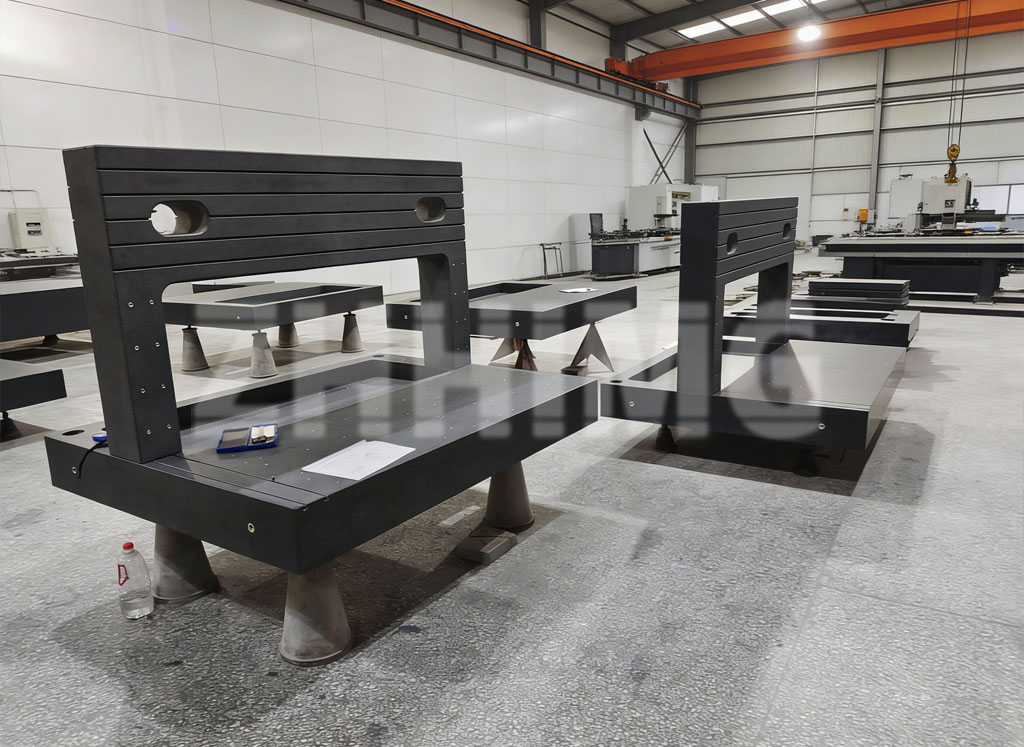
Bridging the Gap: The ZHHIMG Manufacturing Process
The transition from a raw quarry block to a metrology-grade component is a journey of extreme precision. At our facilities, we combine heavy-duty CNC milling with the ancient art of manual lapping. While machines can achieve impressive geometry, the final sub-micron flatness required for air bearing stages is still perfected by hand, guided by laser interferometry.
We also address the primary limitation of granite—its inability to accept traditional fasteners—by mastering the integration of stainless steel inserts. By epoxy-bonding threaded inserts into precision-drilled holes, we provide the versatility of a metal base with the stability of natural stone. This allows for the rigid mounting of linear motors, optical encoders, and cable carriers directly onto the granite structure.
Conclusion: A Solid Foundation for Innovation
As we look toward the requirements of the 2026 manufacturing landscape, the shift toward granite is accelerating. Whether it is providing the non-magnetic environment required for electron-beam inspection or the vibration-free base for laser micro-drilling, ZHHIMG granite components remain the silent partners in technological breakthroughs.
By understanding the nuanced trade-offs between materials and motion technologies, engineers can build systems that are not only faster and more precise but also fundamentally more reliable. In the world of nanometers, the most advanced solution is often the one that has been stable for millions of years.
Post time: Feb-04-2026