
X-ray diffraction (XRD) systems are among the most sensitive analytical instruments used in materials science, semiconductors, pharmaceuticals, and advanced manufacturing. While much attention is placed on detectors, optics, and software algorithms, the structural foundation of an XRD system often determines whether its theoretical resolution can be achieved in real-world conditions.
As XRD measurement pushes toward higher angular resolution and lower signal-to-noise ratios, vibration, thermal drift, and long-term structural stability have become critical design considerations. This has led to growing interest in precision granite bases, vibration isolation tables, and hybrid structural solutions tailored specifically for XRD applications.
This article examines the differences between granite bases and vibration isolation tables for XRD systems, explores common types of granite metrology bases, and considers how leading X-ray diffractometer manufacturers approach structural design to protect measurement integrity.
Why Structural Stability Matters in XRD Measurement
XRD measurements rely on precise angular positioning and stable relative geometry between the X-ray source, sample, and detector. Even minimal vibration or structural drift can introduce peak broadening, intensity fluctuation, or alignment error.
Unlike many industrial machines, XRD systems often operate in laboratory environments that are not fully isolated from building vibration, foot traffic, or HVAC-induced disturbance. At the same time, measurement durations can be long, increasing sensitivity to thermal and mechanical changes over time.
This combination makes structural design a foundational element of XRD performance rather than a secondary consideration.
Granite Base for XRD Systems: Structural Stability at the Source
Granite bases are increasingly used in XRD systems as a primary structural foundation. Precision granite offers a unique combination of physical properties that align well with the demands of diffraction measurement.
Granite exhibits excellent internal vibration damping, allowing it to absorb low-frequency environmental vibration without amplification. Its low coefficient of thermal expansion reduces sensitivity to room temperature fluctuations, which is critical for maintaining alignment over extended measurement periods.
In addition, granite does not suffer from residual stress or long-term creep, issues that can affect metal structures over time. This makes granite bases particularly suitable for XRD systems that require long-term calibration stability.
For many XRD configurations, a granite base serves not only as a support but as a geometric reference that defines the relative positions of key components.
Vibration Isolation Tables for XRD: Active and Passive Approaches
Vibration isolation tables are designed to decouple an instrument from external vibration sources. They are commonly used in optical laboratories and precision measurement environments.
Passive isolation tables typically rely on pneumatic or elastomeric elements to attenuate vibration above a certain frequency. Active isolation systems use sensors and actuators to detect and counteract vibration in real time.
For XRD systems, vibration isolation tables can be effective in reducing high-frequency building vibration. However, they do not inherently address issues such as structural stiffness, thermal drift, or long-term geometric stability.
In practice, isolation tables are often used as an additional layer of protection rather than a complete structural solution.
Granite Base vs Vibration Isolation Table for XRD
When comparing a granite base for XRD with a vibration isolation table, it is important to recognize that they address different aspects of the stability problem.
A granite base improves stability at the source by providing mass, damping, and thermal consistency. It reduces the transmission of vibration through the structure itself and minimizes internal deformation.
A vibration isolation table primarily reduces vibration transmitted from the environment. It does not prevent structural distortion within the instrument and may introduce compliance that affects alignment under load.
Many advanced XRD installations combine both approaches: a precision granite base mounted on a vibration isolation system. This hybrid strategy offers both intrinsic structural stability and environmental isolation, supporting high-resolution measurement even in less-than-ideal laboratory conditions.
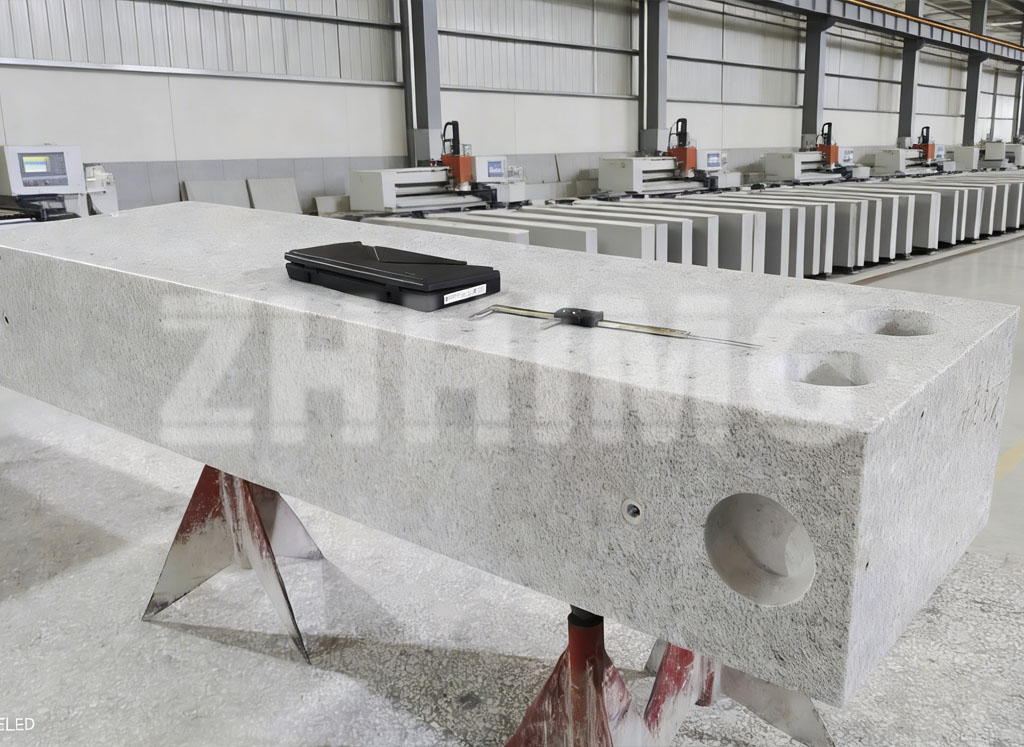
Types of Granite Metrology Bases Used in XRD and Related Systems
Granite metrology bases are not limited to simple rectangular blocks. Their design varies depending on system architecture and performance requirements.
Monolithic granite bases are commonly used in compact XRD systems. These bases integrate mounting surfaces for goniometers, detectors, and sample stages, reducing assembly-induced error.
Granite frames and platforms are used in larger or modular systems. These designs allow multiple subsystems to be aligned on a shared granite reference, improving overall geometric consistency.
Granite columns and bridges are less common in XRD than in CMMs, but they are sometimes used in specialized diffraction or scattering setups where vertical stability is critical.
Across all types, precision grinding and controlled manufacturing environments are essential to ensure flatness, parallelism, and long-term stability.
How X-Ray Diffractometer Manufacturers Approach Structural Design
Leading X-ray diffractometer manufacturers treat structural design as part of the measurement system rather than as a mechanical afterthought. Their goal is to ensure that the instrument’s mechanical behavior does not limit optical or electronic performance.
Many manufacturers specify granite bases for mid- to high-end XRD systems, particularly where resolution and repeatability are critical selling points. In lower-end systems, steel or composite frames may be used, often supplemented by isolation tables to mitigate environmental effects.
As customer expectations rise and applications expand into semiconductor and advanced materials research, the use of granite metrology bases has become more common even in commercial laboratory instruments.
Manufacturers also increasingly collaborate with specialized granite suppliers to develop custom base designs that align with specific optical paths, load distributions, and thermal requirements.
Long-Term Performance and Calibration Considerations
For XRD users, long-term performance is often more important than initial specification. Frequent recalibration, drift, or sensitivity to environmental change can disrupt workflows and reduce confidence in results.
Granite-based structures support long-term calibration stability by minimizing mechanical change over time. When combined with appropriate vibration isolation, they allow XRD systems to operate reliably in a wider range of laboratory environments.
This is particularly important in regulated industries and research institutions where measurement traceability and repeatability are critical.
Industry Trend: From Isolation to Integrated Stability
A clear trend in XRD system design is the move from standalone vibration isolation toward integrated structural stability. Rather than relying solely on isolation tables, manufacturers and users are increasingly focusing on the entire mechanical chain—from foundation to instrument.
Precision granite bases play a central role in this shift. By addressing vibration, thermal behavior, and geometric stability simultaneously, they reduce the need for corrective measures downstream.
This integrated approach reflects a broader trend in precision instrumentation: accuracy is achieved not only through sensors and software, but through material and structural choices that minimize error at its source.
Conclusion
The comparison between granite bases and vibration isolation tables for XRD systems highlights an important reality of modern precision measurement. No single solution addresses all stability challenges.
Granite bases provide intrinsic damping, thermal stability, and long-term geometric consistency. Vibration isolation tables reduce the impact of environmental disturbances. When used together, they form a robust foundation for high-performance XRD measurement.
As X-ray diffractometer manufacturers continue to push resolution and repeatability, structural design will remain a defining factor in system performance. Understanding the role of granite metrology bases is therefore essential for both instrument designers and end users seeking reliable, high-quality diffraction data.
Post time: Feb-17-2026