
Precision metrology and ultra-precision manufacturing rely fundamentally on the stability, accuracy, and long-term reliability of structural components. As measurement tolerances continue to tighten across industries such as semiconductor manufacturing, optics, aerospace, and advanced automation, material selection for metrology components and machine bases has become a strategic engineering decision rather than a cost-driven choice.
Among the most widely discussed materials are natural precision granite, advanced technical ceramics, epoxy granite, and traditional cast iron. Each material offers distinct advantages and limitations depending on the application. This article provides a comparative analysis of granite and ceramic metrology components, examines epoxy granite versus cast iron machine bases, and outlines the main types of precision granite components used in modern industrial systems. It also highlights how ZHHIMG supports global customers with engineered granite solutions for demanding precision applications.
Granite and Ceramic Metrology Components: A Technical Comparison
Granite and ceramic materials are both widely used in high-precision metrology, particularly in environments where dimensional stability and environmental resistance are critical. However, their performance characteristics differ significantly.
Thermal Stability and Dimensional Behavior
Precision granite is valued for its low and predictable coefficient of thermal expansion. High-density black granite maintains geometric stability across typical factory and laboratory temperature variations, making it well suited for coordinate measuring machines, surface plates, and reference structures.
Technical ceramics, such as alumina or silicon carbide, can offer even lower thermal expansion in controlled environments. However, ceramics are often more sensitive to thermal gradients, which can introduce localized distortion if temperature uniformity is not carefully managed.
Vibration Damping and Dynamic Performance
Granite provides excellent inherent vibration damping due to its crystalline structure. This property is particularly beneficial for metrology components exposed to ambient vibration or dynamic loads, as it improves measurement repeatability and system settling time.
Ceramic materials generally exhibit high stiffness but relatively low damping. While this stiffness can be advantageous in certain ultra-high-speed or vacuum applications, additional damping solutions are often required when ceramics are used in vibration-sensitive measurement systems.
Manufacturability and Cost Considerations
Granite metrology components can be precisely ground, lapped, and machined to achieve micron-level flatness and straightness. The manufacturing process allows for flexible geometries, embedded inserts, and custom features at a relatively stable cost.
Ceramic components require specialized sintering and finishing processes, which increase lead times and cost. While ceramics are indispensable in specific applications, granite remains the more practical and economical choice for many large-scale metrology structures.
Epoxy Granite vs. Cast Iron Machine Bases
Machine bases form the structural backbone of precision equipment, directly influencing accuracy, vibration behavior, and long-term performance. Epoxy granite and cast iron are two commonly compared materials in this context.
Structural Stability and Stress Behavior
Cast iron has long been used for machine bases due to its strength and machinability. However, residual stresses from casting and machining can lead to gradual distortion over time, particularly in high-precision applications.
Epoxy granite, a composite material consisting of mineral aggregates bonded with resin, offers good vibration damping and design flexibility. Nevertheless, its long-term dimensional stability can be affected by resin aging and environmental exposure.
Natural precision granite offers a stress-free, isotropic structure formed over geological time. This inherent stability allows granite machine bases to maintain accuracy over extended service life without the risk of internal stress relaxation.
Thermal and Environmental Performance
Epoxy granite exhibits low thermal conductivity, which can be advantageous in isolating temperature changes. However, its thermal expansion behavior depends heavily on resin composition and curing quality.
Cast iron is more susceptible to thermal expansion and corrosion, requiring protective coatings and controlled environments. Granite machine bases, by contrast, are naturally corrosion-resistant, non-magnetic, and thermally stable, making them suitable for cleanrooms and precision inspection environments.
Types of Precision Granite Components
Precision granite components form a comprehensive ecosystem supporting metrology, motion systems, and advanced manufacturing equipment.
Granite Surface Plates
Granite surface plates provide a flat, stable reference plane for dimensional inspection, calibration, and assembly. They are fundamental tools in quality control and metrology laboratories worldwide.
Granite Machine Bases and Frames
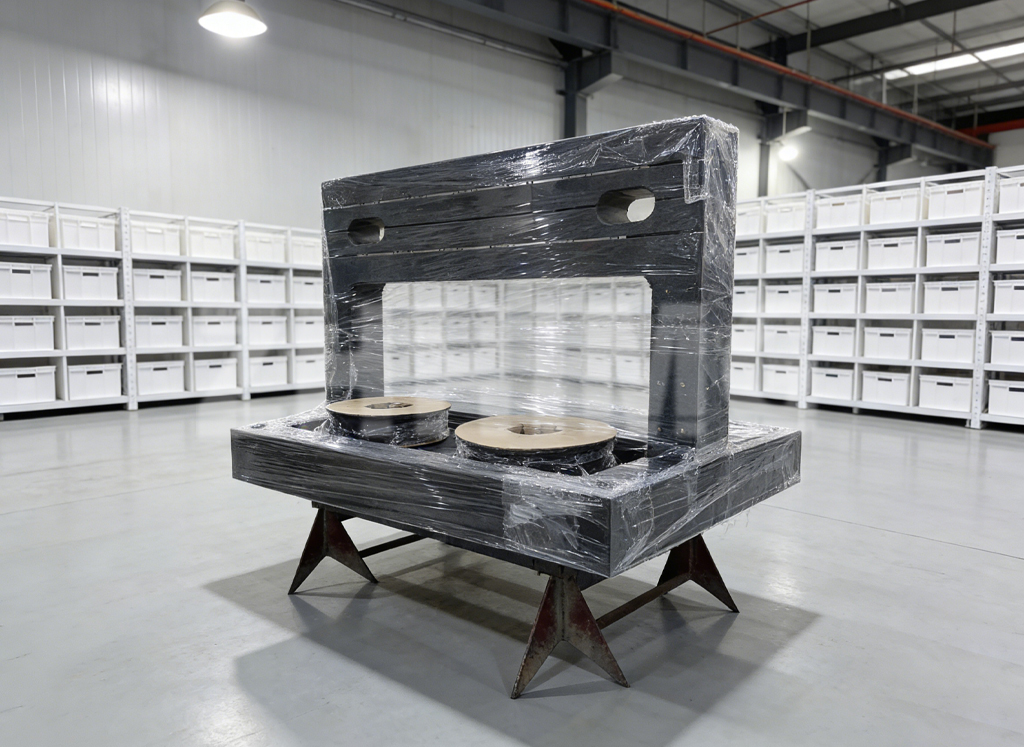
Granite bases and frames support CNC machines, coordinate measuring machines, and ultra-precision motion stages. Their stiffness and damping characteristics enhance system accuracy and reduce vibration-induced errors.
Granite Bridges and Gantries
Granite bridges and gantries are used in large-format CMMs and inspection systems. Their geometric stability ensures consistent measurement accuracy across extended spans.
Custom Granite Metrology Structures
Custom-engineered granite components, including angle plates, guideway structures, and integrated machine bases, are increasingly used to meet application-specific requirements in semiconductor, optics, and automation industries.
Industry Trends and Material Selection Strategies
The growing complexity of precision manufacturing systems has shifted material selection toward performance-driven decision-making. Engineers increasingly evaluate materials based on lifecycle stability, total cost of ownership, and system-level performance rather than initial cost alone.
Granite continues to gain preference in applications where long-term accuracy, low maintenance, and environmental robustness are critical. While ceramics and composite materials play important roles in specialized niches, precision granite remains a cornerstone material for metrology and ultra-precision equipment.
ZHHIMG’s Expertise in Precision Granite Solutions
ZHHIMG specializes in the design and manufacturing of precision granite components for global industrial customers. Using premium black granite and advanced precision grinding processes, ZHHIMG delivers metrology components and machine structures that meet stringent international accuracy standards.
The company’s capabilities include granite surface plates, machine bases, CMM structures, and custom granite solutions tailored to customer-specific applications. Through close collaboration with equipment manufacturers and metrology professionals, ZHHIMG supports reliable, long-term performance in demanding precision environments.
Conclusion
Material selection plays a decisive role in the performance of modern metrology and precision manufacturing systems. When comparing granite and ceramic metrology components, as well as epoxy granite and cast iron machine bases, natural precision granite consistently demonstrates advantages in stability, damping, and lifecycle reliability.
As industries continue to push the limits of accuracy and repeatability, precision granite components will remain essential elements within advanced metrology and machine tool systems. Through dedicated expertise and manufacturing excellence, ZHHIMG is well positioned to support these evolving industrial requirements.
Post time: Jan-21-2026