
In the world of high-end manufacturing, the foundation of a machine determines its ultimate limit. Whether you are developing a next-generation semiconductor lithography tool, a high-speed CNC center, or a coordinate measuring machine (CMM), the choice of material for your base and critical components is the most consequential decision in the R&D phase.
At ZHHIMG, we specialize in a multi-material approach. We understand that no single material is “best” for every scenario; rather, the “best” material is the one that perfectly balances physical properties with the specific environmental and mechanical demands of your application. This guide provides a definitive precision materials comparison to help you navigate your machine base material selection.
Natural Granite: The Gold Standard for Metrology
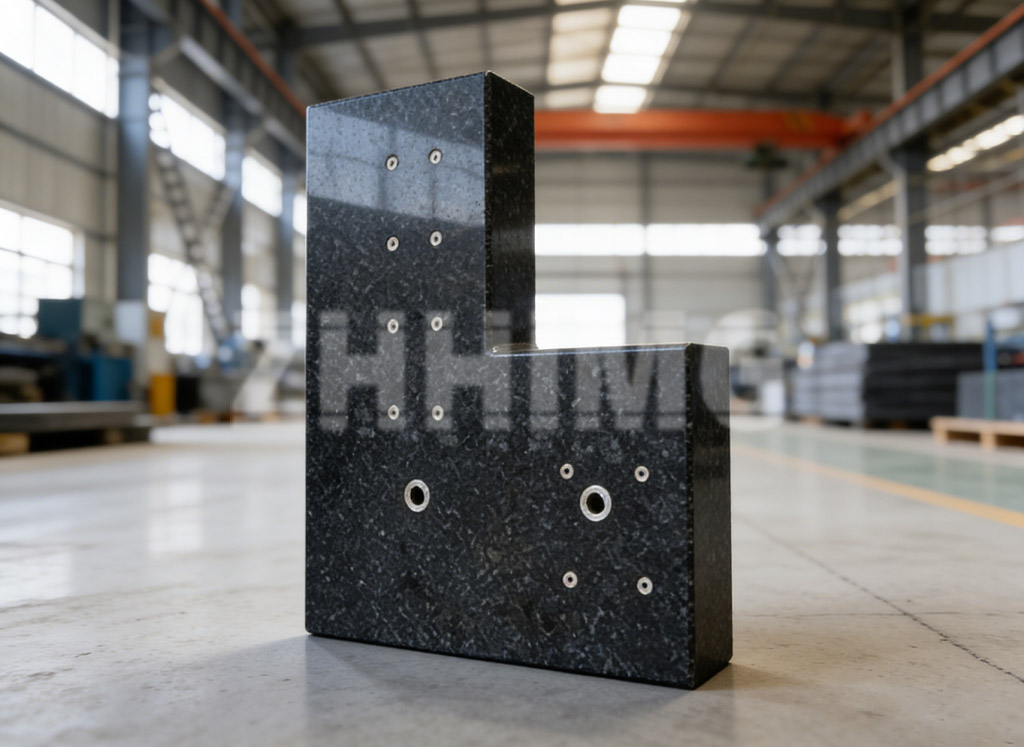
Natural granite, specifically high-density “Jinan Black,” remains the premier choice for static high-precision applications.
-
Key Advantage: Incredible dimensional stability and a very low coefficient of thermal expansion.
-
Best For: CMMs, laboratory Grade 00 surface plates, and air-bearing stages.
-
The ZHHIMG Edge: Our granite components reach densities of ~3100kg/m³, ensuring minimal internal stress and a lifetime of reliability.
Precision Ceramics: For Extreme Environments
When the application moves beyond standard room temperatures or involves high-speed wear, technical ceramics (like Alumina or Zirconia) outperform all other options.
-
Key Advantage: Extreme hardness, zero corrosion, and non-magnetic properties.
-
Best For: High-speed scanning probes, semiconductor handling tools, and vacuum environment components.
-
Why It Matters: In the granite vs ceramic vs metal debate, ceramic is the winner for wear resistance and electrical insulation.
Advanced Metals: Versatility and Toughness
For structural components that require high tensile strength and complex internal geometries, precision-machined metals remain essential.
-
Key Advantage: High ductility and ease of integration for moving parts.
-
Best For: Aerospace structural components, high-load motor mounts, and high-pressure valves.
-
Capability: We utilize ISO-certified processes to achieve micron-level tolerances in various high-performance alloys.
Carbon Fiber: The Lightweight Disruptor
The newest frontier in automation is the use of Carbon Fiber Reinforced Polymer (CFRP) to overcome the limitations of mass.
-
Key Advantage: Highest strength-to-weight ratio and exceptional vibration damping.
-
Best For: High-speed robot arms, gantry beams for laser cutting, and any part where “moving mass” hinders acceleration.
-
The Impact: Replacing a heavy metal beam with a carbon fiber structure can increase machine throughput by up to 50% without changing the motors.
How to Make the Selection?
Choosing the right material involves a trade-off between Stiffness (E-Modulus), Weight (Density), and Cost.
| Application Goal | Recommended Material |
| Maximum Static Precision | Natural Granite |
| High-Speed Dynamic Response | Carbon Fiber |
| Harsh Environment / Wear | Precision Ceramic |
| High Strength / Complex Assembly | Precision Metal |
Conclusion: A Partnership in Precision
At ZHHIMG, we don’t just provide materials; we provide solutions. Our engineering team works across the spectrum—from the ancient stability of granite to the modern speed of carbon fiber—to ensure your equipment performs at the cutting edge of technology.
By understanding the nuances of this precision materials comparison, you can build machines that are faster, more stable, and more durable.
Post time: Apr-01-2026