
As precision manufacturing and advanced metrology continue to evolve, the role of machine frame materials has become a defining factor in system performance. Across Europe and North America, equipment manufacturers are reassessing long-established structural solutions and moving toward granite machine bases, epoxy granite, and polymer concrete structures to meet increasingly stringent accuracy requirements.
From coordinate measuring machines to SMT production lines and optical inspection systems, the demand for stable, vibration-resistant, and thermally reliable machine frames has never been higher. These requirements are not driven by material preference, but by measurable performance outcomes in precision, repeatability, and long-term stability.
In traditional industrial environments, cast iron and welded steel frames dominated machine construction. These materials offered acceptable stiffness and manufacturability for conventional machining applications. However, as tolerances tightened and measurement uncertainty became a critical parameter, their limitations became more pronounced. Thermal distortion, residual stress, and insufficient vibration damping increasingly constrained achievable accuracy.
This shift has placed granite machine bases at the center of modern precision system design. Natural granite, when processed specifically for precision engineering, provides a unique combination of mechanical stability, excellent vibration damping, and long-term dimensional integrity. Unlike metallic structures, granite is non-magnetic, corrosion-resistant, and inherently stress-free, making it particularly suitable for metrology and inspection equipment.
In metrology applications, even micro-level vibrations or thermal fluctuations can compromise measurement reliability. Metrology granite structures address these challenges at the material level. Their high mass and crystalline structure effectively dissipate vibration energy, while their low thermal conductivity reduces sensitivity to ambient temperature changes.
For CMM machine bases, these properties are not optional—they are fundamental. Coordinate measuring machines rely on stable reference geometry to ensure accurate probing and scanning. A granite CMM machine base provides a stable foundation that maintains flatness and alignment over extended periods, supporting both contact and non-contact measurement technologies.
Granite surface plates remain a cornerstone of dimensional inspection, calibration, and quality control. Despite advances in digital metrology, surface plates continue to serve as primary reference planes in laboratories and production environments. Their durability, wear resistance, and ability to maintain accuracy over decades reinforce granite’s enduring relevance in precision measurement.
As machine designs became more complex, polymer concrete and epoxy granite emerged as engineered alternatives that complement natural granite. Polymer concrete, often referred to as mineral casting, combines selected aggregates with polymer binders to create composite structures optimized for machine frames.
Polymer concrete machine bases are particularly advantageous when complex geometries, integrated channels, or embedded components are required. The casting process allows designers to incorporate cable routing, pneumatic lines, and mounting features directly into the structure, reducing secondary machining and assembly steps.
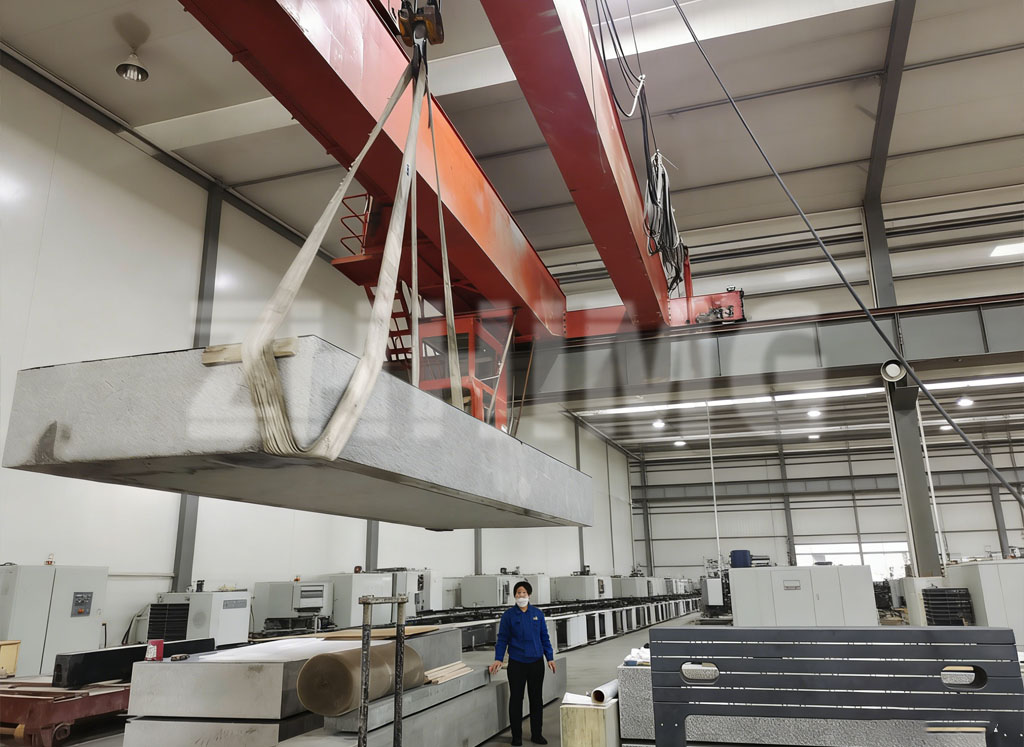
From a dynamic standpoint, polymer concrete exhibits excellent vibration damping characteristics. In many automation and SMT applications, this damping performance significantly exceeds that of traditional metallic frames. As a result, SMT granite frames and polymer concrete structures are increasingly used in high-speed pick-and-place machines, inspection stations, and automated assembly systems.
Epoxy granite occupies a similar engineering space, but with greater emphasis on precision and surface quality. Epoxy granite machine frames combine mineral aggregates with epoxy resin systems formulated for dimensional stability and mechanical strength. These structures are widely used in precision machine frames where both stiffness and damping are critical.
In precision machine frame design, epoxy granite enables high structural rigidity while minimizing resonance. This is particularly valuable in systems employing linear motors, high-speed spindles, or sensitive optical sensors. The inherent damping of epoxy granite reduces the transmission of dynamic loads, improving positioning accuracy and extending component life.
Compared to natural granite, epoxy granite offers greater design freedom. However, its performance is closely tied to material formulation, aggregate selection, and manufacturing control. In high-end applications, epoxy granite is often used in combination with precision granite reference surfaces, leveraging the strengths of both materials.
The choice between granite machine bases, epoxy granite, and polymer concrete is not a matter of superiority, but of application-specific requirements. In metrology and CMM systems, natural granite remains the preferred solution due to its unmatched long-term stability and reference-grade surface quality. In automation and SMT environments, polymer concrete and epoxy granite offer flexibility, damping, and integration advantages.
What unites these materials is their ability to support the fundamental goal of modern precision engineering: consistency. In automated production lines and measurement systems, consistency over time is as important as initial accuracy. Structural materials that minimize drift, absorb vibration, and resist environmental influences directly contribute to reliable system performance.
Across global precision industries, the transition toward granite-based and composite machine frames reflects a broader recognition that machine foundations are not passive components. They actively shape system behavior, influence control strategies, and determine achievable performance limits.
At ZHHIMG, extensive experience with granite machine bases, metrology granite structures, and precision machine frames has reinforced this perspective. By aligning material selection with application demands—whether for CMM machine bases, SMT granite frames, or granite surface plates—precision equipment can achieve higher accuracy, longer service life, and greater operational confidence.
As manufacturing and metrology technologies continue to advance, the role of granite, epoxy granite, and polymer concrete will remain central to the design of next-generation precision systems. Their continued adoption is not a trend, but a reflection of engineering fundamentals applied at the highest level.
Post time: Jan-27-2026