
In modern manufacturing, CNC machines are expected to deliver unprecedented precision, speed, and reliability. As production tolerances tighten and machining complexity increases, the choice of machine base and gantry material has emerged as a critical factor in achieving optimal performance.
Recent industry reports indicate a growing trend toward granite gantry frames over traditional steel structures, particularly in high-precision machining, semiconductor fabrication, and optical equipment manufacturing. Granite’s inherent vibration damping and thermal stability are driving this shift, offering measurable improvements in CNC machine accuracy and repeatability.
Precision Requirements in Modern CNC Machining
CNC machines today are not just tools; they are precision instruments. Tolerances in the micron range require a machine structure that is both rigid and stable. Even minimal vibrations, thermal expansions, or material flex can directly impact dimensional accuracy, surface finish, and production yield.
Traditionally, steel gantries have provided the stiffness necessary for many industrial applications. However, engineers and metrology specialists increasingly recognize that steel alone may not meet the vibration damping and long-term stability requirements of ultra-precision CNC equipment.
Granite Gantry vs Steel Gantry: Performance Comparison
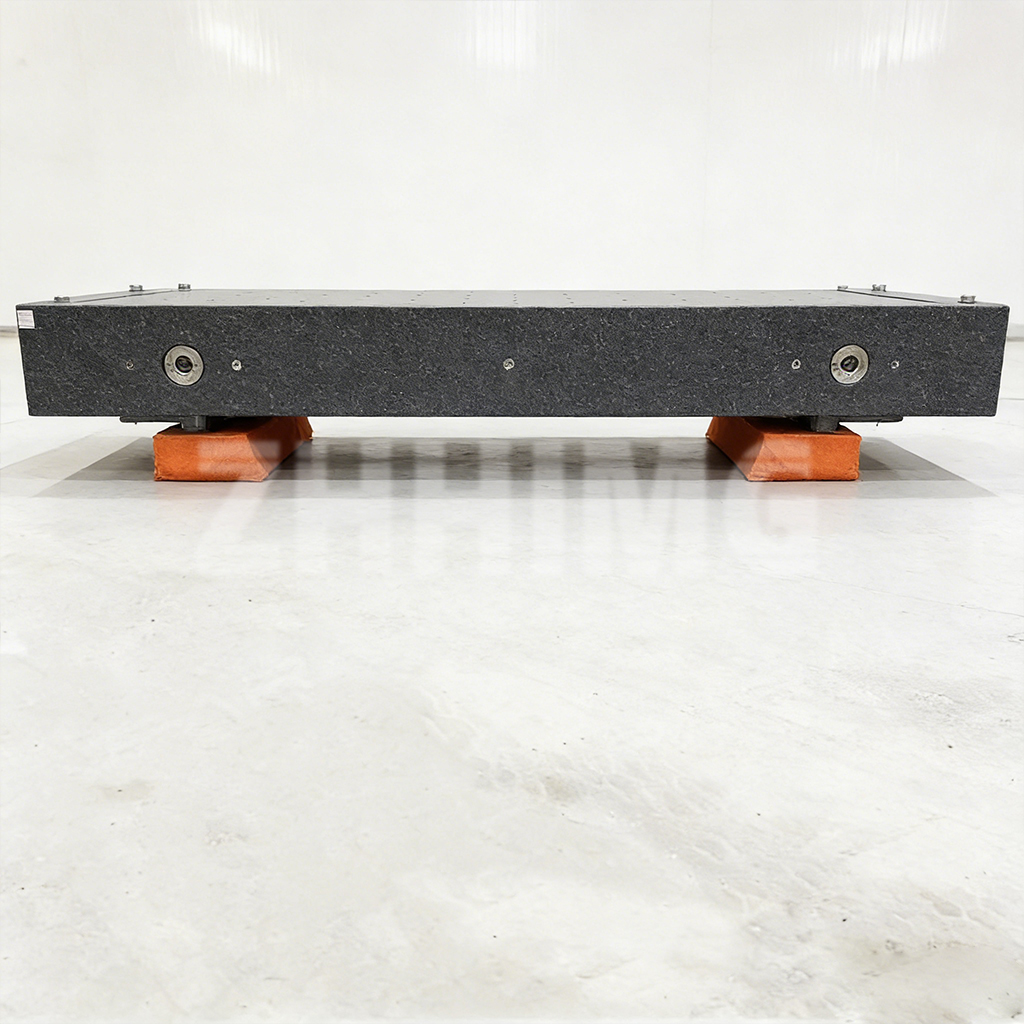
Granite gantries are crafted from high-density natural granite, precision-machined and stress-relieved to deliver an exceptionally flat and stable structure. The material properties of granite provide several advantages over steel in CNC applications:
-
Vibration Damping: Granite naturally absorbs and dissipates vibrational energy, reducing resonance and improving surface finish. Steel, while stiff, transmits more vibrations, requiring additional damping solutions.
-
Thermal Stability: Granite exhibits low thermal expansion, minimizing dimensional changes during machining. Steel, by contrast, expands more significantly with temperature fluctuations.
-
Long-Term Flatness: Granite maintains geometric integrity over decades, whereas steel may warp or creep under sustained load.
-
Non-Magnetic and Corrosion Resistant: Granite does not interfere with sensitive measurement systems and requires minimal maintenance.
Industry case studies show that CNC machines equipped with granite gantries consistently achieve tighter tolerances and improved repeatability compared to comparable steel gantry systems.
Suggested graphic: Side-by-side diagram comparing granite and steel gantry vibration response under identical CNC load conditions.
Granite Machine Base: The Foundation of Precision
A granite machine base is more than just a support—it is a reference plane for all motion and measurement. Its properties directly influence CNC accuracy, spindle stability, and tool path consistency.
Key benefits of granite machine bases include:
-
High rigidity and structural stability
-
Superior vibration damping
-
Minimal thermal distortion
-
Long-term geometric consistency
Manufacturers report that granite bases reduce the need for frequent recalibration and improve machine uptime, translating into higher productivity for precision manufacturing operations.
CNC Machine Vibration Damping: Granite’s Role
Vibration is a primary source of error in CNC machining, affecting surface finish, dimensional accuracy, and tool life. Granite gantries and bases contribute significantly to vibration mitigation:
-
Passive Damping: Granite’s dense crystalline structure dissipates energy from spindle and feed motions.
-
Reduced Resonance: The natural damping characteristics lower the amplitude of harmonic vibrations, especially at high feed rates.
-
Integration with Isolation Systems: Granite bases can complement active or passive isolation platforms, further enhancing machining precision.
Engineering teams report that machines with granite gantries exhibit up to 50% reduction in vibration amplitude compared to equivalent steel-structured machines under similar operating conditions.
Suggested graphic: Vibration amplitude chart comparing CNC machines with granite vs steel gantries.
Industry Trends and Adoption
Granite gantries and machine bases are increasingly adopted in:
-
Semiconductor fabrication equipment
-
Optical lens grinding and inspection machines
-
High-speed CNC milling and engraving systems
-
Coordinate measuring machines (CMMs) integrated with automated stages
The trend reflects a broader industry move toward material-driven precision optimization, where the gantry and base materials are considered integral to machine performance rather than merely structural supports.
Hybrid designs combining granite foundations with steel or aluminum moving components are also emerging, leveraging the strengths of each material for both stability and dynamic motion.
Expert Commentary
“Granite gantries are no longer niche; they are becoming standard for any high-precision CNC application where vibration and thermal effects cannot be tolerated,” said a senior mechanical engineer at a European precision machining firm. “Investing in granite bases pays off in reduced calibration cycles, higher repeatability, and better surface finish across the production lifecycle.”
Conclusion: Materials Define CNC Performance
As CNC machines push the boundaries of precision and speed, the choice of gantry and base material becomes pivotal. Granite gantries and machine bases offer clear advantages in vibration damping, thermal stability, and long-term flatness. Steel remains widely used, especially in heavy-duty industrial machinery, but may require additional measures to achieve comparable performance.
For precision machining, metrology, and high-speed production, granite is increasingly recognized as the material that delivers measurable improvements in both accuracy and productivity.
Post time: Feb-05-2026