
In precision engineering, machine accuracy is rarely defined by a single component. Instead, it is the result of how materials, structures, and motion systems interact over time. As tolerances move from microns to sub-microns, traditional solutions are increasingly questioned, particularly when it comes to guideways, machine bases, and bearing technologies.
Over the past two decades, granite has moved from a niche material used mainly in surface plates to a core structural element in high-end machinery. At the same time, air bearings have emerged as a practical alternative to conventional mechanical bearings. Understanding how these technologies compare—and how they work together—has become essential for equipment designers and manufacturers.
Granite Guideways and Cast Iron Guideways: A Shift in Design Philosophy
For many years, cast iron guideways were the default choice in machine tools. Their popularity came from familiarity, ease of machining, and acceptable performance for general manufacturing. In environments where thermal variation and vibration were manageable, cast iron delivered reliable results.
However, as machines began operating at higher speeds and higher measurement resolution, limitations became more apparent. Cast iron reacts relatively quickly to temperature changes and transmits vibration more readily than designers would like. Over long operating periods, lubrication-related wear can also introduce subtle but measurable errors.
Granite guideways represent a different design philosophy. Rather than compensating for material weaknesses through added mass or external damping, granite relies on its intrinsic physical properties. High-density granite naturally absorbs vibration and responds slowly to thermal change. This creates a more stable reference for precision motion, particularly in inspection and metrology systems where environmental influences cannot be completely eliminated.
As a result, granite guideways are increasingly selected for applications where repeatability and long-term stability matter more than raw cutting force.
The Expanding Role of Granite Machine Base Manufacturers
The adoption of granite guideways has naturally elevated the importance of granite machine base manufacturers. Today, these suppliers are no longer simple material providers. They act as partners in machine architecture.
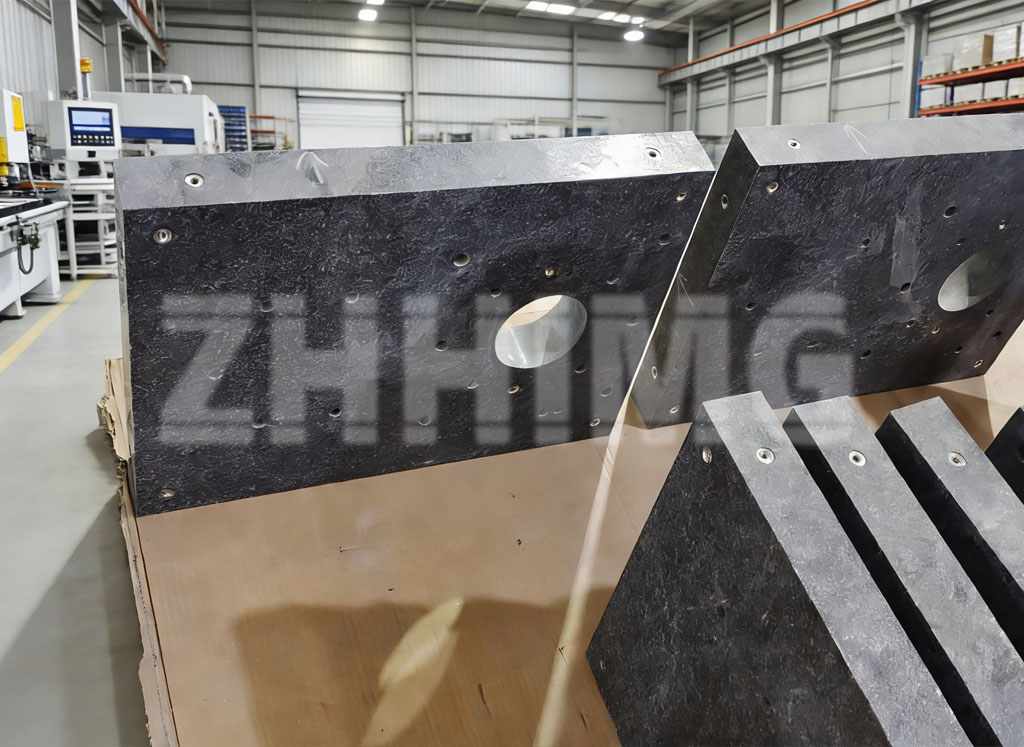
Modern granite machine bases are engineered structures. Their geometry, mass distribution, and interface surfaces are designed to control deformation, vibration modes, and thermal symmetry. Inserts, threaded features, and bearing reference surfaces are integrated during manufacturing rather than added later as compromises.
This level of integration is particularly valuable in coordinate measuring machines, semiconductor equipment, and optical inspection platforms. In these systems, the machine base is not just a support—it is the primary reference that defines accuracy across the entire working envelope.
Leading manufacturers invest heavily in precision grinding, climate-controlled workshops, and traceable inspection systems. The goal is not only to achieve initial accuracy, but to ensure that accuracy remains stable over years of operation.
Air Bearings and Mechanical Bearings: Different Answers to the Same Question
Bearing selection is inseparable from base and guideway material choice. Mechanical bearings have long been the industry standard, offering compact designs and high load capacity. For many industrial machines, they remain a practical and cost-effective solution.
However, mechanical contact inevitably introduces friction, wear, and micro-vibration. Even with advanced preload designs, these effects become increasingly visible as measurement resolution improves.
Air bearings approach motion from an entirely different angle. By separating surfaces with a thin film of pressurized air, they eliminate contact altogether. This results in exceptionally smooth motion and virtually no wear. When combined with granite guideways, air bearings benefit from the flatness, stiffness, and thermal stability of the granite substrate.
This combination is especially effective in cleanroom environments, optical systems, and ultra-precision metrology, where consistency and repeatability outweigh raw load capacity.
Why Integration Matters More Than Individual Components
The real advantage of granite structures does not come from guideways, bases, or bearings in isolation. It emerges when these elements are designed as a unified system.
A granite machine base provides a stable foundation. Granite guideways preserve motion accuracy over time. Air bearings translate that stability into frictionless movement. Together, they form a structural ecosystem that supports precision rather than fighting environmental disturbances.
This system-level approach explains why granite-based designs are now common in high-end CMMs, wafer inspection tools, and laser measurement platforms. In these fields, accuracy is not something that can be recalibrated away—it must be built into the structure itself.
Conclusion
The comparison between granite and cast iron, or air bearings and mechanical bearings, is no longer a matter of preference. It reflects a broader shift in how precision machines are designed and evaluated.
As performance requirements rise, materials and structures that offer inherent stability, damping, and thermal consistency gain a clear advantage. Granite guideways and machine bases, supported by air bearing technology, are becoming the foundation for the next generation of precision equipment.
For manufacturers focused on long-term accuracy rather than short-term convenience, these choices are shaping the future of precision engineering.
Post time: Feb-20-2026