
In precision engineering industries, accuracy is never the result of a single component. It is the outcome of material science, manufacturing discipline, and adherence to internationally recognized standards. As automation, metrology, and high-end manufacturing continue to advance, the role of granite machine base manufacturers has become increasingly central to system-level performance.
Across Europe and North America, precision engineering machine bases are no longer viewed as passive structural elements. They are now recognized as functional components that directly influence vibration behavior, thermal stability, and long-term geometric integrity. This shift has driven renewed attention toward granite machine bases and the standards that govern their production and verification.
The evolution of precision engineering has placed unprecedented demands on machine foundations. Traditional machine tools once operated within tolerances that allowed for material deformation, residual stress, and environmental influence. Today, applications such as coordinate measuring machines, optical inspection systems, semiconductor equipment, and ultra-precision automation require structural stability at the micron and sub-micron level.
In this context, granite has emerged as a preferred material for machine bases. Its inherent properties—high compressive strength, excellent vibration damping, and low thermal expansion—address many of the challenges faced by modern precision systems. Unlike metallic structures, granite is naturally stress-free and maintains dimensional stability over long periods, even under variable environmental conditions.
Granite machine base manufacturers therefore play a critical role in enabling precision engineering. Their expertise extends beyond material supply into quarry selection, material aging, precision machining, surface finishing, and metrological verification. Each of these steps directly affects the performance of the final machine base.
Precision engineering machine bases must perform consistently throughout their service life. This requirement places strict demands on flatness, straightness, parallelism, and squareness. For granite machine bases, achieving these characteristics depends on both material quality and manufacturing control.
Experienced granite machine base manufacturers understand that not all granite is suitable for precision applications. Mineral composition, grain structure, density, and internal homogeneity must be carefully evaluated. High-quality precision granite exhibits uniform grain distribution and minimal internal defects, ensuring predictable mechanical behavior and long-term stability.
Manufacturing processes further define performance. Precision grinding, lapping, and hand scraping are commonly employed to achieve tight geometric tolerances. Environmental control during manufacturing and inspection is essential, as temperature fluctuations can influence measurement results at the micron level. Manufacturers capable of maintaining controlled conditions demonstrate a higher level of technical maturity and reliability.
In precision engineering, standards provide the common language that connects manufacturers, equipment builders, and end users. Granite surface plate standards are a prime example of how formalized requirements support consistency and trust across global markets.
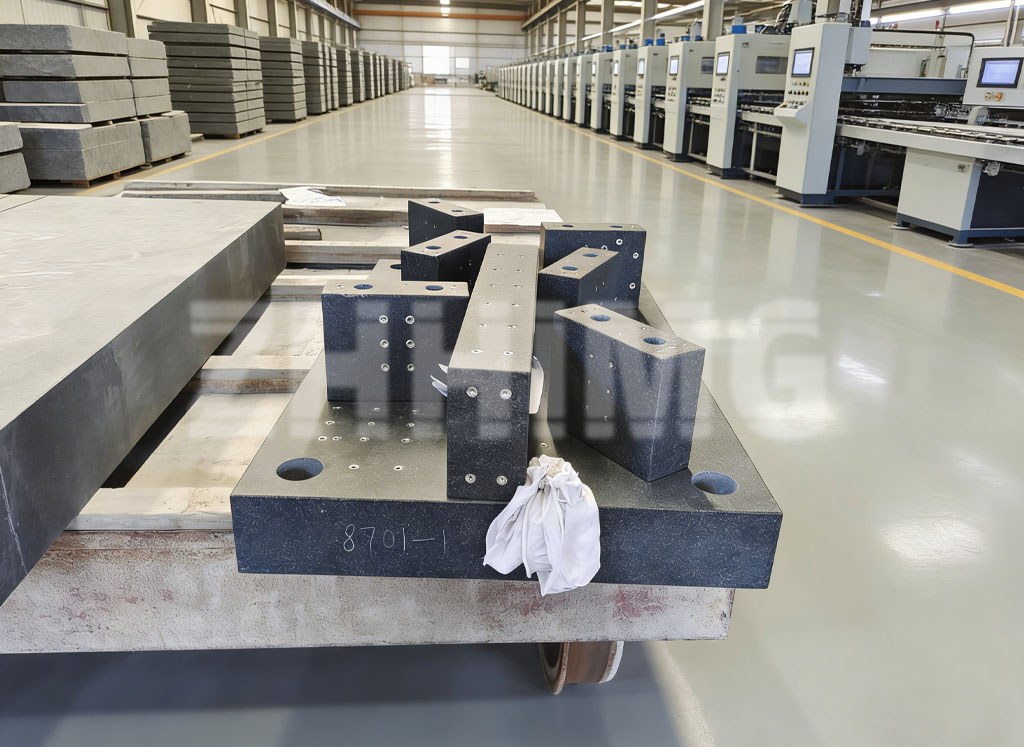
International standards such as ISO, DIN, and ASME define allowable flatness deviations, inspection methods, and calibration procedures for granite surface plates. These standards ensure that a surface plate used in a metrology laboratory in Europe meets the same fundamental accuracy expectations as one used in North America or Asia.
Granite surface plate standards also influence granite machine base manufacturing. Many machine bases incorporate precision reference surfaces that must meet similar flatness and stability requirements as surface plates. Manufacturers familiar with these standards are better equipped to design and produce machine bases suitable for metrology-grade applications.
Calibration and traceability are central to the value of granite surface plates and precision machine bases. A granite surface plate is not defined solely by its initial flatness, but by its ability to maintain accuracy over time. Regular calibration, conducted in accordance with recognized standards, verifies that the surface continues to meet specified tolerances.
For granite machine base manufacturers, understanding calibration principles is essential. Machine bases often serve as reference structures within larger systems, influencing measurement results and positioning accuracy. Manufacturers that integrate metrological knowledge into their production processes contribute to higher system reliability for their customers.
Precision engineering machine bases are increasingly customized to suit specific applications. From CMM machine bases to automation platforms and laser processing systems, the geometry and functional features of machine bases vary widely. This customization places additional responsibility on granite machine base manufacturers to maintain accuracy while accommodating complex designs.
Advanced manufacturers combine traditional granite processing techniques with modern CNC machining and precision measurement technologies. This hybrid approach allows for complex interfaces, integrated mounting features, and high-accuracy reference surfaces within a single structure. The ability to deliver such solutions differentiates experienced manufacturers from commodity suppliers.
As global industries move toward higher levels of automation and digitalization, the importance of structural accuracy continues to grow. Precision engineering machine bases serve as the physical foundation upon which sensors, motion systems, and control algorithms operate. Any instability at this level propagates through the entire system.
Granite machine base manufacturers that invest in material science, precision manufacturing, and standards compliance are therefore strategic partners in advanced equipment development. Their role extends beyond fabrication into collaboration with equipment designers, metrology specialists, and system integrators.
At ZHHIMG, long-term involvement in precision granite manufacturing has reinforced a fundamental principle: accuracy begins with the foundation. By aligning granite machine base production with internationally recognized granite surface plate standards and precision engineering requirements, stable and reliable machine structures can be achieved for a wide range of applications.
As precision engineering continues to evolve, the demand for capable granite machine base manufacturers will only increase. Material expertise, manufacturing discipline, and adherence to standards will remain the defining factors that separate precision foundations from ordinary structures.
Post time: Jan-27-2026