
In precision metrology, accuracy is not determined solely by sensors, probes, or software algorithms. The structural foundation beneath the measurement system plays a decisive role in defining repeatability, uncertainty, and long-term reliability. As tolerances continue to tighten across industries such as aerospace, semiconductor manufacturing, and optical inspection, the importance of machine base design has never been greater.
Among various structural materials, granite has become the reference standard for metrology equipment bases. Its vibration damping performance, dimensional stability, and suitability for calibration-critical applications distinguish it from traditional metallic structures.
The Role of Machine Bases in Precision Metrology
Every metrology system relies on a stable reference frame. Whether the equipment is a coordinate measuring machine (CMM), an optical measurement system, or a surface inspection platform, the machine base defines the geometric integrity of the entire system.
Any vibration, thermal deformation, or material aging at the base level propagates upward through guideways, sensors, and measurement axes. In high-precision environments, even micro-level disturbances can translate into measurable errors. For this reason, the selection of a metrology equipment base is a foundational engineering decision rather than a secondary consideration.
Granite Machine Base Vibration Damping: Material Science in Practice
One of the primary reasons granite is widely used for metrology equipment is its exceptional vibration damping capability. Unlike steel or cast iron, granite has a crystalline structure that naturally dissipates vibrational energy.
In a granite machine base, micro-vibrations generated by motors, air bearings, nearby equipment, or building infrastructure are absorbed rather than amplified. This internal damping behavior significantly reduces resonance effects and improves measurement stability, particularly in dynamic measurement processes.
From a material science perspective, vibration damping in granite is influenced by density, grain uniformity, and internal microstructure. High-quality black granite exhibits a fine, homogeneous grain structure that enhances energy dissipation. This is why premium granite materials are preferred for high-end metrology applications.
Compared with steel machine bases, granite machine base vibration damping performance is inherently superior and does not rely on additional isolation systems or complex structural modifications. While external vibration isolation can further enhance performance, the base material itself provides the first and most critical layer of stability.
Thermal Stability and Long-Term Dimensional Behavior
Vibration control alone is not sufficient in precision measurement. Thermal stability is equally critical. Granite has a low and predictable coefficient of thermal expansion, allowing metrology systems to maintain geometric accuracy under varying ambient conditions.
Unlike welded or cast metal structures, granite does not contain residual internal stresses that can be released over time. This ensures long-term dimensional stability, which is essential for equipment that must maintain calibration accuracy over years of operation.
Calibration of Granite Surface Plates: Ensuring Measurement Integrity
Granite surface plates are fundamental reference tools in metrology laboratories and inspection rooms. They provide a flat, stable datum for measurement, alignment, and calibration activities.
The calibration of granite surface plates is a critical process that directly affects measurement confidence. Over time, even high-quality granite plates can experience minor wear due to repeated contact, environmental influences, or improper handling. Regular calibration ensures that flatness deviations remain within specified tolerances.
Calibration typically involves precision instruments such as electronic levels, autocollimators, or laser interferometers. The surface plate is measured against certified reference standards, and deviations are documented to establish traceability to national or international metrology standards.
Importantly, the calibration of granite surface plates is not merely a compliance exercise. It is a preventive measure that protects the accuracy of downstream measurements. In high-precision environments, an uncalibrated or worn surface plate can introduce systematic errors that are difficult to detect.
Granite’s wear resistance and hardness make it particularly suitable for repeated calibration cycles. Unlike metal surfaces, granite does not burr or deform plastically, allowing it to retain flatness characteristics over long periods when properly maintained.
Environmental Control and Best Practices for Surface Plate Calibration
Environmental factors such as temperature gradients, humidity, and vibration can influence calibration results. For this reason, granite surface plate calibration is typically performed in temperature-controlled environments with stabilized conditions.
Proper support is also essential. Surface plates must be mounted on correctly positioned support points to avoid distortion. Incorrect support can introduce bending stresses that affect flatness readings, even if the granite itself is dimensionally stable.
Different Types of Metrology Equipment Bases
Metrology equipment bases are not one-size-fits-all. Different measurement systems impose different structural and functional requirements on the base.
CMM Machine Bases
Coordinate measuring machines require highly stable granite bases to support air bearings, guideways, and probing systems. The base must maintain geometric accuracy under both static and dynamic conditions, making vibration damping and thermal stability critical.
Optical Metrology Bases
Optical measurement systems, including laser interferometers and vision inspection platforms, are highly sensitive to vibration. Granite bases provide the damping characteristics needed to stabilize optical paths and maintain signal integrity.
Surface Inspection and Calibration Platforms
These systems often rely on large granite structures that serve as reference planes for alignment and inspection. Flatness, wear resistance, and long-term stability are the primary design considerations.
Hybrid Metrology Equipment Bases
In advanced systems, granite bases may integrate metallic inserts, air channels, or cable routing features. These hybrid designs combine the stability of granite with functional integration, reducing assembly complexity and improving system performance.
Understanding the different types of metrology equipment bases allows manufacturers and users to align structural design with application-specific requirements.
ZHHIMG Precision Granite for Metrology Applications
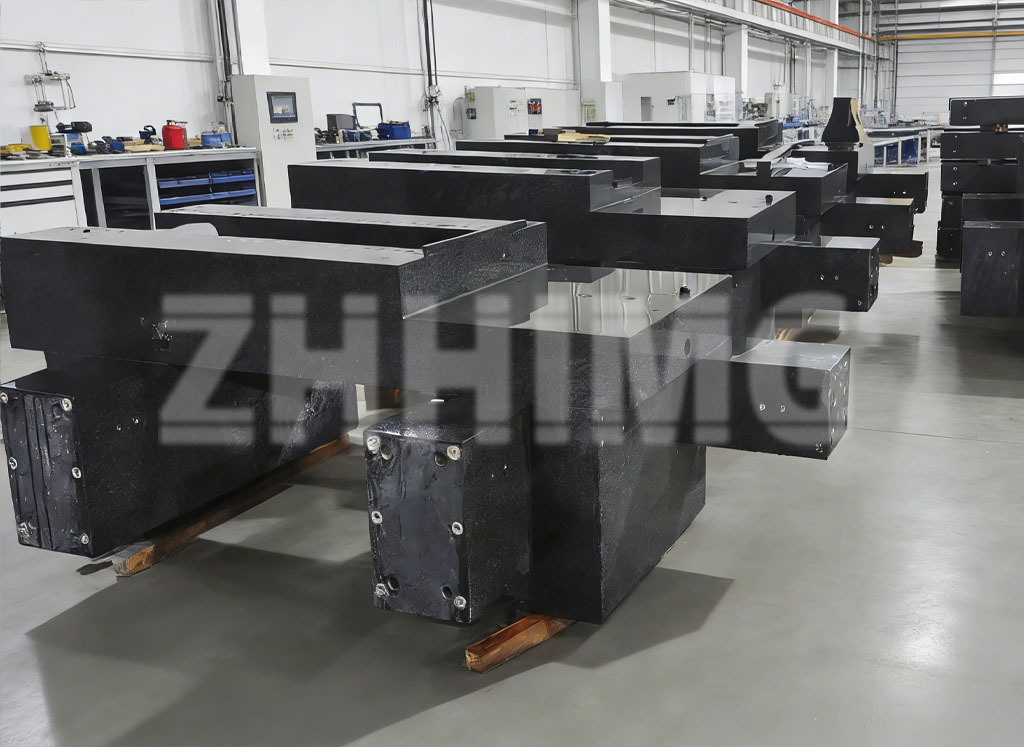
ZHHIMG specializes in precision granite solutions engineered specifically for metrology and inspection systems. Using carefully selected Jinan black granite, ZHHIMG manufactures granite machine bases, surface plates, and custom metrology structures with controlled material properties.
Each granite component undergoes precision grinding and inspection in temperature-controlled environments. Flatness, parallelism, and geometric tolerances are verified using advanced metrology equipment to ensure suitability for high-precision applications.
ZHHIMG’s approach emphasizes not only material quality but also structural design optimization. By tailoring rib structures, mass distribution, and mounting interfaces, ZHHIMG delivers metrology equipment bases that support accuracy, repeatability, and long-term reliability.
Conclusion: Measurement Accuracy Starts at the Foundation
In precision metrology, accuracy is built from the ground up. Granite machine base vibration damping, proper calibration of granite surface plates, and the selection of appropriate metrology equipment bases all contribute to measurement confidence.
Granite has proven itself as a foundational material that meets the demanding requirements of modern metrology. Its vibration damping performance, thermal stability, and durability make it an essential component in precision measurement systems.
As measurement technologies continue to evolve, the role of the machine base remains constant: to provide a stable, reliable reference that supports accurate and repeatable results. ZHHIMG continues to support global metrology industries by delivering precision granite solutions engineered for this purpose.
Post time: Jan-30-2026